

[비즈한국] Season 12 of the 'Korean Art Support Project,' a program designed to cultivate the fertile soil of Korean art, has begun. This project has now been recognized by the art community as a meaningful event for discovering and nurturing artists, and it has gained a reputation among artists as a project they aspire to participate in. The fundamental keywords the 'Korean Art Support Project' has pursued from the start have been 'the acceptance of diverse currents in Korean art and the pursuit of developmental change.' As a result of these principles, it is credited with establishing a unique perspective on contemporary Korean art.
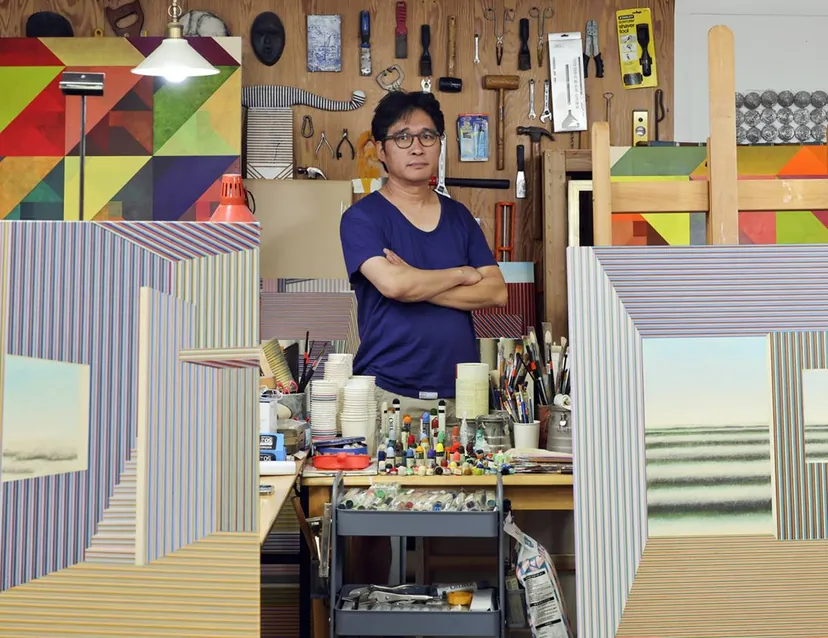
In painting, the meaning of space is the most important element among many. This is because it involves implementing a three-dimensional reality onto a two-dimensional plane. Thus, many painters have strived to interpret space in their own ways.
The meaning of space in painting began to emerge clearly when landscapes were chosen as subjects. In Western art, various methods for expressing space have been developed for about 500 years. A prime example is the invention of perspective.
As a result, it became possible to realistically transfer space onto a flat surface. Experts called this the 'art of illusion.' It is a method that maximizes the effect of optical illusion—making things look a certain way even if they are not so in reality. This was the result of diligent efforts focused on the visible world.
Thanks to this, Western painting developed dramatically. Therefore, the space represented in Western landscape painting deals with the world unfolding before one's eyes. It is essentially physical space.
20 solo exhibitions (2025 Art Center ZAIN-Seoul, Gallery Artspace H-Seoul, 2024 Hyundai Department Store Pangyo-Community Lounge-Gyeonggi, Gallery space35-Seoul, 608 Gallery-Gyeonggi, etc.), 20 group exhibitions (2025 Chusa/Abstraction-Seoul Dihwite Gallery, 2024 Four Artists in January 2024-Seoul Gallery 41, etc.)
Works in Collections
Clayarch Gimhae Museum, Korea Medical Foundation, etc.
Education and Career
Graduated from the Department of Ceramics, College of Fine Arts, Hongik University and its Graduate School
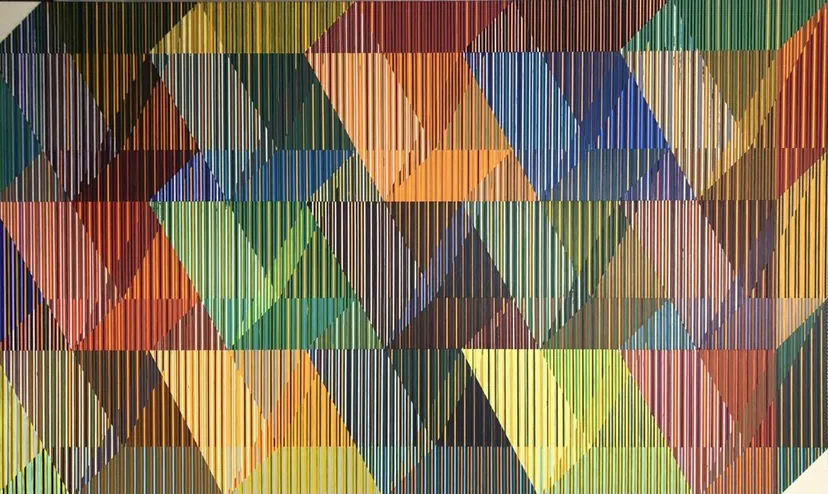
In contrast, the space represented in Eastern painting is not realistic. This was natural for Easterners, who were more interested in the world hidden behind the visible world than the visible world itself. They endeavored to express the invisible world by comparing it to the visible one. Experts refer to this as 'painting the meaning.' Therefore, the space appearing in the landscape paintings that form the main body of Eastern art is psychological or philosophical.
Yong Hwan-cheon’s painting theme is also the creation of landscapes through space. However, the space appearing in his paintings also has an ideological (sa-ui) character. Although it is a landscape that looks like an abstract painting where colors and geometric lines harmonize, it is not a real space. Thus, the space he expresses lacks a sense of three-dimensionality.
He faithfully follows perspective—the standard for spatial representation—specifically linear perspective (a method where objects shrink toward a vanishing point, making foreground objects appear larger and background objects smaller), but it appears flat. This is due to his colors and the densely organized vertical and horizontal lines. He divides the screen with strong colors as if composing color fields.
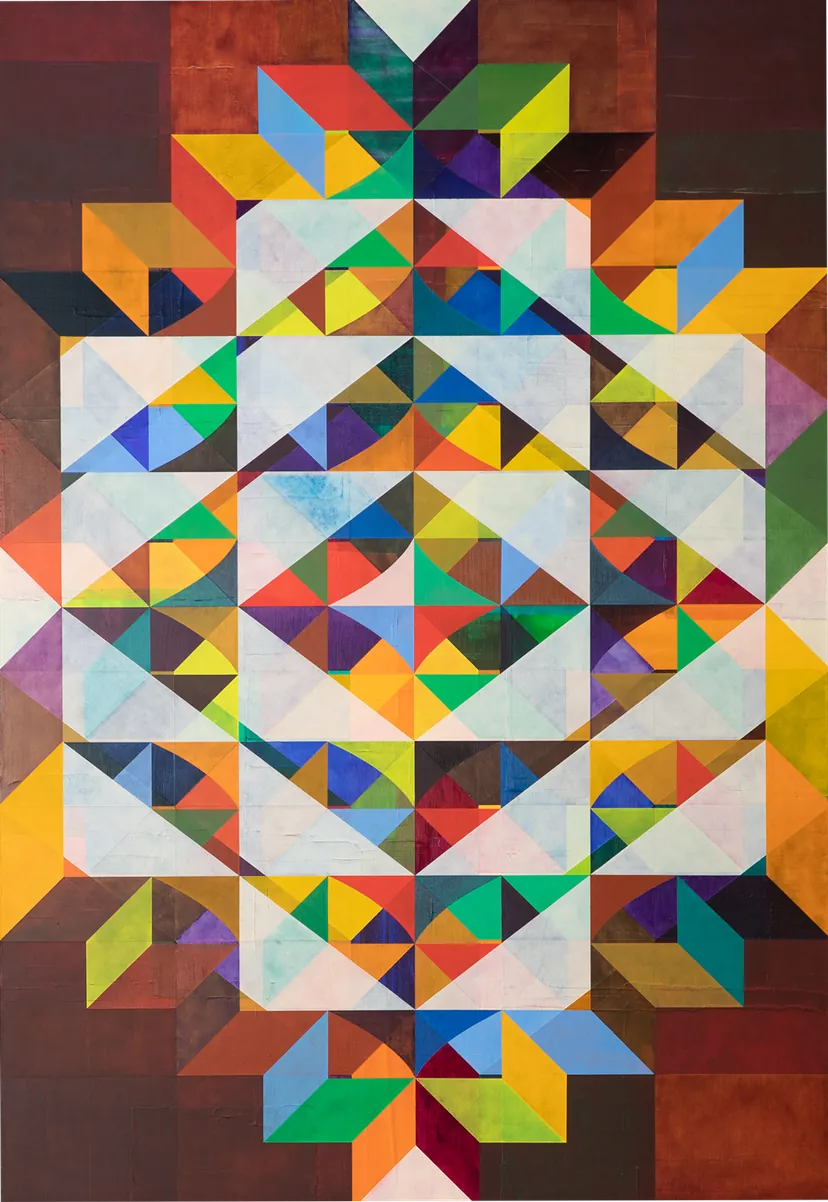
What kind of landscape is Yong Hwan-cheon trying to create through space? Or rather, what is he trying to say through these landscapes?
His paintings feature interior and exterior landscapes clashing in a single frame with heterogeneous characteristics. He captures the perspective of looking out from inside through windows or doors, based on a geometric structural composition. Therefore, it appears as a metaphysical space.
The interior consists of walls meticulously described with geometric lines and colors, while the view outside the window is fields or a sky with clouds, expressed with natural touches. Through this heterogeneous composition, the artist says he "wants to find the relationships between people interwoven by chance and necessity, or the connection point between myself and the world."
![[Korean Art Support Project Season 12] Kim Kyung-won - Original Paintings Created Through Optical Illusions](https://s.bizhankook.com/attachments/2026/07/4942ec34bbf7_bd974ed4.jpg)
![[Korea Art Promotion Project Season 12] Claire Kim - Cartoon-like Paintings](https://s.bizhankook.com/attachments/2026/07/79ed5c5967a3_47729c25.jpg)
![[Korean Art Support Project Season 12] Song Gwang-chan - Making Ordinary Daily Life Extraordinary](https://s.bizhankook.com/attachments_webp_no_wm/2026/07/134426_no_wm_c2f8a941.webp)
![[Korean Art Support Project Season 12] Park Ha-kyung - Folk Painting Expressed with Modern Sensibility](https://s.bizhankook.com/attachments_webp_no_wm/2026/07/134733_no_wm_80980f44.webp)
![[Korea Art Support Project Season 12] Kim Doma - Amidst the Contradiction of Common Sense and Nonsense](https://s.bizhankook.com/attachments_webp_no_wm/2026/08/135090_no_wm_cbf4e121.webp)