

[비즈한국] This week, buying pressure first focused on assets with confirmed individual catalysts, such as exchange-traded product (ETP) inflows and new service launches, before spreading to decentralized finance (DeFi), Layer 2, and meme coins. Even after the U.S. Federal Reserve’s interest rate hike, Bitcoin and major altcoins rebounded, liquidating leverage positions that had bet on a decline, and the price elasticity of mid-cap altcoins with high volatility proved greater than that of large-cap assets.
According to CoinMarketCap, a global cryptocurrency market tracking site, Zcash (ZEC) recorded the highest weekly growth rate in the cryptocurrency market from 6:00 on September 11 to 6:00 on September 18, rising 31.00%. Its current price is 2,047,933 KRW, and it has risen 12.35% over the last 24 hours alone.
Uniswap (UNI) ranked 2nd with a weekly growth rate of 25.21%. Its current price is 10,494 KRW, with a 17.29% rise in the last 24 hours, showing an acceleration of gains toward the end of the reporting period.
Arbitrum (ARB) rose 20.38% over the week to take 3rd place. Its current price is 246 KRW, having increased 9.72% over the last 24 hours.
NEAR Protocol (NEAR) claimed 4th place with a weekly growth rate of 19.88%. The current price is 4,153 KRW, and with a 16.55% change over the last 24 hours, the upward trend on the final day was particularly notable.
PancakeSwap (CAKE) rose 16.39% over the week to place 5th. The current price is 3,409 KRW, with a 9.86% increase over the last 24 hours.
6th place Pendle (PENDLE) rose 16.14% weekly to trade at 3,224 KRW. 7th place Pons rose 11.65% over the week to 899 KRW. 8th place JUST (JST) rose 10.64% to 158 KRW, and 9th place Pepe (PEPE) traded at 0.005023 KRW, up 9.65%. 10th place Dash (DASH) recorded an 8.82% weekly rise to 84,628 KRW.
Zcash, Buying Pressure Concentrated on Privacy Assets
Zcash is a privacy-focused cryptocurrency that uses zero-knowledge proofs to verify transaction validity without revealing the sender, recipient, or amount. Like Bitcoin, it has a fixed supply cap of 21 million, and users can choose between transparent and protected transactions.
The expansion of the Zcash spot ETP (ZCSH) listed on the U.S. stock market was a direct catalyst for this rally. Since beginning trading on the NYSE Arca on August 25, ZCSH’s assets under management exceeded $500 million within two weeks, and options trading was added on September 8. In this process, cumulative net inflows surpassed $70 million, and a Digital Currency Group subsidiary deposited 85,705 ZEC as a spot asset to acquire approximately $100 million worth of ETF shares. With the structure of locking circulating supply within the product highlighted, and news of large venture capital firm Paradigm’s holdings in Zcash becoming public, buying pressure focused on this privacy asset.
The price range was further amplified by the liquidation of derivatives during the rally. Approximately $345 million in leverage positions were forcibly liquidated across the entire market over 24 hours, of which $208 million were short positions betting on a decline. Zcash-related liquidations reached about $56 million, showing a trend where spot catalysts overlapped with a short squeeze.
Uniswap is a decentralized exchange protocol that allows users to swap tokens through liquidity pools without depositing assets into an exchange. UNI serves as a governance token used to vote on the protocol’s operational direction and major proposals.
Uniswap Labs began supporting the Uniswap protocol, web applications, wallets, and APIs on Circle’s Layer 1 network, Arc, which focuses on stablecoin finance, on September 16. Prior to this, on September 10, it released a "StableSwap Hook" for Uniswap v4, which automatically recalculates exchange fees based on market conditions. As features designed to protect liquidity providers' profits in stablecoin and tokenized asset trading were announced consecutively, Uniswap’s real-world utility expanded, and combined with the market rebound, its 24-hour growth surged.
Arbitrum is a Layer 2 network that increases speed and lowers fees by processing transactions off the Ethereum mainnet and then recording the results on Ethereum. ARB is a governance token used to participate in technical changes to the network and the management of foundation funds.
According to the first-half report released by the Arbitrum Foundation in early September, Arbitrum-related networks processed 478 million transactions over six months, with monthly stablecoin transfers exceeding $70 billion. Licensing revenue from the Robinhood Chain, built with Arbitrum technology, accounted for 35% of Arbitrum DAO's income in July. While governance regarding security programs and network operational procedures took place during this period, specific new announcements explaining the entire price surge were limited. It can be interpreted that rotational buying flowed into Layer 2 assets, bolstered by profit metrics identified in the Robinhood Chain and tokenized asset businesses.
From DeFi to Meme Coins, Buying Pressure Spreads to High-Volatility Assets
NEAR Protocol is a Layer 1 blockchain that parallelizes transactions by sharding the network. Recently, it has pushed "NEAR Intents" and private execution features—which allow users to exchange assets across different chains at once—as core services. On September 17, it was announced that the value of assets deposited in its private finance services had surpassed $70 million, meeting the threshold for related reward programs. A roadmap for signature technology resistant to quantum computer attacks was also released, but as a significant portion of the weekly growth was concentrated in the last 24 hours, the impact of market-wide buying pressure at the end of the week was as significant as individual announcements.
PancakeSwap is a decentralized exchange that offers token swapping, liquidity provision, and derivatives trading. CAKE is used for staking, rewards, and governance, and a portion of trading fees is linked to token burn mechanisms. An operational report released on September 9 stated that approximately 2.07 million CAKE were net-burned in August, marking 36 consecutive months of total supply reduction. Tradeable tokenized stocks and ETPs have also surpassed 1,000 items. The combination of supply reduction and the expansion of real-world asset trading contributed to the price rise.
The composition of the top 6 to 10 also shows that no single technical sector dominates the market. Pendle is a yield market that separates and trades the right to receive interest from the underlying principal, while JUST provides lending and stablecoin services in the TRON ecosystem. Pons is a non-custodial launch platform that allows anyone to issue and trade fixed-supply tokens on the Robinhood Chain. Pepe is a meme coin more heavily influenced by trends and trading flow than business performance, and Dash is a cryptocurrency that emphasizes payment speed and optional transaction privacy.
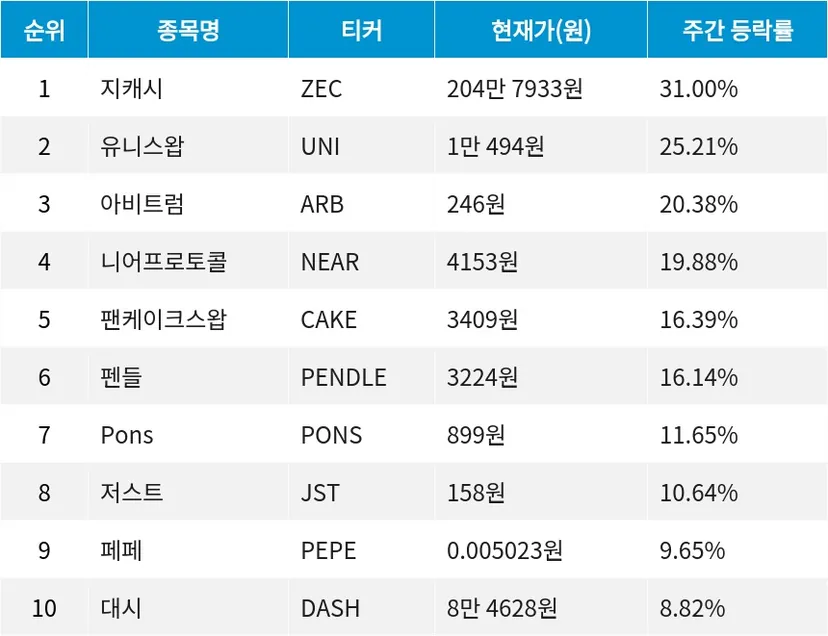
With four DeFi projects, two privacy assets, and a mix of Layer 1/Layer 2, token issuance platforms, and meme coins making the top list, it signifies that risk appetite has spread to various high-volatility assets starting from specific projects with individual catalysts, rather than a monolithic rally in a single industry. While Zcash saw ETF inflows and short liquidations, and Uniswap and PancakeSwap saw verified changes in service and token supply, assets like Arbitrum and Pepe were more significantly influenced by the broader market rebound and rotational buying.
Although the Fed raised the base interest rate by 0.25 percentage points, Bitcoin and Ethereum quickly absorbed the shock as expectations emerged that aggressive further hikes were unlikely. While the growth of large-cap cryptocurrencies was limited, the liquidation of short bets significantly increased the price elasticity of altcoins. This week’s top performers demonstrate how much the volatility of mid-cap altcoins can amplify when verified business catalysts, thin liquidity, and leverage supply-demand dynamics intersect, rather than representing a unilateral rally across the entire market.
※ This article was written by Bizhankook and MetaVX’s generative AI.