

[비즈한국] Young people have long been called the ‘N-po Generation.’ The term refers to a generation that has given up on one thing after another, such as dating, marriage, childbirth, and owning a home. However, the current reality of young people is difficult to explain through the simple lens of ‘giving up.’ While the burden of housing and living costs is growing and the job market is changing rapidly, there are also distinct efforts to reduce costs, increase income, and find new opportunities within that landscape.

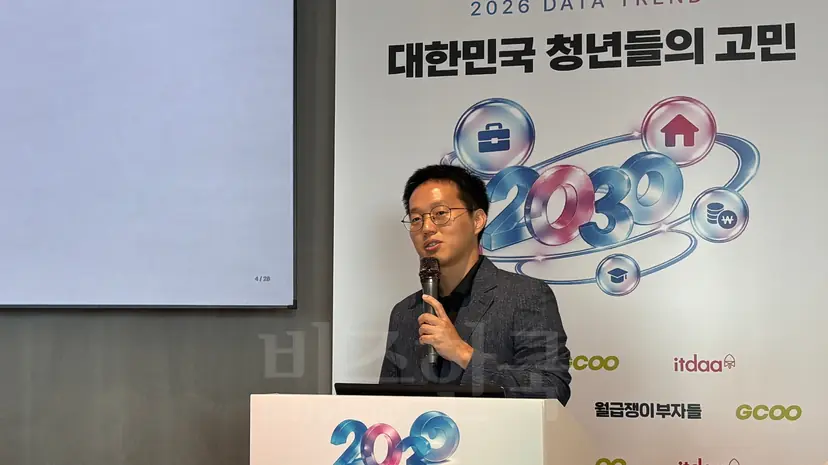
On the morning of the 7th, a joint media seminar titled ‘2026 Korean Youth Concerns: The Term N-po Generation Is Not Enough’ was held at the PR Bridge Storium in Chungjeong-ro, Seoul. Three companies—Glocalmates, Itda, and Gbike—revealed how the housing, employment, and commuting patterns of young people are changing based on data accumulated from their respective services.
For 2030s who find it hard to own a car, shared mobility for awkward distances
According to the CarIsYou Data Research Institute, the number of new passenger car registrations by people in their 20s in the first half of last year was 29,066, accounting for only 5.7% of all new individual passenger car registrations. For those in their 30s, the figure was 19.5%, marking the lowest level of new car registrations for the 20s and 30s age group in the last 10 years. Meanwhile, the average daily commute time for workers was 73.9 minutes round-trip, reaching 82 minutes in the Seoul metropolitan area.
Shared mobility has filled the gap for segments where owning a car is burdensome but walking is too far. According to Gbike, the monthly active users of its shared mobility platform ‘GCOO’ are approximately 1.4 million, with those in their 20s and 30s making up 57.56% of that total. This means one in three Koreans in their 20s uses the service.
Actual travel distances are short. 98% of all GCOO trips were 5km or less. Usage was 2.6 times higher during the start of the semester compared to school breaks, and it increased up to 5 times during final exam periods. In Seoul, usage for commuting was 1.5 times higher than elsewhere, suggesting that demand for the so-called ‘last mile’—the distance between subway stations or bus stops and schools, workplaces, or homes—is being reflected.
However, there are many issues that shared mobility must solve. Problems with riding on sidewalks and unauthorized parking, which cause collisions with pedestrians, are still recurring. Analysis of the Korea Road Traffic Authority’s Traffic Accident Analysis System (TAAS) by the Korea Personal Mobility Industry Association shows that while the number of accidents involving Personal Mobility (PM) devices decreased by 14.2% year-on-year to 1,915 in 2025, it is difficult to say that safety issues have been resolved.
Under current road traffic laws, personal mobility devices must have motors that stop operating at speeds of 25 km/h or more and must weigh less than 30 kg. The industry believes this weight limit acts as a constraint on increasing wheel size or adding safety devices.
Still, Gbike CEO Yoon Jong-soo admitted the need for safety improvements, stating, “It is true that there are instances where users ride dangerously.” Gbike also announced that it is developing location correction technology to reduce GPS errors that occur between high-rise buildings.
“What should I show?” AI has changed even job-hunting concerns
The job mentoring platform Itda analyzed 56,030 questions asked by users and 41,552 answers provided by industry professionals from November 2013 to September of this year.
According to Itda, AI-related questions accounted for only 1.8% of the total last year but rose to 16.6% this year. The proportion of industry professionals who mentioned AI in their responses—even when job seekers did not—also increased from 4.5% in 2022 to 21.8% this year. This indicates that moving beyond simply acquiring AI-related knowledge, how to actually utilize AI in a professional role has become a new concern in the job preparation process.
Questions about whether one could enter a specific job field accounted for 27.3% of the total in 2020 but dropped to 14.5% this year. On the other hand, questions about how to prepare one's career trajectory reached 14.6% this year, the highest proportion since 2015.
Cho Yoon-jin, CEO of Ready & Start (Itda), said, “In the past, there were many questions like ‘Can I do it?’ or ‘How can I get hired?’, but now they have changed to questions like ‘What should I show?’” She added, “The advice from industry professionals is also shifting from merely explaining the job itself to advising people to gain practical experience and learn to use AI.”
“I haven't given up on owning a home”: 2030s who take on side hustles and invest
Kim Ji-yeon, Class Team Lead at Glocalmates, explained that “for young people, a home is a place to live and an asset at the same time,” and that owning a home remains a major goal. However, she analyzed that as the gap between house prices and income widens, making it difficult to rely solely on saving a salary, there is a movement to increase assets through side hustles, investments, and tax planning.
According to Glocalmates, content views related to home ownership among users aged 25–44 increased fourfold this year compared to last year. Users are not stopping at just viewing information but are increasingly asking questions directly. Among writers on the Q&A board, the proportion of those aged 25–44 rose by 9.8 percentage points, from 70.3% last year to 80.1% this year.
The number of young people who manage their own assets is also significant. According to data released by the Korea Securities Depository in March, as of the end of last year, among individual investors holding domestic listed stocks, there were approximately 2.04 million people aged 20 or younger and approximately 2.61 million in their 30s. Additionally, as of August, the proportion of ISA (Individual Savings Account) subscribers in their 20s and 30s reached 41.1%.
Lead Kim stated, “To buy a home in Seoul, you would have to save your entire annual income for 14 years without spending a cent. Even standing at the starting line of home ownership is difficult now,” but added, “Young people are more actively contemplating which strategies to choose instead of just consuming, and they are building up their assets.”