

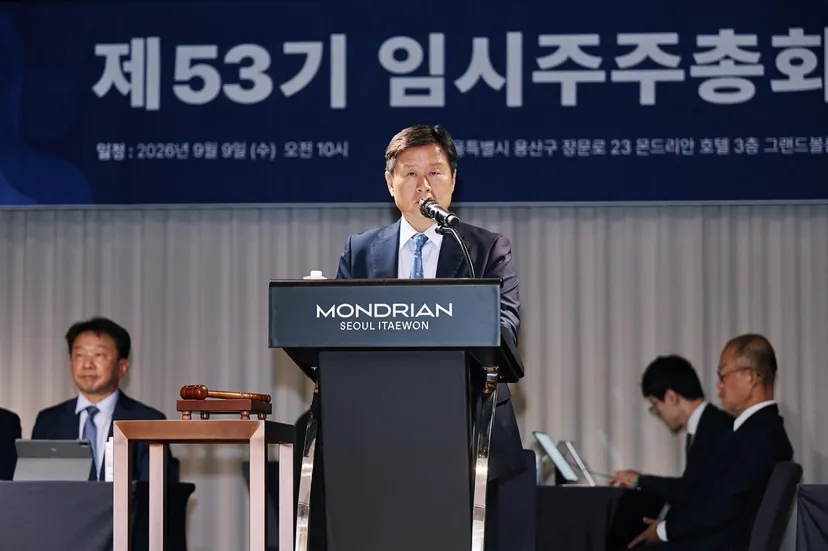
[비즈한국] In the proxy battle for control of Korea Zinc, Chairman Choi Yun-beom’s side has gained the upper hand against the alliance of largest shareholder Young Poong and MBK Partners. During the extraordinary general meeting of shareholders held at the Mondrian Hotel in Yongsan-gu, Seoul, on the 9th, both sides secured two seats each for independent directors. In the vote for the single separately elected audit committee member—seen as the most critical outcome of the meeting—candidate Baek In-kyu, recommended by Korea Zinc, was elected. With this, Chairman Choi Yun-beom has successfully defended his management control by maintaining a solid majority within the newly restructured 19-member board.
The Origin of the Extraordinary Meeting: Injunctions and Commercial Code Amendments
The background of this extraordinary shareholders' meeting involves two intertwined key issues: the court's upholding of injunctions following the disruption of a previous general meeting and the necessity of meeting legal obligations under amendments to the Commercial Code.
The situation began with the extraordinary shareholders' meeting in January 2025. At that time, Korea Zinc enabled Sun Metal Corporation (SMC) to acquire a 10.3% stake in Young Poong just before the meeting. Applying Article 369, Paragraph 3 of the Commercial Code—which states that if a parent company and its subsidiary together hold more than 10% of another company's stock, that other company's voting rights in the parent company are void—Korea Zinc's management blocked Young Poong's voting rights.
The Young Poong-MBK alliance protested and filed for an injunction with the court to suspend the duties of four outside directors. The court ruled that SMC could not be viewed as a subsidiary under the Commercial Code, recognized the illegality of restricting voting rights, and granted the injunction. The four outside directors, whose board activities were essentially blocked from the moment of their appointment, all voluntarily resigned on May 29 following continued dysfunction, leading to four large-scale vacancies on the board.
This coincided with legal obligations following the implementation of amended Commercial Code Article 542-12. Large listed companies with assets of 2 trillion won or more are required to secure at least two audit committee members elected separately from regular directors to strengthen the independence of the audit committee. Korea Zinc amended its articles of association to increase the number of separately elected members from one to two and convened this extraordinary meeting to fill the vacancies for independent directors and appoint a new separately elected audit committee member within the legal deadline.
Election of Independent Directors and Separately Elected Audit Committee Member
On this day, the second agenda item—filling the four vacant independent director seats—was conducted using cumulative voting, which grants four voting rights per share. Due to the nature of cumulative voting, which distributes votes proportionally to shareholdings, candidates from both the company side and the Young Poong-MBK side each secured two seats side-by-side.
From the candidates recommended by the company, Lee Hyung-gyu, Professor Emeritus at Hanyang University Law School, and Seo Eun-sook, a professor at Sangmyung University’s Department of Economics and Finance, joined the board. From the candidates proposed by the Young Poong-MBK alliance, Lee Jun-bong, a professor at Sungkyunkwan University Law School, and lawyer Shim Hye-seop were elected. Thus, the appointment of regular independent directors concluded with a tense balance between both sides.
The biggest turning point of this extraordinary meeting was the third agenda item: the appointment of a separately elected audit committee member (outside director). The separate election system is designed to block the influence of controlling shareholders by separating the election of audit committee members from the initial stage of director nominations. In this agenda item, the "3% rule" of the Commercial Code was applied, capping the voting rights of the largest shareholder and their specially related persons at a combined 3%, regardless of their actual shareholding. With the voting power of the major shareholder alliance effectively tied, the final outcome rested on the votes of the National Pension Service (NPS), foreign and institutional investors, and minority shareholders.
The NPS, considered the casting voter, decided to vote "in favor" of both candidates—Baek In-kyu from the company and Park Yu-kyung from the Young Poong-MBK side—ahead of the meeting. By not siding unilaterally with either party and effectively casting an equal vote tantamount to an abstention, the NPS prevented its votes from shifting to a single camp, leaving the outcome to foreign investors and individual shareholders.
As the results were tallied by selecting the candidate with the highest number of votes after a single round of voting, the company's candidate, Baek In-kyu, defeated Park Yu-kyung, who was proposed by the Young Poong-MBK alliance, and was elected as an audit committee member.
Restructuring the 19-Member Board: Establishing a Majority for the Choi Regime
As a result of this meeting, the Korea Zinc board has expanded from 14 to 19 members. With the addition of four new independent directors (two from the company, two from Young Poong) and the election of Baek In-kyu as a separately elected audit committee member, the board structure is now finalized at 12 members friendly to the company and 7 from the Young Poong-MBK side.
The audit committee was also reorganized into a four-member structure, with the new member Baek In-kyu joining existing members Seo Dae-won (Chair), Kwon Soon-bum, and Kim Bo-young. By filling both required separately elected audit committee seats (Seo Dae-won and Baek In-kyu) with company-aligned figures, Korea Zinc successfully defended its internal monitoring mechanism. While the Young Poong-MBK alliance succeeded in entering the board through the two independent director seats, their failure to enter the audit committee—a key center of oversight—means Chairman Choi Yun-beom has successfully defended his management control.