

[BizHanKook] The government's joint investigation results regarding ghost surgery allegations at Yonsei Sarang Hospital have come under fire again during the National Assembly's parliamentary audit. Although the joint investigation conducted in December 2024 found no illegal activities, the necessity for a reinvestigation has been raised following testimonies in a separate ongoing criminal trial regarding the involvement of medical device company employees in surgeries. The Ministry of Health and Welfare (MOHW) stated it would verify the need for a reinvestigation and the possibility of recouping medical care benefit costs.
Was the Initial Joint Investigation Conducted Properly?
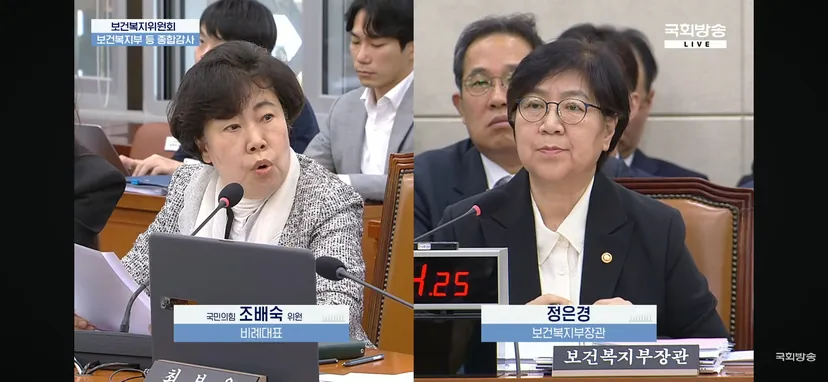
During the National Assembly Health and Welfare Committee audit on the 27th, Rep. Cho Bae-sook (proportional representative) of the People Power Party questioned the appropriateness of the previous joint investigation into the ghost surgery allegations at Yonsei Sarang Hospital.
Rep. Cho explained that allegations of ghost surgery were raised in 2024 after it was revealed that one doctor at Yonsei Sarang Hospital had claimed fees for approximately 4,000 surgeries per year.
While the MOHW, the National Health Insurance Service, the Health Insurance Review and Assessment Service, and the Seocho-gu Public Health Center conducted a joint investigation in December of that year, the scope was limited to only 55 out of the surgeries performed between 2022 and 2024, and no illegalities were confirmed. Surgeries performed between 2019 and 2021 were excluded from the investigation.
Rep. Cho pointed out that even though there were eight days where the hospital director claimed fees for over 15 surgeries and 60 outpatient visits, the investigation team concluded that no false records existed, relying on the director's claim that his core participation time in each surgery was only 10 to 15 minutes.
Rep. Cho questioned, "Did you conclude the investigation by only listening to the hospital's side?" and raised doubts about whether patients and other stakeholders were sufficiently questioned during the process.
In particular, the fact that a separate criminal trial is ongoing regarding surgeries from 2019 to 2021, which were excluded from the initial joint investigation, was also addressed.
Rep. Cho noted that Ko Yong-gon, the director of Yonsei Sarang Hospital, is currently on trial at the Seoul Central District Court on charges of having employees from a medical device company he founded perform surgeries. She added that during the trial, Director Ko argued that it is common practice in domestic hospitals for medical device company employees to enter operating rooms, and while he admitted to some instances where employees drilled into bone or inserted pins, he dismissed these as merely simple assistance.
She also presented a video suggesting that the time the medical device company sales representative participated in surgery coincided with the filming of a promotional video.
Rep. Cho cited Supreme Court precedents stating that if a non-medical professional performs medical acts alongside a doctor, the medical care benefit costs cannot be legally received. She argued that even before the criminal trial result is finalized, a reinvestigation should be conducted based on relevant evidence and that the recoupment of improperly claimed costs should be considered.
In response, Minister of Health and Welfare Cho Kyoo-hong replied, "I attended this audit without grasping the specific details of this matter, so I will check (later)," adding, "I will confirm the necessity for a reinvestigation and the possibility of cost recoupment, and I will report back separately."
"Transforms into Cartilage Cells in 6 Weeks": Controversy Over Unfair Advertising
During the parliamentary audit, issues were also raised regarding the intra-articular injection of autologous adipose-derived stromal vascular fraction (SVF) performed by Yonsei Sarang Hospital. This procedure involves separating and extracting a cell group known as SVF, which includes stem cells, from the patient's own adipose tissue and injecting it into the knee joint cavity to alleviate pain and improve joint function in patients with knee osteoarthritis.
Rep. Cho pointed out, "Although this medical procedure was recognized as a new medical technology in June 2024, the cell extraction, processing, and storage processes were not evaluated," and argued, "Since living cells are directly injected into patients, verification of cell safety and quality control is necessary."
She also claimed that while the effects of the SVF procedure are limited to pain relief and functional improvement, it is being promoted as having cartilage regeneration effects. In particular, she mentioned a case where Director Ko appeared on a terrestrial broadcast and explained that the cells "transform into cartilage cells in 6 weeks."
Minister Cho stated, "Advertising it as having cartilage regeneration effects when such an effect has not been recognized is an unfair advertisement. I will look into that part and take necessary measures."
Allegations of 45 Billion Won Collected from 15,000 Patients for Stem Cell Storage
Allegations surrounding the stem cell storage business between Yonsei Sarang Hospital and the medical device company Skyv were also raised.
Rep. Cho alleged that Yonsei Sarang Hospital and Skyv received a total of 45 billion won in stem cell storage fees from approximately 15,000 patients. She explained that patients were guided to store adipose-derived stem cells to receive repeat procedures when needed, and that relevant contracts, storage certificates, and medical records of repeated procedures exist.
Rep. Cho argued, "The Ministry of Food and Drug Safety responded that there is no record of stem cell release by Skyv; did you judge based only on what the company said?" and insisted that statements from patients and related materials must be verified.
Furthermore, the issue was raised that the MOHW and the Ministry of Food and Drug Safety are shifting responsibility to each other citing jurisdictional boundaries regarding the investigation of unauthorized cell processing facilities and stem cell procedures.
Minister Cho replied, "Regarding cell banks and cell processing facilities, I will consult with the Ministry of Food and Drug Safety to understand the current situation, and I will review countermeasures for this as well and report back."
This parliamentary audit brought to light not only the results of the investigation into Yonsei Sarang Hospital's ghost surgery allegations but also oversight issues regarding SVF procedure advertising and the stem cell storage business. With the MOHW stating it will review the possibility of a reinvestigation and the recoupment of medical care benefits, attention is now focused on how the ministry will verify these allegations through consultation with the Ministry of Food and Drug Safety and what follow-up measures will be prepared.