

[비즈한국] The domestic petrochemical industry is accelerating major structural improvements to ensure its survival. Following the government's approval of the Daesan Project 1 in South Chungcheong Province this past February, a large-scale business restructuring plan was announced on July 22 for Yeosu in South Jeolla Province, the nation's largest petrochemical complex.
‘Yeosu Project 1’ centers on four companies—Yeochun NCC, Lotte Chemical, Hanwha Solutions, and DL Chemical—joining forces to significantly reduce general-purpose petrochemical facilities while transitioning to high-value-added eco-friendly materials. The government has also decided to inject a comprehensive support package worth over 700 billion KRW, including financial aid, tax incentives, R&D funding, regulatory exemptions, as well as support for employment and the local economy.
The petrochemical industry has expressed overwhelming welcome for these measures. However, climate think tanks have pointed out that a fundamental decarbonization roadmap is absent from the core of this restructuring.
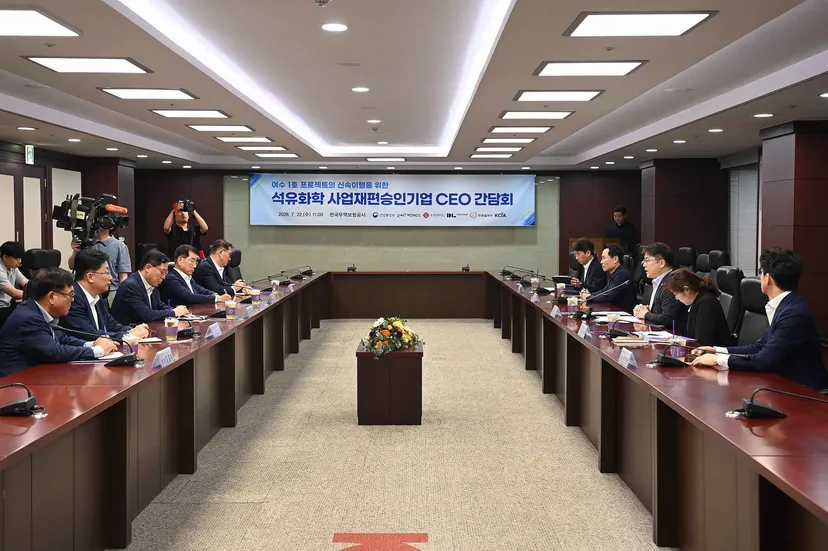
New Joint Entity Created by 4 Companies… 1.39 Million Tons of General-Purpose Ethylene to Be Shut Down
The Yeosu Project 1 restructuring is a “big deal” that integrates the upstream (basic fraction production) and downstream (polymer material production) structures of the four petrochemical firms. According to the restructuring plan, Hanwha Solutions and DL Chemical will contribute their respective downstream business units—such as polyethylene (PE) and petroleum resins for adhesives and coatings—to Yeochun NCC in the form of capital in kind.
Following this, Lotte Chemical will spin off its basic materials business—including the Naphtha Cracking Center (NCC) at its Yeosu plant, as well as PE and polypropylene (PP)—and merge the new entity with Yeochun NCC to launch an integrated corporation with an “equal 3:3:3 equity” structure among the three participating parties.
The core purpose of this integration is to drastically scale back facilities for general-purpose products currently suffering from oversupply. The new integrated entity will completely halt operations of the No. 2 (920,000 tons annual capacity) and No. 3 (470,000 tons) units among the three NCC facilities currently owned by Yeochun NCC. With only the Yeochun NCC No. 1 unit (900,000 tons) and the Lotte Chemical Yeosu NCC (1.23 million tons) remaining, the domestic ethylene production capacity will be reduced by a total of 1.39 million tons at once. The industry expects this to improve facility utilization rates for general-purpose products and break the cycle of deficits caused by intense competition.
The companies are also making large-scale investments in self-rescue efforts and structural improvements. Hanwha Solutions and DL Chemical, as major shareholders of Yeochun NCC, will each conduct a capital increase of 272.5 billion KRW (totaling 545 billion KRW) to improve financial structures and repay debt. Furthermore, the four companies will invest a total of 253.2 billion KRW in new projects to implement the restructuring and transition toward high-value-added products. They plan to inject 103.2 billion KRW into building infrastructure for supply chain pipelines and utility connections such as steam and water, and invest 150 billion KRW to advance into cutting-edge chemical materials like LDPE (low-density polyethylene) for IV bags and medical tubing, and POE (polyolefin elastomer) for packaging adhesives.
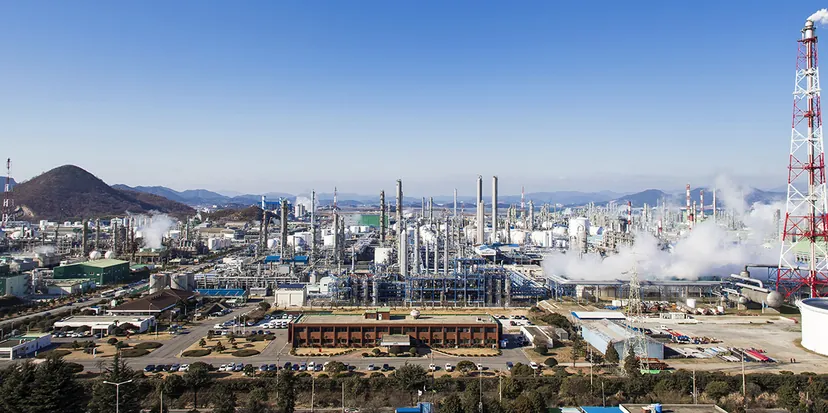
Government Responds with 700 Billion KRW Support Package
The government is also providing a customized support package worth over 700 billion KRW. In the financial sector, it will supply up to 450 billion KRW in new funding through creditor financial institutions such as the Korea Development Bank for facility integration and high-value-added conversion, and has agreed to defer repayment of agreed debts until the end of 2029. Through the Korea Trade Insurance Corporation, it will provide up to a 30% discount on import insurance premiums and 200 billion KRW in import loan guarantees. Benefits such as tax support and institutional rationalization are also included, such as corporate and local tax reductions, extending the duty-free application for imported naphtha and crude oil, and shortening the Fair Trade Commission’s business combination review period (from 120 days to 90 days).
To minimize employment instability and the impact on the local economy resulting from facility closures, an “employment safety net support measure” has been included from various angles. The government has decided to consider designating the area as an “Employment Crisis Area” to provide continued support if local employment conditions do not improve even after the current designation period for preemptive response to employment crises expires.
Furthermore, to address the issue where companies were unable to receive employment retention subsidies due to the necessity of maintaining operation rates despite operating losses, the revenue decline requirements have been significantly relaxed. The government will also allow exceptional recruitment of essential high-value-added R&D personnel during the restructuring period and will actively subsidize job training for existing employees to transition from simple production roles to areas like AI-utilizing process software development.
The industry expressed immediate welcome for these comprehensive support measures. The Korea Chemical Industry Association released a statement immediately after the approval, saying, “The approval of the Yeosu Industrial Complex restructuring, following Daesan Project 1, will contribute significantly to resolving the oversupply in the domestic petrochemical sector and restoring industrial competitiveness,” adding, “We deeply thank the government ministries for their close cooperation in providing swift approval and support across finance, tax, employment, and R&D.”
Eom Chan-wang, Executive Vice Chairman of the Korea Chemical Industry Association, emphasized, “We hope for continued, effective support to ensure that the petrochemical sector, as a national strategic industry, can regain its competitiveness.”
Climate Measures Take a Step Back Compared to Daesan 1… Absence of a Concrete ‘Carbon Reduction’ Roadmap
Despite the industry’s cheers, climate think tanks are criticizing the restructuring plan for lacking depth in its decarbonization strategy. While the support for the Daesan Project 1, approved last February, included specific technical tasks such as utilizing bio-naphtha and introducing ethane gas to reduce carbon emissions from the process itself, the Yeosu Project 1 support measures—aside from some R&D support—have seen almost all specific messages regarding low-carbon transition and process electrification disappear.
Jeong Seok-hwan, head of the Petrochemical Team at Solutions for Our Climate, pointed out, “The country is currently preparing a Green Transition (GX) system, and the government’s second-half economic growth strategy also emphasizes a major structural transformation of fossil-fuel-based industries, such as the electrification of petrochemical processes. Conversely, this restructuring support measure is solely focused on financial funding and facility reduction, lacking clear guidelines on how to fundamentally change the corporate constitution for low-carbon transition and process electrification.” He added, “The core of petrochemical low-carbon transition is ultimately the electrification of processes, but the Ministry of Trade, Industry and Energy has failed to present clear confidence or concrete action plans for this.”
There are also concerns that greenhouse gas reduction effects from facility closures could slow down essential technological innovation. Kim Su-kang, a senior researcher at the non-profit organization NEXT, diagnosed, “Absolute carbon emissions will drop significantly as facilities are shut down rather than just adjusting production volume,” adding, “However, if national greenhouse gas reduction targets (NDC) are easily achieved merely through facility shutdowns, companies may end up neglecting essential decarbonization efforts such as process improvement or the development of innovative technologies.”
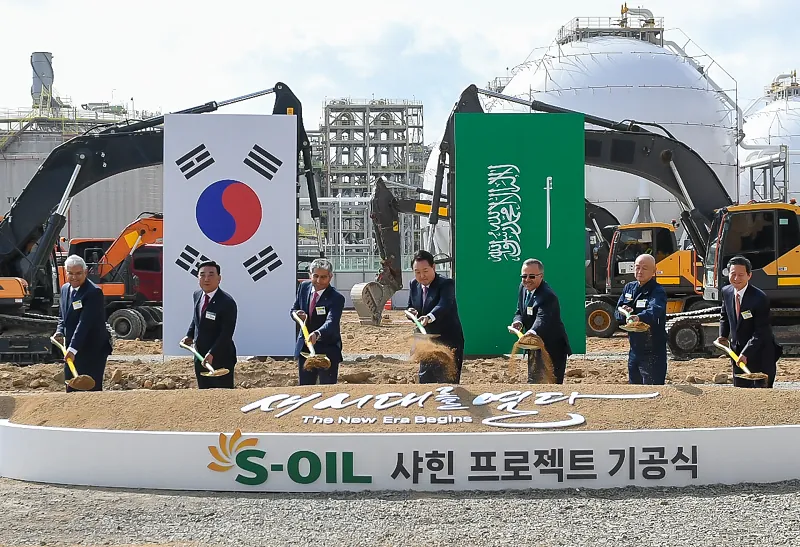
The ‘Next Batter’ is the Ulsan Petrochemical Complex
With the Yeosu Project 1 restructuring settled, the eyes of the government and the industry are moving toward the “Ulsan Industrial Complex,” the next puzzle piece in the petrochemical restructuring. However, restructuring the Ulsan complex faces more difficult hurdles than Daesan or Yeosu, as the massive ‘Shaheen Project,’ a petrochemical project currently being built in Ulsan by S-OIL with an investment of 9.258 trillion KRW, is nearing operation.
The Shaheen Project will mass-produce vast quantities of general-purpose ethylene and petrochemical products using Thermal Crude-to-Chemicals (TC2C) technology, which converts refinery byproducts directly into petrochemical raw materials. A paradox is occurring where traditional petrochemical firms in Daesan and Yeosu are closing facilities and cutting production, while a massive new general-purpose facility is opening in Ulsan.
This structure is bound to cause issues of equity between industrial complexes and between traditional petrochemical companies. Even if domestic firms endure massive losses to reduce general-purpose facilities, if S-OIL—which has a foreign majority shareholder (Aramco)—floods the market with general-purpose products from the Shaheen Project, the effect of resolving oversupply and reducing carbon emissions for the nation as a whole could be negated.
Jeong Seok-hwan warned, “Even if other industrial complex companies endure the pain and transition their business models, if a massive new facility like the Shaheen Project enters the market, the effect of the support package funded by trillions of KRW in tax money becomes unclear,” adding, “If the Shaheen Project does not participate in reducing general-purpose product output or yield volume, other petrochemical firms in Ulsan will find it difficult to join the restructuring willingly, which would act as a stumbling block for the entire petrochemical industry’s restructuring.”