

[비즈한국] While the number of redevelopment and reconstruction projects in Seoul has increased by nearly 20% over the past year, it has been confirmed that one out of every five new project sites is located in Yangcheon-gu. As the reconstruction of the Mok-dong Sin-sigaji apartment complexes has accelerated, the number of redevelopment project sites in Yangcheon-gu has more than doubled, from 11 to 23. This is largely due to the addition of 9 complexes that had not been designated as redevelopment zones until the first half of last year.
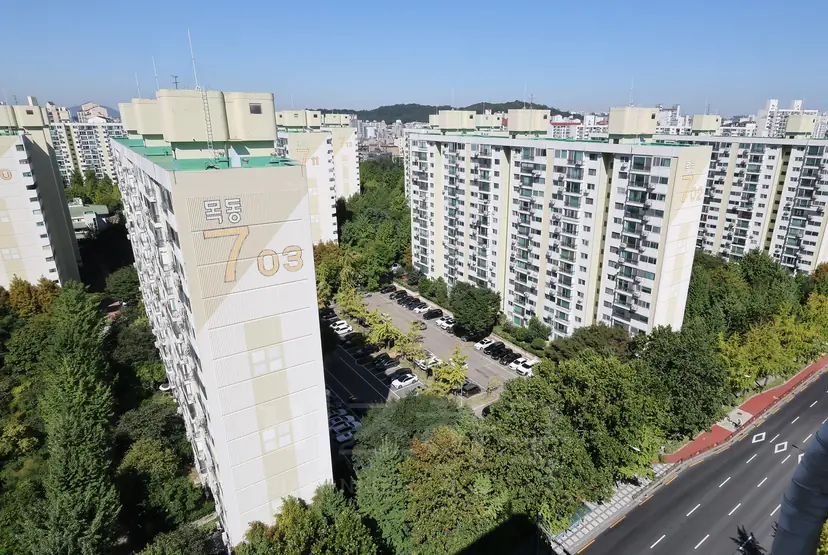
Seoul Redevelopment Projects Up 19% in a Year… Yangcheon Sees ‘Largest’ Increase
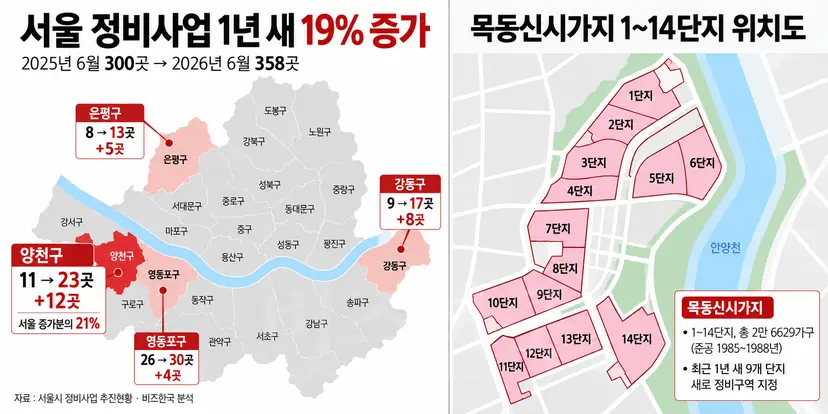
An analysis by BizHankook of Seoul Metropolitan Government data on the status of urban redevelopment projects shows that as of the end of June this year, there were 358 project sites in Seoul, an increase of 58 (19%) from June of last year. The number of new projects added over the past year accounts for 71% of the total 82-site increase seen over the last three years. In other words, the growth rate has accelerated significantly in recent times. Urban redevelopment projects, which have a high proportion of downtown and commercial area redevelopment, were excluded from this count.
By autonomous district, Yangcheon-gu saw the largest increase. The number of project sites in Yangcheon-gu grew from 11 in June last year to 23 this June, an increase of 12 (109%). This accounts for 21% of Seoul’s total increase, meaning one out of every five new redevelopment sites in Seoul over the past year appeared in Yangcheon-gu. Following this, Gangdong-gu increased by 8 (from 9 to 17), Eunpyeong-gu by 5 (from 8 to 13), and Yeongdeungpo-gu by 4 (from 26 to 30).
The growth in Yangcheon-gu was effectively led by the Mok-dong Sin-sigaji apartments. While there were 5 reconstruction project sites in Mok-dong Sin-sigaji in June last year (Complexes 6, 8, 12, 13, and 14), 9 more were added by June this year, bringing all complexes from 1 to 14 into the fold. The 9 newly joined complexes—1, 2, 3, 4, 5, 7, 9, 10, and 11—all completed their designation as redevelopment zones consecutively between July and December of last year. They account for 75% of Yangcheon-gu’s total increase and 16% of Seoul’s total increase over the past year.
In addition to Mok-dong Sin-sigaji, the other new redevelopment projects in Yangcheon-gu include the redevelopment areas in the vicinity of 232 Mok 2-dong and 77 Sinwol 5-dong, as well as the reconstruction of Sinwol Si-yeong. The area near 232 Mok 2-dong is at the promotion committee stage, while the area near 77 Sinwol 5-dong and Sinwol Si-yeong have reached the cooperative establishment stage. While projects outside of Mok-dong Sin-sigaji are also increasing, since 9 out of the 12 new projects in Yangcheon-gu are in Mok-dong, the focus of the recent growth is clearly centered there.
The scale of the projects is also significant. The Mok-dong Sin-sigaji Complexes 1–14 are currently slated to be rebuilt from 26,629 households to 47,438. If completed as planned, the number of apartments will net an increase of 20,809 households. This effectively adds a volume equivalent to 78% of the current number of households in Mok-dong Sin-sigaji. Out of the 60,500 total planned households across the 23 redevelopment projects in Yangcheon-gu as of June this year, the 14 Mok-dong complexes account for 78%.
Yoon Ji-hae, a senior researcher at Real Estate R114, explained, “The increase in Seoul’s redevelopment projects can be seen as a result of the Seoul Metropolitan Government’s efforts to revitalize redevelopment through initiatives like the Rapid Integrated Planning. However, there are limits to judging the scale based solely on the number of projects because the area of each site varies greatly.” He added, “Mok-dong has low existing floor area ratios and large land stakes, and with the strong will of both the cooperative members and the local government, the conditions for the projects are favorable and the speed of progress is relatively fast.”
Construction Firms Eye 30 Trillion Won Market… Complex 6 is the ‘Only’ One to Select a Contractor
As Mok-dong reconstruction projects have all hit their stride, interest from the construction industry is growing. The industry estimates the total construction cost for the reconstruction of all 14 complexes to be around 30 trillion won. Previously, DL E&C and GS E&C set up promotional spaces in Mok-dong for the Mok-dong Complex 6 and the former KT site ‘Mok-dong Yunseul Xi’ projects, respectively. Recently, Hyundai E&C and Daewoo E&C opened promotional spaces with an eye on future bids, and Lotte E&C is also planning to open a promotional hall in October.
To date, Complex 6 is the only one among the 14 Mok-dong Sin-sigaji complexes to have selected a contractor. After the bid for the 1.2868 trillion won project was canceled twice due to a single bidder, DL E&C won the contract for Complex 6 in June. DL E&C, which proposed its high-end brand ‘ACRO,’ has expressed its determination to use Complex 6 as a bridgehead for additional contract wins. After reconstruction, Mok-dong Complex 6 is planned to be reborn as 14 buildings reaching up to 49 floors, totaling 2,173 households.
Subsequent complexes are also proceeding with the contractor selection process. On the 26th of last month, Complex 10 designated Hyundai E&C, which was the sole bidder twice, as the preferred bidder and is currently in the process of negotiating a private contract. For Complex 12, the first bid fell through due to a single bid by GS E&C; it has since entered a re-bidding process, with the second deadline set for October 26. Complex 13 is also preparing for a re-bid after its first attempt failed due to a single bid by Samsung C&T.
So far, there has been no instance among the Mok-dong Sin-sigaji redevelopment projects where a competitive bidding process has successfully taken place following the final bid submission. Although various major companies are active in bidding in the Mok-dong area, they seem to be avoiding excessive competition during the actual bidding process. This is interpreted as a reflection of a selective bidding strategy where firms weigh profitability and the likelihood of winning against rising burdens such as construction costs, financial expenses, and bid deposits.
Complex 8, which is currently approaching its first bid deadline, remains a potential site for a competition. Four companies—Daewoo E&C, HDC Hyundai Development Company, DL E&C, and GS E&C—attended the site briefing for the contractor selection bid last month. The estimated construction cost for Complex 8 is approximately 1.1119 trillion won, and the deadline for the contractor bid is set for the 22nd. If multiple companies participate in the actual bidding, it would be the first time a competitive bidding process is established in the contractor selection for Mok-dong Sin-sigaji.
Most other Mok-dong Sin-sigaji complexes have not yet set their schedules for contractor selection. Complex 7 is accelerating follow-up steps, such as applying for Seoul City’s integrated review in August following its cooperative establishment authorization in July, and others like Complex 14 are also preparing for the contractor selection process. Whether the interest from construction firms will translate into actual competitive bidding in Mok-dong, which led the increase in redevelopment projects, is a key point to watch in the Seoul redevelopment market for the second half of the year.
An official from a large construction firm explained, “Mok-dong has a low existing floor area ratio, which means there are many units for general sale, making it highly profitable. When construction firms evaluate redevelopment projects, they look at profitability, potential for landmark status, and the possibility of additional wins; usually, having just one of those is enough. The 14 complexes in Mok-dong possess almost all three.” Another official from a major firm added, “Mok-dong is highly profitable, large in scale, and boasts excellent residential preference and educational environments.”