[비즈한국] The season of "high skies and plump horses" (autumn) is here, and for those who enjoy indulgence, it’s a time for happy dilemmas. In particular, from October 23 to 25, three major food festivals will be held simultaneously: the Gimcheon Gimbap Festival, the Daegu Tteokbokki Festival, and the Wonju Dumpling Festival. Gimbap, tteokbokki, and dumplings—what an unbeatable combination. It is also interesting that all three festivals feature popular food items rather than specific regional specialties. My personal pick last year was the Wonju Dumpling Festival. While I love gimbap and am crazy about tteokbokki, Wonju has many other places I wanted to visit beyond my beloved dumplings.
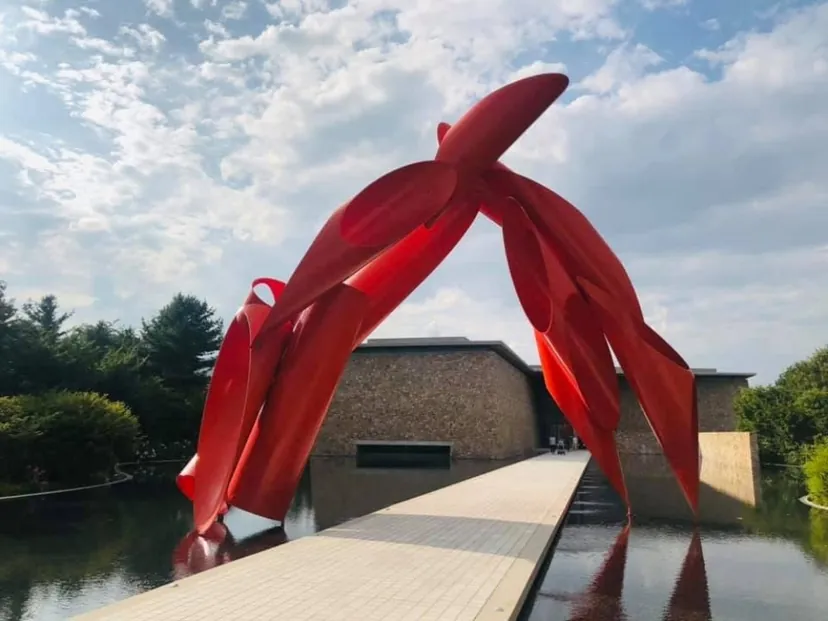
Before heading to the Wonju Dumpling Festival, you must visit ‘Museum SAN’ in Wonju. Famous for being designed by Tadao Ando, this place is familiar to the public as it has appeared in numerous dramas. Its most memorable appearance was as a wealthy family’s mansion in the drama ‘Mine’, and it was also chosen as the meeting place for Hee-joo (IU) in ‘21st Century Dynasty Princess’. Located in the foothills at an altitude of 275 meters, it offers a scenery quite different from other art museums.
While the admission fees for any type of ticket are not cheap, it is highly likely that you will end up purchasing an integrated pass to enjoy all the spaces, as it is hard to miss anything—from the Alexander Liberman sculpture in front of the main building, the Stone Garden inspired by the Silla royal tombs in Gyeongju, the James Turrell Hall where nature, architecture, and art blend together, the Meditation Hall for quiet reflection, to the new permanent exhibition space, the Ground Antony Gormley. If you are visiting for the first time, do not miss the James Turrell Hall. With Lee Bae’s solo exhibition ‘En attendant: Waiting’ running until December 6, there is more than enough reason to visit Museum SAN now.
Once you’ve enjoyed Museum SAN, it’s time to fully experience the Wonju Dumpling Festival. Some may wonder why a dumpling festival is held in Wonju, but there is a story behind it. During the Korean War, Wonju served as a crucial hub for refugees and residents from the Gangwon region. With food being scarce, dishes made from flour and vegetables helped satisfy people's hunger, and dumplings became a staple food for the common people. The presence of long-standing dumpling shops around the Wonju Central Market area, which have been hand-crafting dumplings in their own ways for over 70 years to form a "Wonju Dumpling Road," is the foundation for the festival, giving it quite a bit of historical significance.
The Wonju Dumpling Festival, which debuted in 2023, has grown into a nationwide food culture festival, attracting 410,000 visitors last year. This year, the stage has expanded from the Wonju Stream Morning Market area to the Culture Street and central traditional markets, allowing visitors to enjoy various parts of the old downtown. They plan to reduce long wait times by introducing QR real-time ordering and reservation systems, as well as kiosks, and a new "Nakhwa-nori" (traditional fireworks) performance will be showcased along the Wonju Stream. Of course, the most important thing is to feast on a variety of dumplings, including Wonju dumplings. Start with the light ones and finish with the oily ones. And don't forget the kimchi dumplings, which are the signature of Wonju dumplings. If you get too full, I recommend a stroll through the nearby Gangwon Gamyeong. The 'Chrysanthemums and Autumn Flowers' exhibition is open until November 2, so you can enjoy an autumn evening walk accompanied by the night view of the Gamyeong until 10 PM.
If you spent the night in Wonju, a place to visit the next day is the ‘Park Kyung-ni Literature Park’. Although author Park Kyung-ni’s hometown is Tongyeong, Wonju is like her second home, a place where you can trace the path of her life and works. After looking around her old house, preserved exactly as it was when she lived there, the garden she tended, and the House of Literature, an exhibition space where you can encounter her literary world, you can enjoy a drink inspired by her novel ‘Toji’ at Cafe Seohee and savor the lingering impression of author Park and her masterpiece. Cafe Seohee is also famous for having been remodeled in collaboration with Yoo Jung-soo, the CEO of The Glow Seoul and a leading space designer in Korea.
And finally, Wonju’s ‘Sogeumsan Grand Valley’. When you visit Sogeumsan, known as Korea’s Zhangjiajie, you can enjoy Sogeumsan Grand Valley in a course taking about 2 hours, including a cable car, a 100-meter-high and 200-meter-long suspension bridge, the thrilling Sogeum Jando cliffside path, the iconic Sky Tower, and the Ullung Bridge, which is twice as long as the suspension bridge. At this time, when the autumn atmosphere is in full swing, many people, including hikers, visit to take in the scenery where bizarre rocks, old trees, clear rivers, and wide sandy beaches harmonize. The ‘Naora Show - Night of Lights,’ featuring a musical fountain and media facade set against the flowing river and steep cliffs, is also held, so if you are looking for a special experience, it’s worth visiting in the evening.
I am debating whether to visit Wonju again this year or check out the Gimcheon Gimbap Festival or Daegu Tteokbokki Festival, but I think my choice will likely be Wonju. I believe dumplings have a slight edge over gimbap and tteokbokki when it comes to instantly making people happy with their white steam and indescribable aroma. For reference, targeting those who cannot decide between the two, the Wonju City and Daegu Buk-gu local governments have begun joint cooperation to expand tourist exchanges. Both sides will use social media and promotional channels to promote each other’s festivals, and they will even hold a "visit verification event" for tourists who visit both. If you are an energetic traveler, how about planning a 1-night trip to Wonju and a 1-night trip to Daegu for a gourmet adventure?