

[비즈한국] The top diplomats of South Korea and the United States met in Washington, D.C., to coordinate economic and security issues involving both nations, including the implementation of $350 billion (approximately 460 trillion KRW) in strategic investments in the U.S. and potential military deployment to the Strait of Hormuz.
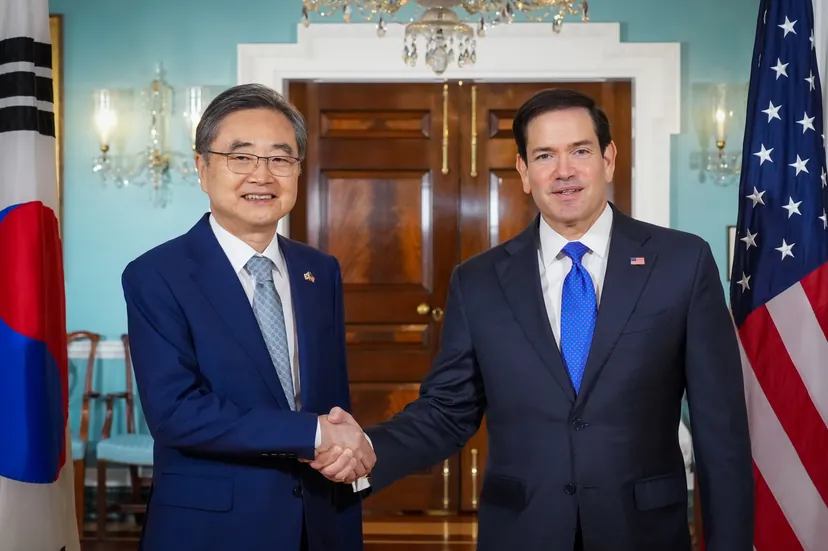
Foreign Minister Cho Hyun and U.S. Secretary of State Marco Rubio held a bilateral meeting at the Department of State in Washington, D.C., on the morning of September 18 (local time). This was their first face-to-face meeting in about seven months since last February, and it was arranged quickly, coming just three and a half weeks after the two ministers held a phone conversation on the 24th of last month.
Calculating the $350 Billion Strategic Investment in the U.S.
The most significant economic agenda item on the table was undoubtedly the $350 billion in strategic investments in the U.S.
In a press briefing for Korean correspondents at the South Korean Embassy in the U.S. immediately following the meeting, Minister Cho stated, "We agreed to strive for successful outcomes in our current strategic investment projects, and I requested Secretary Rubio’s support in this process." He added, "Secretary Rubio mentioned that the State Department would also make efforts to ensure these consultations conclude successfully."
The U.S. State Department released an official statement shortly after the meeting, announcing that "the two ministers pledged continued cooperation across all major strategic sectors, including semiconductors," placing the semiconductor supply chain issue at the forefront. Through a statement from spokesperson Tommy Pigott, the U.S. State Department officially stated that "Secretary Rubio emphasized the importance of securing supply chains for key U.S. industries" and "stressed the swift implementation of the investment commitments under the JFS (Joint Financial Support)."
The announcement of the so-called "first project" of the $350 billion investment, which had initially raised market expectations, was postponed following scheduling adjustments. While an official announcement had been considered likely the previous day (Korea time), the schedule was pushed to next week after the report to the domestic National Assembly on the 17th was delayed. Regarding this, Minister Cho had previously emphasized that "the investment schedule was postponed due to procedural issues, and there is no disagreement between South Korea and the U.S."
Potential friction points regarding the trade environment and market regulations for companies from both countries also surfaced during the meeting.
The U.S. State Department conveyed that "Secretary Rubio emphasized the urgent need for a fair, transparent, and equitable business environment for U.S. companies operating in Korea." This is interpreted as a remark aimed at the recent "Coupang incident" that has sparked domestic controversy, as well as the Korean government's regulations targeting U.S. big tech platforms like Google. The Ministry of Foreign Affairs did not separately include the U.S. State Department's requests regarding the business environment for American companies in the official press release distributed that day.
Discussions on Hormuz Deployment and Denuclearization of the Korean Peninsula
The issue of deployment to the Strait of Hormuz was also a key agenda item. During the correspondents' briefing, Minister Cho said, "I emphasized our government’s commitment to making practical contributions alongside the U.S. and the international community for the restoration of free navigation in the Strait of Hormuz," adding, "We agreed to continue communicating closely on this matter."
The two ministers also agreed to continue diplomatic efforts for the denuclearization and peace-building of the Korean Peninsula. Minister Cho stated, "I emphasized that our government, as a party directly involved in peace on the Korean Peninsula and as a 'pacemaker,' will actively support the resumption of North Korea-U.S. dialogue." In response, Secretary Rubio expressed his intention to cooperate closely with South Korea once North Korea-U.S. dialogue begins in earnest.
Meanwhile, Minister Cho held a separate meeting with U.S. Assistant Secretary of Defense for Policy Elbridge Colby to review defense alliance issues, such as the transition of Wartime Operational Control (OPCON). Minister Cho reported, "Assistant Secretary Colby spoke highly of the South Korean government’s efforts to strengthen alliance capabilities and expand its role, including increased defense spending."
Having finished his Washington schedule, Minister Cho will travel to New York on the 19th to attend the high-level week of the UN General Assembly. He is scheduled to meet with Secretary Rubio again on the 21st for a South Korea-U.S.-Japan foreign ministers' meeting. With the announcement of the first of the $350 billion investment projects approaching next week, the economic and security linkages between the two countries are expected to enter a complex implementation phase.