

[비즈한국] Chinese President Xi Jinping will meet with U.S. President Donald Trump in Washington on the 24th. The market is focusing on artificial intelligence (AI) chips, rare earths, and tariffs as key agenda items. The main areas of interest are whether Nvidia’s sales to China will increase, whether semiconductor stocks related to China will rebound, and if supply instability for rare earths will ease. However, for individual investors, rather than focusing on the phrase "authorizing chip sales" from this summit, it is more important to verify whether such authorization actually leads to orders and shipments.
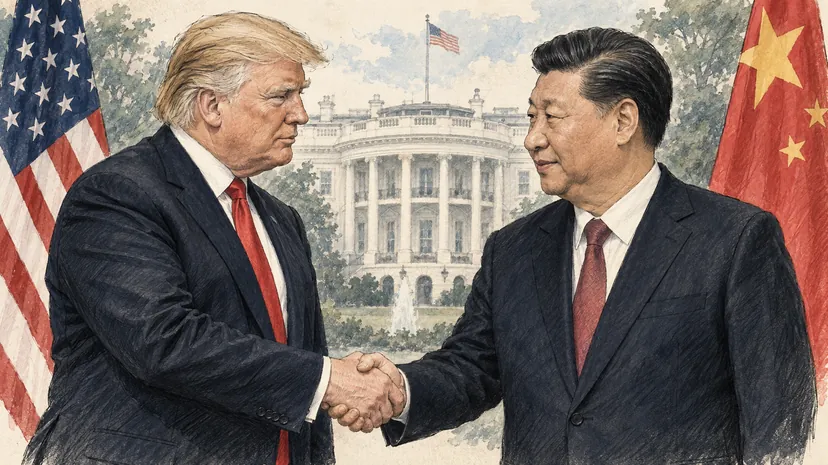
The U.S.-China summit in May already demonstrated this discrepancy. At that time, the U.S. government approved the purchase of Nvidia's H200—a high-performance AI chip—by about 10 Chinese companies, including Alibaba, Tencent, and ByteDance. While this appeared on the surface to be a relaxation of export controls, authorization did not immediately translate to revenue. At the time, it was reported that China, under its policy of fostering its domestic semiconductor industry, encouraged these companies to delay their purchases. The U.S. also imposed conditions, such as preventing military diversion. It was not until July that U.S. officials explained to Congress that limited shipments of the H200 to China had begun. A gap of more than two months, along with Chinese government industrial policy and individual corporate orders, stood between the announcement of "sales authorization" and the "recovery of Nvidia's revenue from China."
This serves as the benchmark for interpreting the upcoming summit. Even if statements regarding AI cooperation or chip sales emerge after the summit, there is no reason to immediately raise forecasts for Nvidia's revenue from China. U.S. export authorization must be granted, Chinese companies must actually place orders, and the Chinese government must allow those companies to choose U.S.-made chips over domestic alternatives. If any one of these three stages is blocked, the authorization will not turn into revenue.
It is also important to note that China views domestic chips not merely as alternatives, but as targets of its industrial policy. Huawei recently stated that demand for its own AI computing equipment is exceeding supply and that it intends to accelerate the launch of next-generation AI chips. Even if U.S. chips are superior in performance and software ecosystems, the policy pressure on Chinese firms to reduce dependence on U.S. technology will not disappear.
Therefore, one should not interpret this summit in terms of "If the U.S. eases regulations, Nvidia wins, and if the U.S. maintains them, Chinese chips win." Even if the U.S. permits some sales, China’s purchasing may remain limited. Conversely, even if China pushes for localization, imports of some U.S. chips may continue as long as the demand for high-performance computing persists. What investors must watch is not the presence of authorization, but the actual shipment volume and the orders placed by Chinese firms following that authorization.
The other pillar of this negotiation, rare earths, should be viewed through the same lens. The mere promise of "stable supply" from China does not mean supply chain risks have vanished. For rare earths, it is more important to know how much and how quickly export permits are actually issued. For companies in electric vehicles, wind power, defense, and electronic components, customs clearance and delivery schedules are more direct to their bottom lines than the principles discussed in negotiation rooms. Investors should also keep November 10th in mind, as it marks the end of the current U.S.-China trade truce. If an agreement to extend the truce emerges from this summit, tariff-related uncertainty may decrease slightly. However, adjusting tariffs on non-sensitive items is fundamentally different from export controls on advanced AI chips. A tariff truce extension should not be interpreted as a relaxation of semiconductor regulations.
Investors holding U.S. semiconductor stocks should look past headlines about "China sales approval" and focus on how future earnings calls address China revenue forecasts and actual shipments. Domestic semiconductor investors also do not need to view the U.S.-China summit as a blanket positive or negative event. AI chip sales to China, China's expansion of domestic chips, rare earth export permits, and tariffs each change demand and competition through different channels. On the day of the summit, the market will react quickly to short headlines. At that time, the job of the individual investor is not to chase stocks that have spiked, but to scrutinize whether the official statements contain keywords like "shipments" rather than "authorization," "volumes" rather than "principles," and "extension periods" rather than just "talks." This is because the most important word in U.S.-China negotiations is not "agreement," but "implementation."