

[비즈한국] The profitability of the top five domestic listed construction companies improved significantly in the first half of this year. As the proportion of low-margin housing projects that began during the period of soaring construction costs has decreased, operating profits have risen by nearly 25%. However, since new housing starts and presales remain sluggish, it is expected to take time for this earnings recovery to translate into top-line growth.
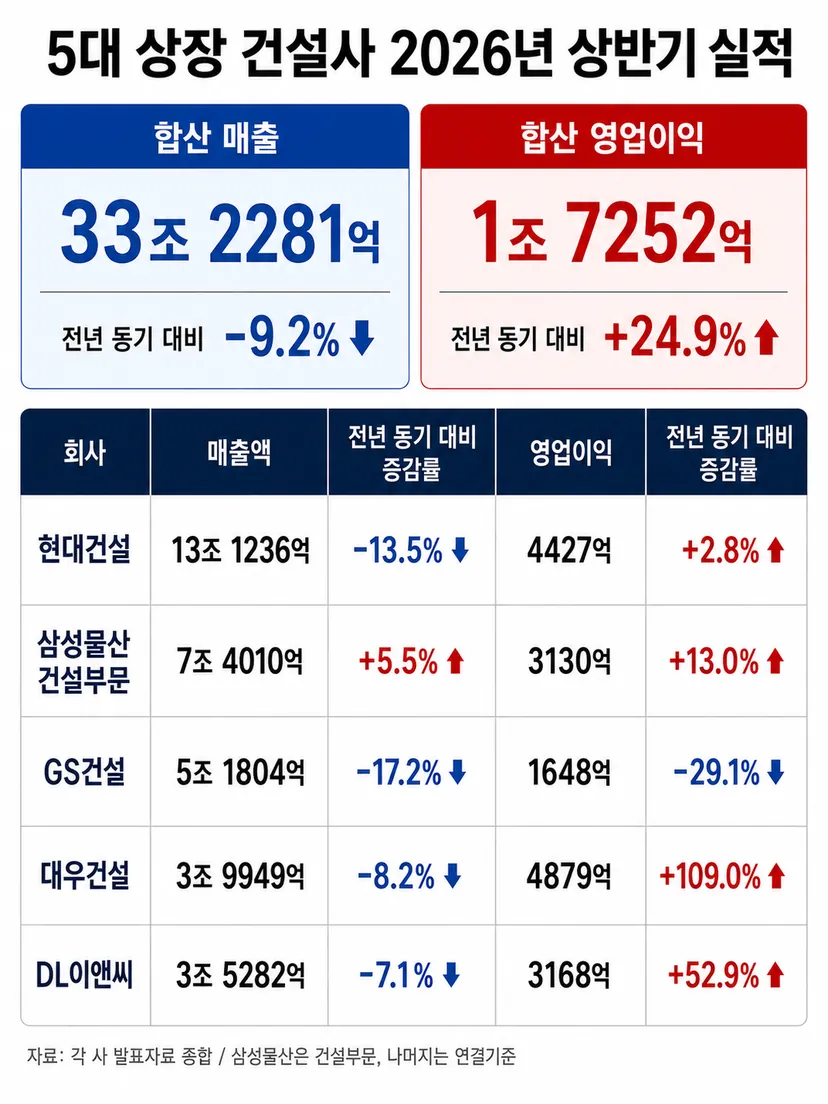
According to the preliminary earnings reports released by each company, the combined operating profit of the top five listed construction firms in the first half of this year reached 1.7252 trillion KRW, an increase of 24.9% compared to the same period last year. By company, the operating profits were as follows: Daewoo E&C 487.9 billion KRW (+109.0%), Hyundai E&C 442.7 billion KRW (+2.8%), DL E&C 316.8 billion KRW (+52.9%), Samsung C&T’s construction division 313.0 billion KRW (+13.0%), and GS E&C 164.8 billion KRW (-29.1%).
During the same period, the combined revenue of the five companies was 33.2281 trillion KRW, down 9.2%. Hyundai E&C had the highest first-half revenue at 13.1236 trillion KRW (-13.5%), followed by Samsung C&T’s construction division at 7.4010 trillion KRW (+5.5%), GS E&C at 5.1804 trillion KRW (-17.2%), Daewoo E&C at 3.9949 trillion KRW (-8.2%), and DL E&C at 3.5282 trillion KRW (-7.1%). Except for Samsung C&T, all four companies saw their top-line figures shrink.
The increase in operating profit despite declining revenue is due to the improvement in cost ratios for housing and building projects. Daewoo E&C, which saw a notable rise in operating profit, saw its construction division’s cost ratio fall by 9.8 percentage points from 88.6% in the first half of last year to 78.8% in the first half of this year. DL E&C’s housing cost ratio fell by 10.8 percentage points to 78.1%, and Hyundai E&C’s separate construction and housing cost ratio dropped by 4.3 percentage points to 90.8%. Profitability has recovered as the share of revenue from high-cost projects has declined.
For Samsung C&T, earnings growth was driven more by facility investments from affiliates than by improvements in housing cost ratios. As the completion of the P4 semiconductor plant in Pyeongtaek and the structural work for P5 gained momentum, alongside smooth progress on overseas plant projects, both revenue and operating profit for the construction division grew in the second quarter. High-tech orders, centered on semiconductor production facilities, reached 6.4 trillion KRW in the first half, nearing the annual target of 6.8 trillion KRW.
GS E&C was the only firm to see its first-half operating profit decrease due to additional cost burdens. While its overall cost ratio for the first half improved by about 2 percentage points to 88.3%, the effect was offset by the reflection of approximately 100 billion KRW in second-quarter receivables from civil engineering and housing projects as bad debt, as well as increased costs for winning redevelopment projects. GS E&C stated, "We will continue to build a stable business portfolio and pursue strategic management centered on profitability."
The issue is a lack of new housing volume to succeed the projects where profitability has improved. According to the Hana Securities Research Center, based on company announcements, the annual target achievement rates for housing presales and construction starts in the first half were: Hyundai E&C 19% (approx. 3,000 units), GS E&C 76% (approx. 11,000 units), Daewoo E&C 36% (approx. 6,000 units), and DL E&C 39% (approx. 4,000 units). Excluding GS E&C, the other three companies had achievement rates below 40%.
Kim Seung-jun, an analyst at Hana Securities, analyzed, "As projects started in 2021-2022—which had high cost ratios—are completed and the revenue share of projects started after 2023 increases, the gross margin for housing has recovered to the 15% level, returning to normal. For the second half, data center-related stocks are the most viable. It is difficult to predict if the one-time profits in the housing sector will continue into the second half, and housing indicators were sluggish in the first half."