

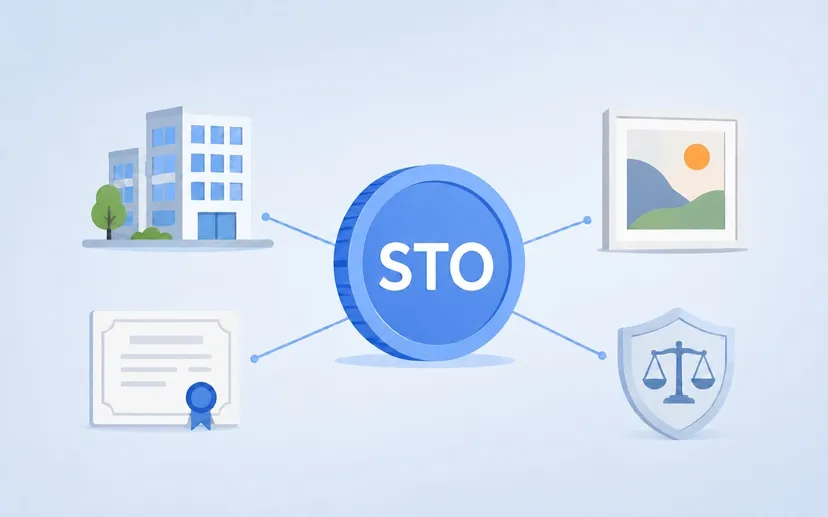
[비즈한국] The government has unveiled its policy plan for Security Token Offerings (STO) ahead of the scheduled implementation of the Capital Markets and Financial Investment Business Act (Token Securities Act) amendment in February 2027. Token securities refer to digital securities created using blockchain technology that allow for the fractional investment of assets such as real estate, artwork, high-quality beef (Hanwoo), and intellectual property rights. This policy outlines key institutional details, including issuance and distribution systems, investor protection standards, and a roadmap for building token security infrastructure.
The core objective of institutionalizing token securities is to expand investment targets. Retail investors can invest small amounts in assets that are difficult to purchase in their entirety—such as buildings, artwork, patents, and content royalties—while businesses can raise capital by securitizing the assets they hold.
Path Opened for Real Estate Fractional Investment, Artwork Still a Work in Progress
On the 3rd, the Financial Services Commission (FSC) held the 3rd meeting of the public-private joint token securities consultative body and announced the "Token Securities Policy Direction." The plan includes detailed standards for key issues, such as a roadmap for token security issuance infrastructure, model guidelines for fractional investment, a distribution system for over-the-counter (OTC) exchanges, the institutionalization of issuer account management, and guidelines for distributed ledger standards. While the terms "token securities" and "fractional investment" are often used interchangeably, token securities technically refer to the entire spectrum of securities issued via distributed ledger technology, such as blockchain, with fractional investment being one of its primary use cases.
The industry has paid close attention to the model guidelines for fractional investment. The plan currently only provides model guidelines for "non-monetary trust beneficiary certificates." Fractional investment products generally fall into two categories. One is "non-monetary trust beneficiary certificates," where physical assets like real estate are entrusted to a trust company, and investors receive a share of the profits. The other is "investment contract securities," where multiple investors pool money into specific assets or business projects, such as artwork or Hanwoo, and share the profits.
Under the guidelines for the basic asset requirements of trust beneficiary certificates announced by financial authorities in December 2023, firms dealing in non-monetary trust beneficiary certificates were previously unable to issue securities based on assets linked to uncertain events, such as land development projects or project financing (PF) loans, nor could they bundle multiple basic assets for issuance (pooling).
A notable feature of this new plan is that the issuance of "bundled fractional investment products" that group multiple assets together is now conditionally permitted. For instance, rather than including only a single property, multiple assets of a similar nature can be combined into a single investment product. This allows for risk diversification compared to investing in a single product and enables the inclusion of assets that are too small or difficult to value individually. The FSC stated, "Bundling is permitted under conditions such as assets being of the same type, clear criteria and purposes for pooling, a prohibition on including distressed assets, and the provision of information on individual assets."
Provided certain conditions are met, "future sales receivables"—the right to receive revenue expected in the future—can also be structured into fractional investment products. This structure uses as-yet-unrealized future earnings as the underlying asset. However, this is only possible if the product is based on stable underlying laws, the revenue is expected to occur in the near term, and investor protection mechanisms are in place.
Conversely, the current system for investment contract securities will be maintained. The authorities announced that they will conduct research to address issues related to the distribution of "shared-ownership investment contract securities" and the issuance of "business-type investment contract securities." Shared-ownership structures, where investors hold joint ownership of a physical asset, face limitations in distribution because changing ownership must comply with civil law. On the other hand, the primary issue with business-type investment contract securities is how to protect investor rights in the event of an issuer's default or bankruptcy. The industry refers to this as the "bankruptcy remoteness" problem, which involves separating issuer risk from investor assets.
Institutionalization Approaches, But Law Revision Still Pending
The policy also includes the tokenization of standardized securities such as funds, bonds, and stocks. The FSC presented a phased roadmap for building token security infrastructure. The roadmap is divided into three stages for both standardized and non-standardized securities, with the first stage commencing in February 2027 upon the implementation of the Token Securities Act. The FSC plans to first permit tokenization of products with relatively simple structures, like fractional investment products, before expanding to existing financial products with complex ownership relationships, such as funds, bonds, and stocks.
Given that fractional investment products are easier to tokenize than standardized securities, "public offerings" will be permitted starting from the first stage. This means retail investors will be able to invest in fractional investment products as soon as the token security system is implemented.
In contrast, for standardized securities with complex rights, the first stage will promote tokenization through private placement for institutions in the case of funds and bonds, and through trust-based methods for unlisted stocks. Following the implementation of the first stage, the FSC will pursue the second stage—which may include the tokenization of publicly offered securities—based on stability, efficiency, and market demand. In the third stage, the plan is to enable the settlement of securities transactions directly on the blockchain using stablecoins, known as "on-chain settlement."
Kwon Dae-young, Vice Chairman of the FSC, stated at the consultative body meeting on the 3rd, "We will not let token securities be limited only to fractional investment. Through a strategic and phased approach, we will establish a foundation where existing financial products like stocks, bonds, and funds can also be issued and traded in token form." He added, "We will connect the entire value chain of the capital market—including issuance, trading, and settlement—from the perspective of a unified digital capital market."
Meanwhile, as concrete policies emerge, the fractional investment industry is beginning to prepare according to the new guidelines. BuySell Standard, the operator of the token securities platform "PIECE," is preparing products based on intellectual property (IP) royalties and is exploring ways to diversify risk by creating portfolios that bundle patents from the same technology field.
Firms dealing in investment contract securities are facing deeper concerns. Kim Hyung-jun, CEO of Tessa, an art and solar power fractional investment firm, pointed out, "Although they said they would conduct research, the prevailing opinion is that it is difficult to resolve the civil law issues regarding shared-ownership products, so it is doubtful whether meaningful results will emerge." He added, "Tessa is preparing business-type investment contract securities products that address bankruptcy remoteness, but we are currently in a situation where there is no platform available to distribute these investment contract securities."
Non-monetary trust beneficiary certificates also require legislation for issuance, but the matter remains stalled in the National Assembly. An industry insider noted, "While a legal basis for the distribution of investment contract securities was established through a related law amendment last January, non-monetary trust beneficiary certificates are currently being issued indirectly through the Asset-Backed Securitization Act rather than the Capital Markets Act. An amendment to the Capital Markets Act that would provide a direct legal basis for issuance is currently pending in the National Assembly, but it has not yet reached the committee review stage."