

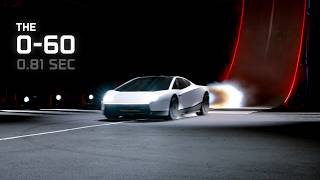
[비즈한국] A car drives up a ramp and continues along the ceiling, upside down. It then leaps into the air, rotates its chassis, and lands back on the ground. While it looks like a scene from a movie, this was an actual demonstration of the next-generation Roadster unveiled by Tesla in Texas on October 15 (local time). Tesla also showcased the car accelerating from a standstill to 60 mph (approx. 97 km/h) in just 0.81 seconds. The secret behind how the car moves this way isn't just because of a more powerful electric motor. Tesla has equipped the vehicle with fans that suck in air to pull the chassis onto the ground, and thrusters that spray high-pressure gas, much like a spaceship. In effect, they have bypassed the limits of "friction between tires and the road," a constraint cars have relied on for over 100 years, using different engineering principles.
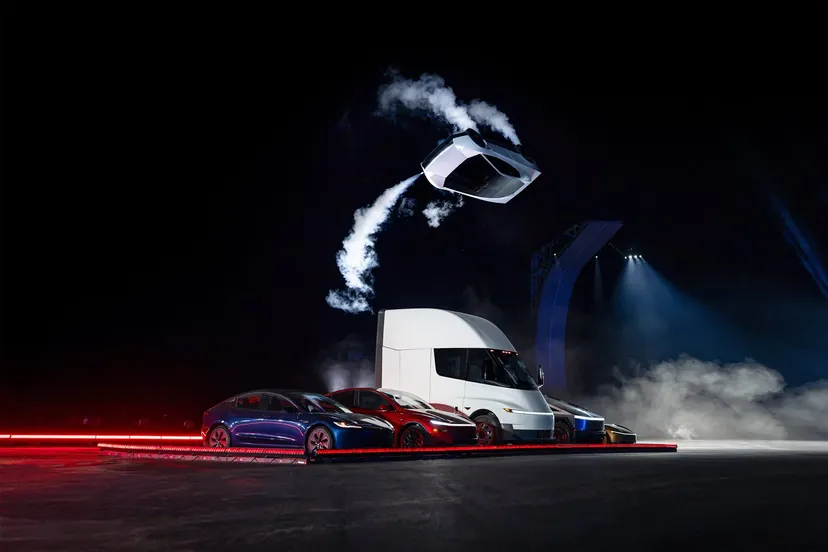
The next-generation Roadster unveiled by Tesla is divided into three main tiers: Performance, Thrust, and Rocket. The Performance model is a two-seater designed for road use, utilizing active aerodynamic devices and an under-chassis suction system. The Thrust model adds rear cold-gas thrusters to this configuration. The top-tier Rocket model reduces the seating to one, instead placing thrusters throughout the chassis to enable vertical, horizontal, and lateral movement, as well as mid-air rotation. Tesla stated the 0–60 mph acceleration time for the Thrust model is under 0.9 seconds, and under 0.59 seconds for the Rocket model, which is not approved for general road use. The goal for mass production is 2028.
Instantly releasing compressed gas instead of fuel
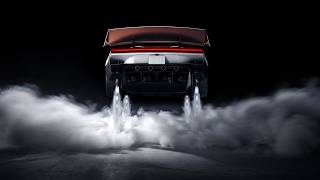
The principle behind the Roadster’s ability to lift into the air is surprisingly simple. A device called a "cold-gas thruster" rapidly ejects gas, which has been compressed and stored at high pressure, through a nozzle. Unlike conventional rocket engines that burn fuel and oxidizer to create hot combustion gases, there is no separate combustion process involved. As the stored compressed gas expands and escapes through the nozzle, the resulting reaction moves the car in the opposite direction. It is essentially applying Newton's Third Law of Motion to a car.
Spraying gas backward moves the car forward, and spraying it downward lifts it. By controlling the spray volume of the nozzles positioned at the front, back, left, or right of the car, the chassis can even be rotated in mid-air. The basic concept is the same as the Reaction Control System (RCS) used by spacecraft to change direction and orientation in space. SpaceX, led by Elon Musk, participated in the actual development of the Roadster. The unveiled Rocket model includes downward-facing nozzles for vertical thrust and additional nozzles for controlling the car's direction.
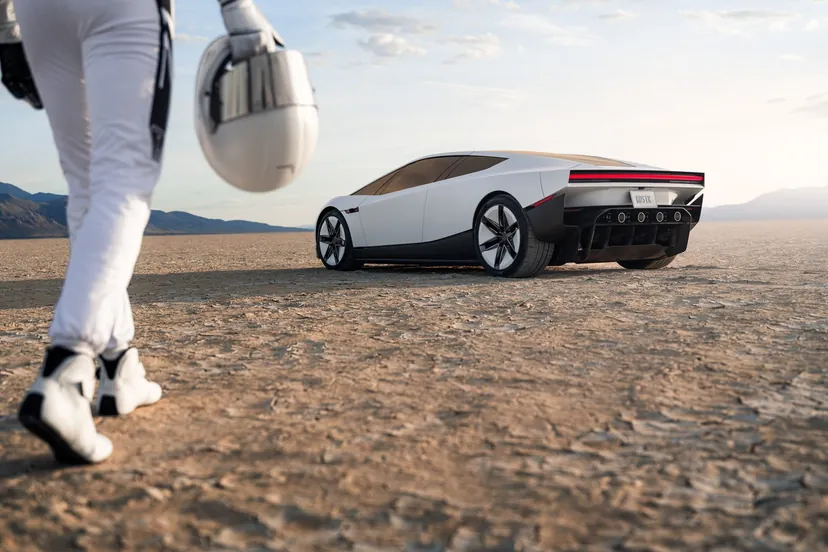
The device that stores this gas is a COPV (Composite Overwrapped Pressure Vessel). This technology, which involves wrapping a metal or airtight liner with high-strength composites like carbon fiber to withstand high pressures while reducing weight, is widely used in space launch vehicles. The pressure vessel in the Thrust model, verified by MotorTrend on-site, is about 200 liters in capacity and uses a pressure of up to 10,000 psi (approx. 69 MPa). Materials like titanium and Inconel were used for the piping connecting the pressure vessel to the nozzles. Because the car could rotate due to differences in side-to-side thrust if the gas does not reach all four rear nozzles at the exact same time, even the length of the piping was designed to be identical.
The problem is that the compressed gas cannot be used indefinitely. Simply put, thrust is proportional to the product of the mass of gas ejected per unit of time and its ejection speed. To lift a car weighing nearly several thousand kg, an enormous amount of gas must be released in a short time. For instance, if the vehicle weighs 1,700 kg, roughly 16.7 kN of vertical thrust is required just to hover in place on the ground. Even more thrust is needed to accelerate rapidly upward. Therefore, the Roadster's "flight" is closer to a method of jumping and changing attitude by concentrating the use of stored compressed gas for a few seconds, rather than flying for dozens of kilometers like an eVTOL that uses propellers.
The secret to driving upside down: The 'vacuum cleaner' principle
Just as interesting as the technology that lifts the Roadster is the technology that sticks the car to the ground in reverse. High-speed fans are installed underneath the vehicle. By using the fans to suck out the air between the chassis and the road, the pressure under the car is lowered, creating a pressure differential with the atmospheric pressure above the car. This pressure difference acts across the entire wide underside of the chassis, pressing the vehicle onto the road surface.
The principle is "pressure difference × area." While the rear wings or diffusers of regular sports cars also use airflow to create downforce, they only become effective at high speeds. The fans are different. They can lower the pressure under the chassis by spinning the motor even when the car is stationary. Tesla explained that the Roadster’s suction system can generate a force equivalent to up to approximately 2G. This is why, in the demonstration, the Roadster was able to climb a steep ramp and drive while hanging upside down, keeping its wheels pressed against the surface.
For example, if the chassis can be pulled toward the road surface with 2G of force, even when the car is hanging completely upside down, it can theoretically press its wheels onto the surface with 1G of force after subtracting 1G of gravity. However, as soon as the car moves away from the road, the efficiency of the fans drops sharply. This is because there must be space between the vehicle's underside and the road surface to maintain the pressure difference. In the end, the structure is designed so the fans hold the car to the ground, and the cold-gas thrusters take over once it leaves the ground.
The bottleneck for electric vehicle speed is tires, not the motor
The reason Tesla created such complex devices is related to the problems currently faced by high-performance electric vehicles. The power output of electric motors is already sufficiently high. The problem lies in the tires that must transmit that force to the road. Simply put, the maximum force a tire can transmit to the road surface is hard to exceed "μN," the product of the coefficient of friction (μ) and the force pressing the tire onto the road (N). No matter how much you increase the motor's power, if the tires slip, you cannot accelerate any faster.
The Roadster’s fan artificially increases N here. It strongly presses the car toward the floor, thereby increasing the very force the tires can transmit. The cold-gas thruster is even more radical. It pushes the car body forward directly without going through the tires at all. Even after the tires' grip reaches its limit, the thrusters can create additional acceleration. While existing cars pushed the limits of friction using better tires, all-wheel drive, torque vectoring, and aerodynamic devices, Tesla chose a method of obtaining some propulsion from devices unrelated to the road surface.
The 0–60 mph in 0.81 seconds revealed by Tesla in the demonstration highlights this difference even more dramatically. 60 mph is approximately 26.8 meters per second. To reach this in 0.81 seconds, the average acceleration must reach about 33.1 m/s², approximately 3.37 times the gravitational acceleration. Assuming a vehicle weight of about 3,750 pounds (1,700 kg), MotorTrend analyzed that if the rear electric motor uses the fan's downforce to generate about 32.3 kN of propulsion and the thrusters add about 19.8 kN, acceleration in the 0.8-second range is possible. However, 0.81 seconds is the figure Tesla presented in its demonstration so far, and it is not an official record measured by an independent agency.
Compressed gas can be refilled after use. Unlike chemical rockets that require the injection of special propellant from an external source, it can be refilled by using an electric compressor to re-compress the air. Ultimately, the starting point of the energy is the Roadster's battery. It is a structure that uses the electrical energy of the battery to turn a compressor, stores it in the form of high-pressure gas, and then discharges it in a short time when needed. In terms of energy efficiency alone, this is less advantageous than sending energy directly from the battery to the electric motor. Instead of being energy used efficiently over a long period, it acts as a "pneumatic booster" that creates an extremely high power output for a few seconds.
Should be understood as a 'technology showcase' rather than mass production
Along with the announcement, Tesla began accepting pre-orders for the Roadster. However, accepting pre-orders is separate from succeeding in mass production. There are many problems to solve. First, the ultra-high-pressure vessel around 69 MPa must be safely protected in the event of a collision, and safety issues when there are people or other cars in the direction the gas is sprayed must also be addressed. The noise and impact generated when ultra-high-pressure gas exits the nozzle, as well as the durability according to repeated charging/discharging of the pressure vessel, must also be verified. The "Rocket model" that lifts into the air touches upon not only automotive safety regulations but also the realm of aviation regulations. Tesla itself introduced the Rocket model as an invitation-only vehicle that is not approved for general road use.
Even considering economic feasibility, the possibility of the Roadster becoming Tesla's flagship model is low. Musk has also previously evaluated the Roadster as a business that does not significantly impact Tesla's performance. In the industry, the Roadster is viewed as a so-called "halo car" that symbolically showcases the manufacturer's technological prowess rather than for sales volume. In reality, Tesla is recently expanding its business scope to include autonomous driving, robotaxis, and humanoid robots. In this situation, it is difficult to see the reason for developing an ultra-high-performance sports car with limited sales volume over 10 years simply as a matter of sales.
Rather, the significance of the Roadster lies in the fact that it has changed the rules of the car performance competition. In the era of internal combustion engines, the basic formula for high-performance car development was to increase engine power, improve the transmission, and then transmit that power to the road through tires, suspension, and aerodynamics. In the electric vehicle era, as it became relatively easy for motors to create enormous torque in a short time, the bottleneck shifted from the power source to the tires. Tesla brought an answer from outside the automotive industry to solve that limit. They force the tires to stick to the ground with suction fans developed in racing cars, and they create the additional propulsion needed using cold-gas thrusters used in spacecraft.
Strictly speaking, the Roadster is different from the "car that flies through the sky to a destination" we have imagined. It has no wings or propellers and is not an efficient propulsion system capable of sustaining flight. However, Tesla has broken the premise that a car accelerates and changes direction only through four tires. On the ground, it sucks in air to hold the car, and in the air, it emits compressed air to move the car. The most interesting technology shown by the flying Roadster might not be the flight itself, but the fact that it stepped outside the boundaries of automotive engineering for the car to become faster.