

[비즈한국] With the institutionalization of non-face-to-face (telehealth) treatment scheduled for this December, both the medical community and the platform industry are pushing back against the government's proposed amendments to the enforcement rules. The medical community argues that the excessively broad scope for allowing initial visits could compromise patient safety, while the platform industry counters that the restrictions on prescription duration and the scope of treatment undermine the continuity of care for patients with chronic diseases. Amidst this, a medical informatics expert who has researched telemedicine for over 20 years suggests that rather than uniform prescription limits, the clinical discretion and accountability of physicians should be strengthened simultaneously.
The Ministry of Health and Welfare (MOHW) announced the legislative notice for the amendments to the "Medical Service Act Enforcement Rules" on the 19th. Non-face-to-face treatment is primarily intended for patients who have received face-to-face treatment at the same medical institution within the last six months for the same symptoms. However, first-time patients who do not meet this requirement can still receive non-face-to-face treatment at a primary care clinic if the patient's residence and the medical institution are located in the same city or province. Rare disease patients and type 1 diabetes patients are exempt from these regional restrictions.
The prescription limit for first-time patients is, in principle, within 7 days. However, if existing medical and prescription history is confirmed and the doctor acknowledges the need for continued treatment, a prescription for up to 30 days can be issued once. The proportion of non-face-to-face treatments per medical institution is limited to within 30% of total semi-annual visits, and per doctor to an average of 500 cases per month per half-year, excluding night and holiday treatments from the calculation.
KMA: "Too Permissive for First Visits and Hospitals," Demands Removal of 30-Day Prescription Exception
The Korean Medical Association (KMA) demanded a full reconsideration of the amendment on the 19th. The reason is that the four principles previously agreed upon—the principle of face-to-face treatment, focus on follow-up patients, focus on primary care clinics, and the prohibition of institutions dedicated solely to non-face-to-face treatment—have been undermined. The KMA argued that the subordinate legislation has excessively expanded the scope of first-time and hospital-level non-face-to-face treatments that were only exceptionally permitted by law.
First, it took issue with the plan to allow first-time non-face-to-face treatment across entire cities and provinces. The association argued that if an entire area like Seoul or Gyeonggi Province is bundled as a single treatable zone, it would be difficult to quickly connect a patient to a nearby facility for face-to-face care even if abnormal symptoms are discovered. The KMA demanded that the areas allowed for first-time visits be narrowed down to city, county, and district units, and that treatment outside the region be limited to unavoidable cases such as rare disease patients or those in correctional facilities.
They also opposed the clause allowing up to a 30-day prescription as an exception for first-time patients. The KMA emphasized that limiting the prescription period to 7 days for first-time patients who have not been examined in person is the minimum safeguard for patient safety. They argued that allowing a month's worth of medication without verifying progress could effectively nullify the 7-day prescription principle. Accordingly, they stated that the 30-day exception should be deleted, or if it must be acknowledged, it should be limited to within 14 days.
The expansion of non-face-to-face treatment eligibility to hospital-level medical institutions was also pointed out as a problem. According to the KMA, the amendment expands the scope of hospital-level care to include 14 types of exceptions for out-of-region treatment, post-procedure patients, chemotherapy and organ transplant patients, night/holiday minor treatments for children under 13, and clinical trial participants. The KMA maintains that hospital-level non-face-to-face treatment should be limited to patients exceptionally recognized by law.
The KMA also claimed there are loopholes in the limit on the number of cases intended to prevent institutions from operating exclusively for non-face-to-face care. While the amendment limits the proportion to 30% of total visits and 500 cases per doctor per month, it excludes treatments on weekday nights (after 8 PM), Saturday evenings (after 6 PM), and holidays. The KMA argued that these exceptions could allow for the operation of facilities essentially dedicated to night/holiday telehealth and demanded that such treatments also be included in the case count limits.
The KMA stated that if the government finalizes the amendment without keeping to the principles agreed upon with the medical community, they will carefully review whether or not their members should participate in non-face-to-face treatment at all.
Remote Medicine Industry Association: "7-Day Prescription Limit is Excessive," Fears Interruption of Chronic Disease Treatment
The Remote Medicine Industry Association (RMIA) also urged the Ministry of Health and Welfare on the 19th to fully reconsider the amendment. However, the reason is the exact opposite. They argue that if regional restrictions, limits on the proportion of visits per institution, and prescription day limits are applied simultaneously, patient accessibility to medical care could be excessively reduced.
In particular, the RMIA pointed out that limiting prescriptions for first-time patients to 7 days and allowing a 30-day prescription only once could undermine the continuity of care for chronic disease patients. This is because even patients who have been taking the same medication for a long time at other institutions may be classified as "first-time" patients at the medical institution they use for telehealth.
For example, even if a chronic patient receives a 30-day prescription via telehealth in January, prescriptions for the same medication would be limited to 7 days starting in February. According to a survey by the RMIA, 58% of telehealth users for chronic or managed diseases receive prescriptions exceeding 30 days. The RMIA argued that a situation could arise where a patient must receive at least 5 consultations to secure a 30-day supply of medication, increasing the burden on the patient regarding time and medical costs, as well as national health insurance expenditures.
They also raised the issue that the 30-day prescription exception is difficult to apply in practice. Currently, there is no system in place for medical institutions or platforms to check whether a patient has already received a 30-day prescription exception from another facility. The RMIA expressed concern that if medical professionals are held responsible for violating unverifiable conditions, doctors might avoid 30-day prescriptions altogether, effectively neutralizing the exception clause.
Disagreements over medication delivery also remain. The current amendment allows for the delivery of medication outside of pharmacies only for residents of islands and remote areas, long-term care benefit recipients, registered persons with disabilities, category 1 and 2 infectious disease patients, and rare disease patients. In principle, medication is to be delivered from pharmacies within the same city, county, or district as the patient’s address, though some exceptions are applied. It allows pharmacies to delegate delivery to professional couriers and has established accountability standards for identity verification, medication guidance, and delivery accidents.
However, the RMIA maintains that the scope for home delivery needs to be expanded, with safety measures in place, to increase medication accessibility for patients who have difficulty visiting pharmacies. Conversely, the Korean Pharmaceutical Association argues that rather than fully allowing medication delivery, it should be implemented limitedly for patients specified by law and its safety should be verified. The pharmaceutical association emphasized that a management system must be established first to prevent medication degradation or misdelivery during transport and to ensure safety from prescription to dispensing and delivery.
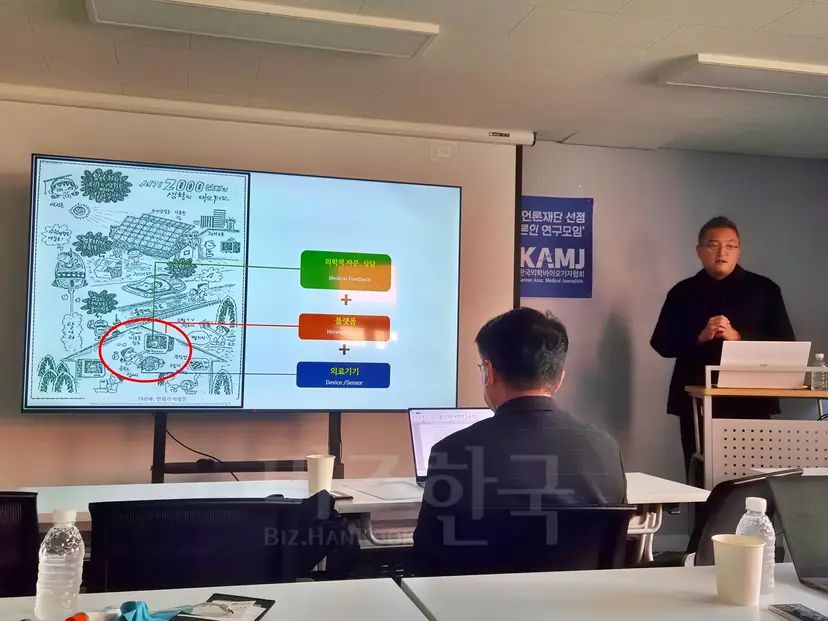
Professor Kim Hun-sung, a 20-Year Researcher of Telemedicine: "Give Doctors Discretion, But Hold Them Accountable"
Amidst this confrontation, Professor Kim Hun-sung of the Department of Endocrinology and Metabolism at the Catholic University of Korea Seoul St. Mary's Hospital questioned the approach of uniformly limiting the number of prescription days. Professor Kim, who has been researching telemedicine since 2002 and has participated in pilot project evaluation research, currently serves as Vice President of the Korean Society of Telemedicine and Director of the ICT Medical Convergence Center at Seoul St. Mary's Hospital.
At the Korea Medical & Bio Journalists Association Media Academy held at Sangyeonjae in Jung-gu, Seoul, on the 20th, Professor Kim argued that uniformly limiting prescription days to 7, 14, or 30 days holds little clinical significance. He explained that if a patient's condition is unstable, a doctor might prescribe only a one-day supply and recommend face-to-face treatment, but for a patient who has been taking diabetes medication long-term at another hospital, it should be possible to prescribe a 30-day supply based on the medical team's judgment.
He emphasized that while doctors should be granted autonomy in non-face-to-face treatment, inappropriate prescriptions should be strictly held to account. He stated that the medical team must sufficiently verify the patient's existing prescriptions and examination records and switch to face-to-face treatment if uncertainties arise during the consultation process.
At the same time, he strongly criticized the indiscriminate prescription of diet pills, hair loss treatments, and narcotic drugs. Professor Kim pointed out that acts where some doctors prescribe medication without sufficient examination or leave patients to be prescribed overlapping medications from multiple institutions must be strictly punished, and that medical staff who exploit non-face-to-face treatment as a means of profit should be held strongly accountable.
In fact, cases where loopholes in the management system during the prescription of medication through telehealth have been revealed. On the 7th, the pharmacist group "Pharmacists in Action" revealed a case where a patient was prescribed 90 days' worth of finasteride hair loss treatment from each of 7 different medical institutions on the same day, totaling a 630-day supply.
Regarding diet pills, according to data from Doctor Now released by Representative Baek Seon-hee of the Rebuilding Korea Party on the 6th, out of 735,285 applications for diet pill consultations, 683,872 cases (93.0%) involved the patient selecting the medication and dosage directly before the consultation. However, this refers to the selection rate at the application stage and does not necessarily mean the actual rate at which the medication was prescribed.
Professor Kim also expressed concern about the additional management fee of around 30% applied to non-face-to-face treatment. He stated, "The proportion of non-face-to-face treatment in total health insurance expenditures is merely a fraction," adding, "Arguments claiming that non-face-to-face treatment is bankrupting health insurance finances do not match statistical facts." At the same time, he noted, "The criticism that the intrinsic value of face-to-face treatment is undermined if telehealth receives excessively higher compensation is valid," pointing out that "even overseas, there are almost no cases where telehealth fees are consistently set higher than face-to-face fees."
The Ministry of Health and Welfare plans to finalize the amendment to the Medical Service Act enforcement rules after collecting opinions until November 9. The effective date for the revised Medical Service Act is December 24.