

[비즈한국] Han Kuang 42. This is the largest military exercise that Taiwan has conducted annually since 1984 to prepare for a potential armed invasion by the Chinese military. It takes place across Taiwan every summer, and this year’s exercise ran from the 5th to the 14th. While Han Kuang 42 is similar to South Korea’s ‘Ulchi Freedom Shield’ joint exercise, it differs in scale, location, format, and content. I covered the Han Kuang 42 exercise on-site and observed the actual training grounds.
Tactical Maneuvers Next to Restaurants… The Entire Big City as a Training Ground
The exercise was held simultaneously not only in coastal areas and villages but also in major cities such as Taipei, Kaohsiung, Taichung, and Taoyuan. Troops were deployed throughout city centers, and surface-to-air missiles, tanks, and armored vehicles were on the move.
During a night-time airport defense drill, authorities even blocked the underpass at the entrance to Songshan Airport in the heart of Taipei and fired blank rounds. Soldiers conducted tactical maneuvers and set up barricades right next to where citizens were eating or driving. In front of a university auditorium, training was held for handling mass casualties, involving the treatment and evacuation of the injured.
However, live-fire exercises involving guns, cannons, and missiles were strictly excluded. This was done both to avoid excessively provoking China and to prevent safety accidents, as the training was conducted in civilian residential areas.
Close Access to Secret Operations… Full Disclosure of Training Sites
The fact that the training was open to the public was also noteworthy. Numerous journalists, civilian military enthusiasts, and local residents watched the exercises without needing separate press credentials. Any citizen could take photos, and footage from the field was shared in real-time through the media and social media.
In particular, registered reporters who accompanied the training sites were able to closely cover even secret special operations under the title of ‘embedded journalists.’ They delivered vivid reports and footage from the field while adhering to minimal military security guidelines.
The True Purpose of ‘No-Script’ Training: Preparing for Command Paralysis
This exercise was conducted in a so-called ‘no-script’ manner. Wellington Koo, the Minister of National Defense of Taiwan, described the nature of the Han Kuang 42 exercise as “an exercise with a situation, but without a script.”
At first, it was hard to believe, but as I observed it on-site, the tasks the soldiers had to perform changed continuously, and commanders had to make decisions in real-time according to evolving crisis situations. Given the strength of the Chinese military, the command and control functions of the Taiwanese military headquarters could be paralyzed in an emergency; therefore, the goal was to cultivate the ability for field commanders to carry out operations independently.
Runway Excursions and Martial Law Controversies: The ‘Flaws in the Jade’
Of course, the exercise was not without accidents and controversies.
As numerous units moved simultaneously across the country, minor incidents followed. An F-16V fighter jet slid off a runway due to a wet surface, and an M60A3 tank had an incident where an emergency escape hatch on the bottom of the hull fell off while moving through the city. There was even an accident where a civilian contractor dropped a 203mm artillery shell while moving it onto a truck.
There were also political controversies. As military police, engineers, and armored units maneuvered and conducted blank-fire training in downtown areas like Taipei, the opposition Kuomintang (KMT) protested, calling it “fake exercises, real martial law.” A drill that blocked all internet access except for emergency calls, intended to test responses to Chinese cyberattacks, also drew complaints from citizens.
The South Korean Military Must Verify the Most Uncomfortable Scenarios
Watching the Han Kuang 42 exercise, I felt that there are many elements that the South Korean military, facing the threat of North Korea, can learn from.
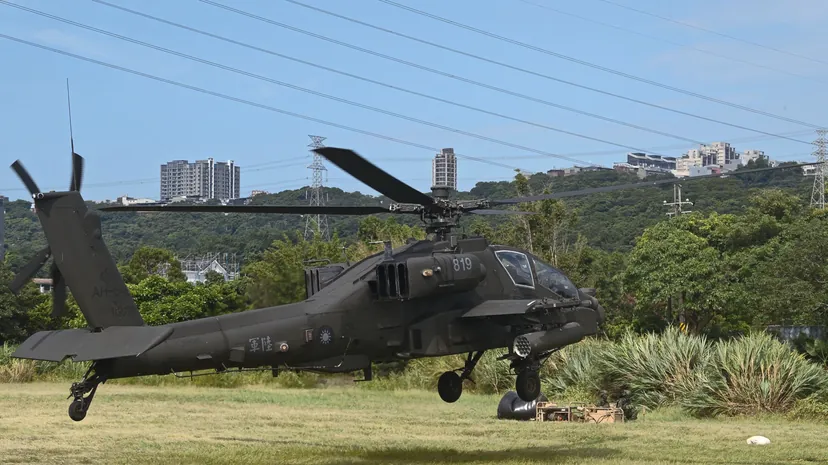
Training scenarios such as assuming the destruction of a helicopter base by Chinese missile attacks, using transport helicopters to ferry aviation fuel and weapons from rear areas, utilizing the middle of a park as a refueling base for attack helicopters, and moving Sky Bow surface-to-air missiles to various urban locations to evade air raids are all worth noting for our military as well.
The South Korean military, which is preparing for the transition of Wartime Operational Control (OPCON), also needs the courage and resolve to carry out no-script exercises in front of the eyes of its citizens.
Of course, this process may lead to political controversy or reveal loopholes such as safety accidents. However, the experience gained through such training is an asset that can save citizens' lives in actual combat.
Before the transition of OPCON, the South Korean military must also honestly verify its most uncomfortable scenarios. An unprepared OPCON transition could result not in the restoration of sovereignty, but in the exposure of critical security vulnerabilities.