

[비즈한국] The Trans-Siberian Railway (TSR) has been a reliable land route utilized by South Korea and other Asian countries for sending freight to Europe. Crossing the Russian territory horizontally, this route can reduce transit time by approximately 50% compared to maritime transport, serving as a vital artery for high-value cargo such as automotive parts and electronics, where delivery timing is critical.
However, the war in Ukraine, which broke out in February 2022, forced a complete revision of the existing logistics formula. As Western nations imposed heavy financial and economic sanctions on Russia, global shippers and exporters faced risks in transportation plans transiting through Russian territory. Furthermore, the war-related insurance premiums surged in the wake of anti-Russia sanctions, putting the brakes on the use of the TSR.
According to statistics, the cargo volume handled by the TSR plummeted by more than 50% year-on-year after the war, reaching a state of paralysis. With the northern rail line, once considered a safe asset, blocked, the trade industry found itself at a crossroads, forced to secure alternative supply chains that do not pass through Russia.
The Middle Corridor: Spotlighted by the Russia-Ukraine War
As the northern route was blocked and maritime shipping also saw freight rates fluctuate due to geopolitical risks, such as Houthi rebel attacks in the Red Sea preventing the use of the Suez Canal, the eyes of the logistics market naturally turned to detour routes.
This is why the ‘Middle Corridor,’ which cuts through Central Asia—the southern end of Russia—and the Caspian Sea to reach Europe, has emerged as effectively the only viable land alternative. Once ignored due to the inconvenience and inefficiency of transshipment, this route has been re-evaluated as a "relief pitcher" capable of preventing the chain collapse of global supply chains. This path, which was the grassland route of the ancient Silk Road, has been revived as a new Silk Road amidst the flames of war.
Among trade enterprises, an alarm has spread that relying solely on a single route leads to an immediate shutdown during a crisis. Accordingly, moves to incorporate the Middle Corridor—which bypasses Russia—into portfolios for the purpose of risk diversification and stable delivery management are accelerating.
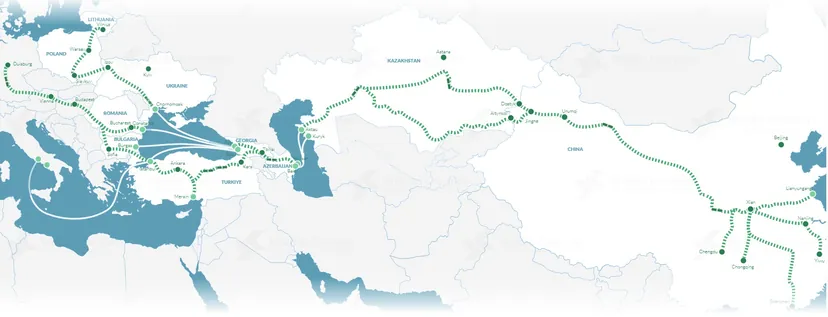
The main route of the Middle Corridor is the ‘Trans-Caspian International Transport Route (TITR).’ Starting from China, it is a large-scale logistics route that passes through inland Central Asian countries such as Kazakhstan and Uzbekistan, crosses the Caspian Sea by ship, and connects to the European mainland via Azerbaijan, Georgia, and Turkey. Unlike the Trans-Siberian Railway, which passes through a single railway network in a single country—Russia—the Middle Corridor must pass through at least 5 to 6 different borders.
In particular, since it is necessary to cross the massive Caspian Lake located in the middle of the route, containers must be frequently transferred from rail to sea, and then from sea back to rail. For this reason, the competitiveness of the entire Middle Corridor route hinges on the efficient operation of a multimodal transport system that organically combines various modes of transport.
Explosive Growth in Cargo Volume… Pushing for Administrative One-Stop Services via TRACECA
As geopolitical crises become a constant, the transport indicators of the Middle Corridor are recording explosive growth. Once a minor alternative with an annual cargo volume of only 350,000 tons, the Middle Corridor has surged nearly 12-fold to approximately 4.5 million tons per year as of 2024, following the full-scale entry of global shippers after the war. The scheduling of freight trains through the Central Asian interior has been regularized, and the number of dockings at ports along the Caspian Sea has increased. Having solidified its position as the shortest detour connecting the West and Asia, it has become an emerging trade route where cargo moves most dynamically across the Eurasian continent.
As cargo volume exceeds threshold levels, global capital and institutional investment are being concentrated to resolve supply chain bottlenecks. According to a 2023 World Bank report on the Middle Corridor (Middle Trade and Transport Corridor—Policies and Investments to Triple Freight Volumes and Halve Travel Time by 2030), if infrastructure upgrades continue, annual cargo volume is expected to reach 11 million tons by 2030, supporting the need for large-scale investment.
The central axis of this infrastructure improvement is the ‘TRACECA (Transport Corridor Europe-Caucasus-Asia)’ cooperation structure. This international cooperative body, in which the European Union (EU) and countries along the Black Sea and Caspian Sea participate heavily, is leading efforts to lower different tariff barriers between transit countries and streamline administrative procedures into a one-stop system. Recently, TRACECA member countries agreed on the full digitization of cross-border customs documents and the integration of electronic cargo tracking systems, and are not sparing investments in the dredging of major hub ports and the double-tracking of railways.
Kwon Oh-kyung, a professor in the Division of Asia-Pacific Logistics at Inha University, stated, "The Middle Corridor is highly valuable as an emergency alternative route to avoid risks when bottlenecks in international logistics networks occur," adding, "Since countries around the Middle Corridor are rich in resources, an approach from a supply chain perspective that goes beyond simply borrowing the route to combine resources and manufacturing is necessary."
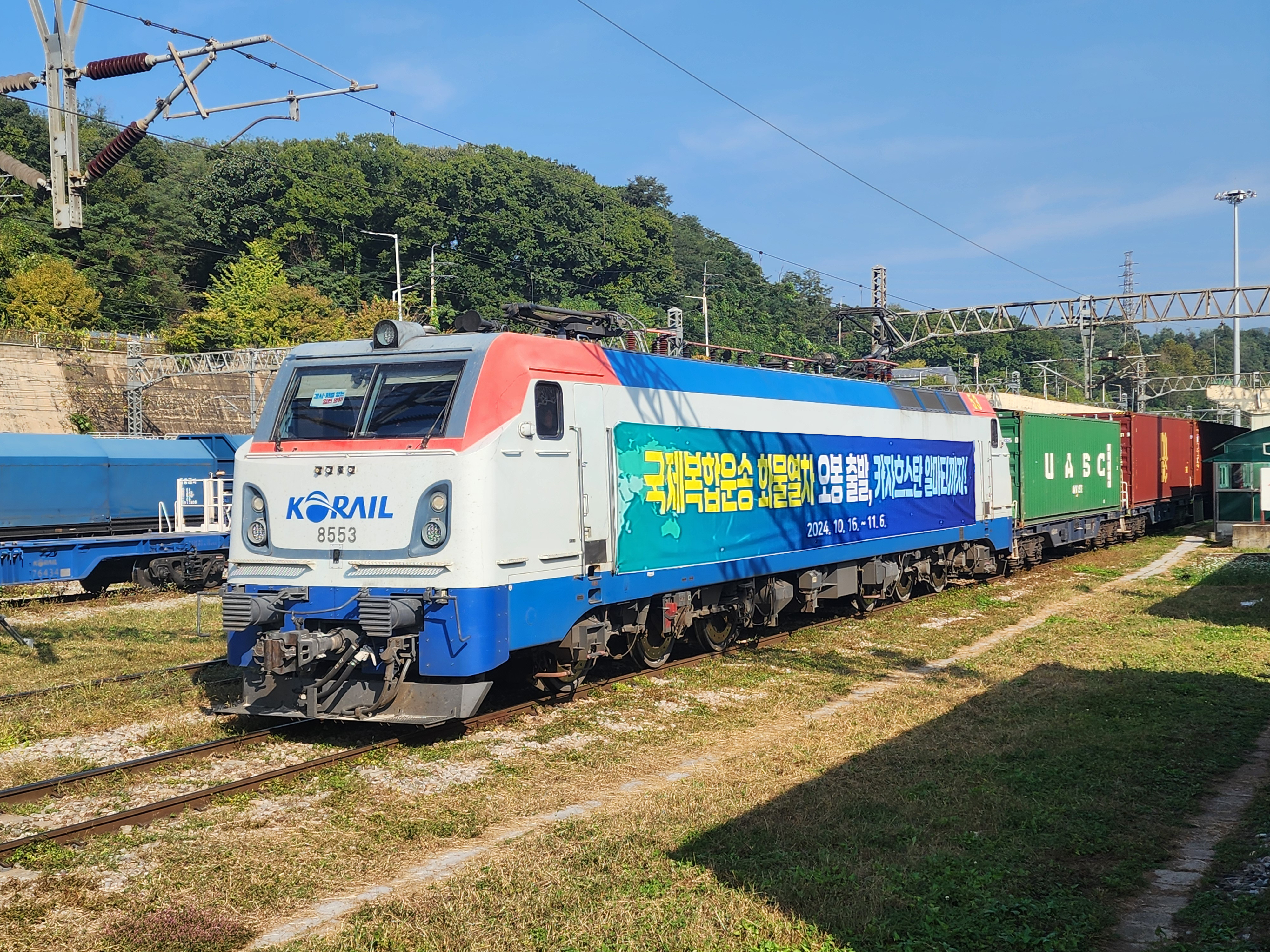
Amid the major shift in the global logistics landscape, KORAIL has also captured the strategic value of the Middle Corridor and has begun to take full-scale steps to preempt the route. KORAIL has been pursuing a continental railway network linkage project to resolve the logistics bottlenecks toward Europe and Central Asia that domestic export companies are experiencing.
To prove its effectiveness as an actual business model, KORAIL conducted the ‘Korea-China-Kazakhstan-Uzbekistan Multimodal Transport Pilot Project’ in 2024. In this pilot project, domestic cargo departing from Obong Station in Uiwang, Gyeonggi-do, was loaded onto ships at Busan Port, transported by sea to Lianyungang, China, and then moved by land to Almaty, Kazakhstan, and Tashkent, Uzbekistan, in connection with the Trans-China Railway (TCR) route. As a result of four empirical tests, it achieved the milestone of reducing the transport period, which previously took over a month, to as little as 19 days.
“Large Gap in Class to be a True Alternative”: Limitations of the Middle Corridor
However, the structural limitations and vulnerabilities of the Middle Corridor must also be clearly addressed. While the short-term cargo volume growth rate is steep, there is still a clear gap in class in terms of economic feasibility and absolute infrastructure capacity compared to the Trans-Siberian Railway, which previously handled the core of Eurasian cargo, or full-scale maritime routes centered on large container ships. Logistics experts unanimously point out that many hurdles remain to be cleared before it can fully take root as a long-term, official trade route.
The most fatal limitation is the lack of total transport capacity. Although the Middle Corridor’s annual cargo handling capacity has grown to the 4.5 million-ton level, this is significantly less than the tens of millions of tons handled annually by the Trans-Siberian Railway before the war. With too many single-track sections across the entire route, making it difficult for trains to pass each other, and an absolute shortage of locomotives to pull cargo and freight cars to load containers, it has the weakness of not being able to handle everything if shippers' demand were to concentrate at once.
The inefficiency of multimodal transshipment resulting from the Trans-Caspian structure is also a problem. Because the process requires transshipping cargo from trains to ships at ports, crossing the sea, and unloading from ships back to trains at least twice, the risk of damage to goods increases, and time delays and additional costs such as transshipment storage fees inevitably occur. Furthermore, the existence of the broad-gauge (1520mm) system in the former Soviet region mixed with the standard-gauge (1435mm) system in Europe and China adds technical complexity, requiring reloading at every border station and worsening bottlenecks.
The fact that there are many transit countries is also an administrative and geopolitical risk factor. Unlike the Siberian route, which operated within a single national administrative network, the Middle Corridor passes through multinational territories including China, Kazakhstan, Azerbaijan, Georgia, and Turkey. This means that every time cargo crosses a border, it is subject to different customs regulations, clearance procedures, and tariff rates. Although standardization through the TRACECA system is underway, it is a fragile structure where the entire logistics system can be paralyzed like dominoes if any one country experiences bureaucratic administrative delays, political unrest, or border conflicts.
The Middle Corridor is also criticized from the perspective of ESG (Environmental, Social, and Governance), which has become a key decision-making criterion for global companies. There have been reports of environmental destruction, with claims that the process of forcibly expanding ports along the Caspian Sea and building railways to handle the surging cargo volume is seriously damaging the surrounding inland sea ecosystem. In particular, large-scale dredging work combined with the inherent decline in the water level of the Caspian Sea is cited as a factor threatening marine biodiversity.
In addition, organizations like the Business & Human Rights Resource Centre (BHRRC) have pointed out poor working environments and violations of basic rights for workers at infrastructure construction sites and railway operations in some transit countries. For the Middle Corridor to be recognized as a sustainable core route beyond a temporary detour, it faces the long-term challenge of resolving these structural limitations and external ethical criticisms.
![[Supply Chain Detours] ① Finding Another Way to Avoid War and Climate Disaster](https://s.bizhankook.com/attachments/2026/07/12752f5971a9_639505e7.jpg)
![[Supply Chain Detours] ② Expectations and Concerns Surrounding the 'Trans-Mexico Railway' as an Alternative to the Panama Canal](https://s.bizhankook.com/attachments/2026/07/a7e020919bbb_9ef3d72b.jpg)
![[Supply Chain Detours] ③ How the Hormuz Blockade Reshaped the Maritime Logistics Map](https://s.bizhankook.com/attachments_webp_no_wm/2026/07/134357_no_wm_d75f72f0.webp)
![[Supply Chain Detours] ④ Is the ‘Middle Corridor,’ Spotlighted by the Russia-Ukraine War, the New Silk Road?](https://s.bizhankook.com/attachments_webp_no_wm/2026/07/134633_no_wm_84fcb68e.webp)