

[BizHanKook] The government has officially launched the legislative process for the ‘Ultra-Wide Special Zone Act,’ which contains the largest scale of deregulation in a single piece of legislation in history. The goal is to support the operation of the ‘3 Mega-Projects’—represented by robots, semiconductors, and AI data centers—and to lead balanced national growth driven by local regions. The business community has welcomed the move, stating that it will serve as a catalyst for attracting large-scale investment and driving technological innovation amid the global tech hegemony race. Conversely, 134 civil society organizations, including labor, farmer, environmental, and human rights groups, have called for an immediate withdrawal of the bill. They are clashing head-on with the government, labeling it an ‘Ultra-Wide Destruction Act’ that rolls back labor rights, destroys the environment and ecosystems, and provides special privileges to large conglomerates.
On October 20, Representative Park Sang-hyuk of the Democratic Party of Korea, and on October 21, Representative Choi Ki-sang of the same party, respectively sponsored the ‘Special Act on the Designation and Operation of Ultra-Wide Strategic Industry Special Zones for Locally-Led Growth’ (Ultra-Wide Special Zone Act). This act turns the previously common term ‘Mega-Special Zone’ into a legal term, forming a massive special bill composed of approximately 260 articles.
The fundamental background for this bill lies in the intensifying concentration of population and high-tech industries in the capital region, the rapid weakening of industrial bases in non-capital regions, and the resulting crisis of regional extinction. The government and the ruling party’s diagnosis is that existing R&D special zones, opportunity development zones, and regulation-free zones were operated in a fragmented manner, divided by individual ministries and purposes, thus failing to meet the complex demands of companies planning large-scale investments or keep pace with the speed of rapid technological change. Consequently, the intent is to build a ‘bottom-up’ institutional foundation where regions and companies work as a team to lead the planning of growth engines at an ultra-wide scale, with the government providing all-out support.
The core content of the Ultra-Wide Special Zone Act is divided into three types of deregulation and a comprehensive policy package. The first is a ‘menu-style regulatory special case.’ It contains about 320 regulatory exemption/relaxation cards—the largest in a single bill—covering land use, permits, environmental regulation easing, energy infrastructure, and fiscal/levy exemptions. The second is the ‘demand-responsive regulatory suspension,’ introduced for the first time in the country. Even if a regulation is not included in the 320-item menu listed in the bill, if a company and a local government apply, the government can suspend or relax the effect of the regulation after a review. The third is an ‘upgraded regulatory sandbox’ that significantly shortens review periods and provides flexible periods for demonstration. These are bundled with pan-governmental support measures, such as the establishment of special growth engine subsidies granted during large-scale investments, the expansion of the National Growth Fund, the installation of brand-name university departments, and various tax and levy reductions.
Government: “Bold Regulatory Innovation”; Business Community: “Speed and Flexibility are Key”
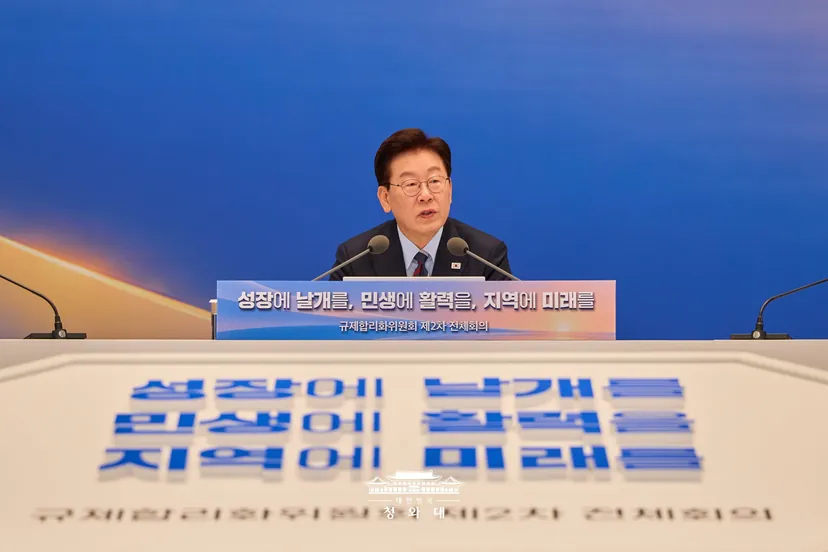
The government is fleshing out its plan to anchor high-tech industrial ecosystems in local regions early through the Ultra-Wide Special Zone Act. President Lee Jae-myung emphasized at the 2nd plenary session of the presidential Regulatory Rationalization Committee held at the Blue House Guest House on October 23, “We must quickly and boldly improve outdated or inconvenient regulations that block the development of new technologies and new industries.” He added, “We have entered an era where decentralization and fair distribution increase efficiency, rather than the old way of pouring scarce capital and opportunities into the capital region.” He further urged the National Assembly for swift legislative review, stating, “We must ensure that young people born and raised in our regions do not have to leave for the capital region for jobs, but can work and start families locally.” The government is concurrently making administrative preparations, such as drafting enforcement decrees, with the goal of designating at least one ultra-wide special zone in every region across the country by the first half of 2027 once the bill passes.
The business community has clearly expressed its welcome. In a statement, the six major economic organizations, including the Korea Chamber of Commerce and Industry and the Korea Enterprises Federation, stated, “We welcome the proposal of the Ultra-Wide Special Zone Act for balanced regional growth and the fostering of national strategic industries, and we will strive to increase corporate investment and employment in regions in accordance with the intent of the law.” On the other hand, they noted, “Labor special cases included in the bill, such as exemptions on working hours for R&D work, the expansion of settlement periods for selective working hour systems, and the extension of employment periods for fixed-term workers, are essential elements for enhancing competitiveness in the increasingly fierce global industrial competition. It is regrettable that the bill was announced without the labor special provisions, which may make it difficult to achieve the legislative purpose of the Ultra-Wide Special Zone Act.”
In particular, the Korea Enterprises Federation requested active attention and cooperation from the National Assembly and the government, stating, “As the success of the ultra-wide special zone depends on ‘speed’ and ‘flexibility,’ the business community actively welcomes the government’s regulatory rationalization measures—such as working hour exemptions for high-income R&D personnel, the introduction of a fast-track for semiconductor permits, the creation of foundations for robot demonstration and commercialization, and the easing of key regulations for autonomous driving and bio—as essential measures for securing global competitiveness.”
Civil Society Strongly Opposes: “A Law for Capital That Devours Everything”
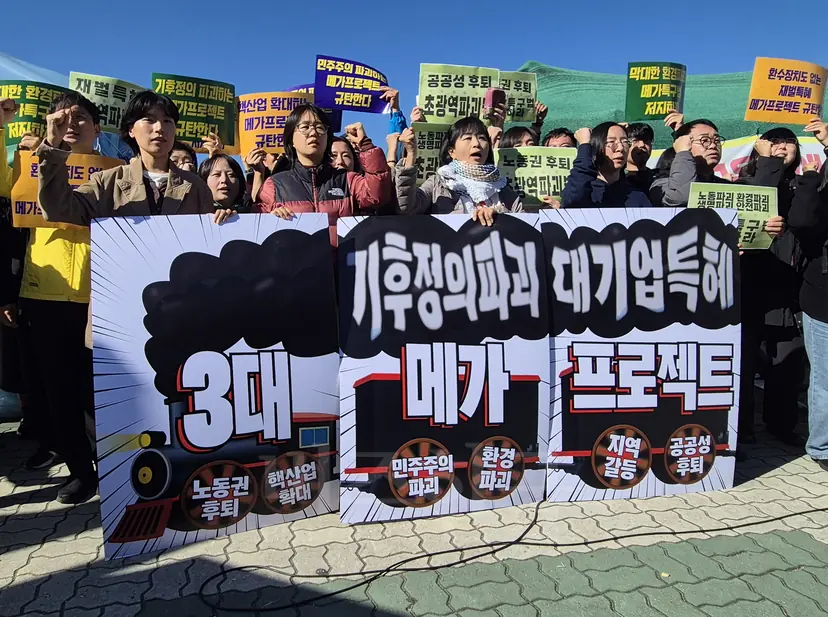
On the other hand, the backlash from civil society, composed of labor, farmers, environmental, and human rights groups, is fierce. The ‘Joint Action for Blocking the Mega-Special Zone Special Act and Denouncing the 3 Mega-Projects’ (Mega-Denunciation Action), formed by 134 organizations including the KCTU, FKTU, Korean Peasants League, Korea Federation for Environmental Movements, and Green Korea United, held a large-scale press conference in front of the National Assembly on October 27, demanding a total nullification of the bill.
They criticized that most of the 260 articles of the Ultra-Wide Special Zone Act include provisions stating “notwithstanding any other law,” effectively neutralizing fundamental rights and safety devices that our society has built over a long time in an instant.
Jeong Rok, an activist with the Climate Justice Alliance, who delivered the keynote speech, raised his voice: “The plan for the government to take the lead in supplying the electricity, water, land, and labor needed for conglomerates to invest hundreds or thousands of trillions of won to build semiconductor factories and data centers is precisely this Ultra-Wide Special Zone Act. It is not a project for a dignified and equal life that everyone wants to enjoy, but a law solely for greedy capital that devours everything, and a law that turns non-capital regions into lawless zones for capital.”
Civil society groups pointed out a structural contradiction where development profits are monopolized by large corporations and private investors, while the risks and side effects are passed on entirely to the local community and the public. They argued that by allowing local governments to accept corporate special zone proposals without special reasons, the bill excludes the decision-making power of residents, and opens the way for the privatization of public assets by allowing state-owned properties to be leased long-term through private contracts for up to 50 years.
Along with this, criticism was raised that the inclusion of special cases for the opening of medical institutions by foreign-established corporations in Article 104 of Representative Park Sang-hyuk’s bill is the “start of medical privatization through the permission of for-profit hospitals.” The provision allowing the collection of location and video information of unspecified multiple people without separate review for the purpose of AI learning was also pointed out as a serious infringement of information human rights.
The point of the most acute conflict is the ‘labor special provisions’ stipulated in Articles 132 to 134 of Representative Park Sang-hyuk’s bill. Labor circles define these clauses as effectively the “legalization of death from overwork and free labor.”
Representative Park’s bill allows for exceptions for R&D and top 3% high-income professionals by excluding them from the 52-hour weekly limit and overtime/night/holiday work allowances under the Labor Standards Act, and even abolishing the duty to record working hours. This is the so-called ‘Korean-style white-collar exemption.’ Article 133 intends to extend the settlement period of the selective working hour system, currently at a maximum of 3 months, to 6 months. According to labor analysis, this makes it possible to work ultra-long hours reaching ‘80 hours per week’ for up to 16 consecutive weeks in a specific period. This figure far exceeds the current criteria for industrial accidents related to cerebrovascular and cardiovascular diseases (average of over 60 hours per week). On top of this, a special case extending the usage period of fixed-term workers from the current 2 years to 4 years is included. This is why criticism is emerging that it will entrench non-regular workers and encourage the practice of mass layoffs.
Ham Jae-kyu, Vice Chairman of the KCTU, emphasized, “By abolishing the duty to record working hours through the Korean-style white-collar exemption, they are even trying to prevent proof of death from overwork, and by expanding the selective working hour system, they are legalizing murderous labor.” He added, “What is needed now is not deregulation competition, but safe jobs, reduced working hours, expansion of direct employment, and strengthening the responsibility of prime contractors. Instead of deregulation, we hope you will create ‘Good Job Special Zones’ that mandate direct employment for regular and continuous work and targets for regional and youth employment.”
Ryu Je-gang, head of the FKTU Policy 2nd Division, also pointed out, “Proposing a bill including labor special provisions before full-scale discussions have even begun is an act that violates pre-confirmed principles and seriously undermines the trust of social dialogue.” He criticized, “Lowering labor standards for the sake of corporate investment and strengthening industrial competitiveness can never be justified, and growth achieved by rolling back basic labor rights is not sustainable.”
In response, the Ministry of Employment and Labor explained in a press briefing, “Regarding the labor special provisions of the Ultra-Wide Special Zone Act, we have held five ‘one-point social dialogues’ at the working-level consultative body level with labor, management, and relevant ministries.” They added, “The government has not decided on whether to introduce them or the specific methods in advance, and we are not considering a unilateral revision of the enforcement decree.” Government-related ministries, including the Ministry of Trade, Industry and Energy, also announced a policy to faithfully reflect the results of the deliberation of the social dialogue among labor, management, and government during the National Assembly’s combined review process. The six major economic organizations announced that they would devise reasonable compensation systems, such as restructuring wage systems, through consultations between workers and employers, and would also seek ways to guarantee workers’ health rights.
Criticism also poured in regarding ecological preservation and climate crisis response. To speed up development projects, the bill includes provisions that drastically shorten the environmental impact assessment consultation period to 30 days for strategic environmental impact assessments and 45 days for environmental impact assessments, and limit requests for supplementary evaluation reports to one time. Additionally, easing of activity restrictions within development-restricted areas (Greenbelts), easing of standards for mountain conversion, and exemptions for various environmental costs such as ecosystem preservation levies, alternative forest resource creation fees, and environmental improvement charges are applied in a lump sum.
Jeong Gyu-seok, Secretary-General of Green Korea United, pointed out, “Environmental impact assessment is the minimum safety device to verify the environmental damage caused by development in advance and hold the cause-provider responsible, but the government and the National Assembly are obsessed only with how quickly they can end the consultation rather than the faithfulness of the assessment.”
In the energy sector, an inequality structure where the public supports the massive power consumption of semiconductor clusters and AI data centers was pointed out. Critics argue that while the government reduces power industry base fund levies for large corporations and allows direct power purchase agreements (PPA) so that they can take only the sweet parts of cheap electricity, the burden of transmission network overload and system stabilization costs is passed on to the state-run Korea Electric Power Corporation (KEPCO) and the general public.
Lee Young-kyung, Secretary-General of Energy Justice Action, criticized, “The most serious thing is the destruction of energy publicness. While presupposing enormous power demand, they haven't asked companies for a single obligation to reduce greenhouse gases. Instead, they give large corporations reductions in power industry base fund levies and give special privileges to private dedicated power supply operators, allowing them to monopolize profits.” She added, “They are passing on the risk of power grid overload and blackouts, or the costs of backup power and grid stabilization, entirely to KEPCO, a state-run company, and the public. It is a structure where companies take the profits and pass the risks to the public.”