

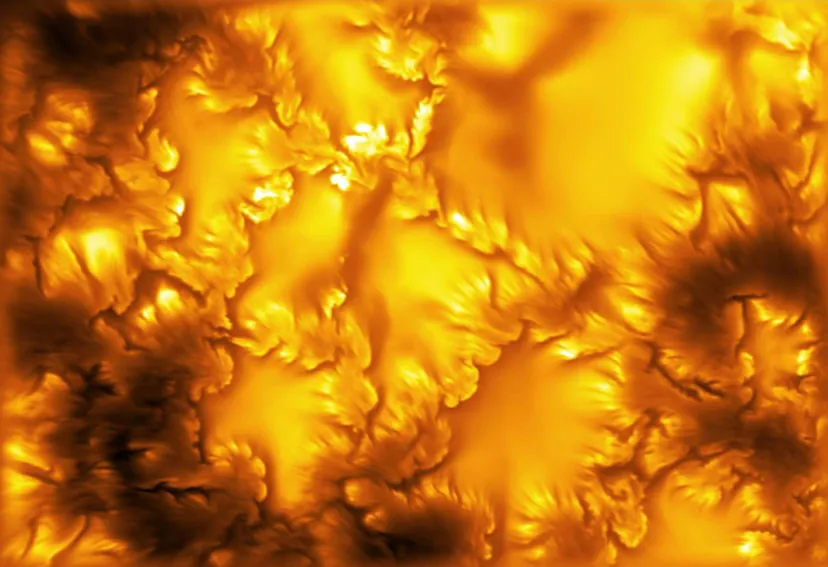
[BizHanKook] What you see on the screen now is not a painting by Van Gogh. Massive, yellowish lumps are bubbling and moving, while black streaks and small vortices constantly form and vanish in between. Turbulence, which one might expect to see in the atmosphere of a gas giant like Jupiter or Saturn, is unfolding on the surface of the Sun, which is composed of plasma. This is neither an artist’s impression nor computer graphics. It is the most detailed look at the solar surface ever captured by humanity.
The Sun is effectively the only star where we can spatially resolve and examine the fine details of its surface. Even with the largest telescopes, most other stars appear as little more than a single shining dot. However, the Sun is only about 150 million kilometers away from Earth—a mere 8 minutes away at the speed of light. Thanks to this, we can directly observe how the stellar surface moves, how plasma and magnetic fields entangle, and how that energy leads to solar flares.

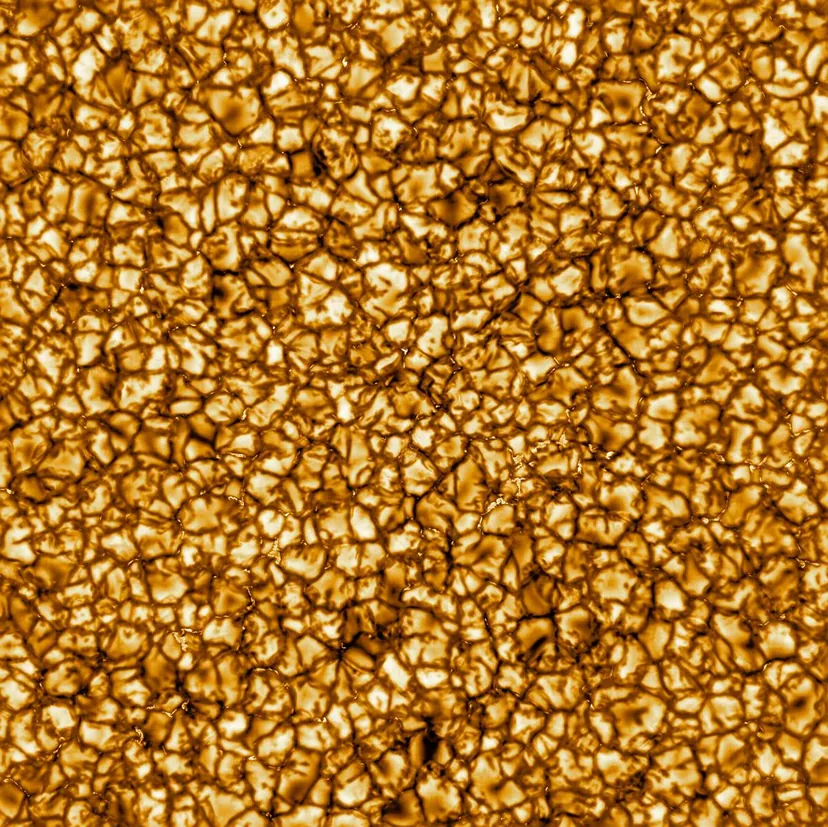
Of course, the Sun does not have a solid surface like Earth where one could set foot. What we call the solar surface is the "photosphere." It is the layer where light escaping from the Sun’s interior is no longer trapped by plasma and begins to be emitted into space. The temperature of this photosphere reaches about 5,800 Kelvin. The bright and dark grains filling the screen are called "granules." Each granule typically ranges from 500 to 2,000 kilometers in diameter. They may look like small cells, but in reality, each one is large enough to cover the entire Korean Peninsula.
In the bright areas, hot plasma from the Sun’s interior rises to the surface. Once the plasma reaches the surface, it releases its energy as light, cools down, and sinks back down along the dark boundaries between the granules. This is convection, similar to how hot water rises and cooler water sinks in a boiling pot. However, on the Sun, because the moving substance is charged plasma, convection and magnetic fields cannot be considered separately. The flow of plasma creates magnetic fields, and the magnetic fields in turn alter the flow of plasma. The solar surface is a site where massive convection and magnetic fields constantly push and pull against each other.
Humanity has long attempted to peer into this dynamic face of the Sun. Around 1610, observers like Thomas Harriot, Galileo Galilei, Johannes Fabricius, and Christoph Scheiner all observed sunspots using telescopes around the same time. In 1611, Fabricius published findings linking the movement of sunspots to the Sun’s rotation. In 1845, Fizeau and Foucault produced the first daguerreotypes of the Sun, and in the 20th century, spectroscopic observations and magnetic field measurements began to reveal the physics hidden beneath the Sun’s exterior.
As observation equipment moved into space, the Sun began to appear not as a static photograph, but as a living, moving star. The Solar Optical Telescope on the Hinode spacecraft, launched in 2006, observed the fine structure of solar magnetic fields with a resolution of about 0.2 arcseconds. The Solar Dynamics Observatory (SDO), launched in 2010, captures the entire Sun in various ultraviolet wavelengths every 12 seconds. A large portion of the footage we see of burning rings, solar flares, and coronal mass ejections comes from this satellite.
Icarus-like challenges to get a closer look at the face of the Sun continued. In December 2024, the Parker Solar Probe approached within just 6.1 million kilometers of the solar surface. At the time, it reached a speed of about 690,000 kilometers per hour, the fastest speed ever achieved by a human-made object. The Parker probe is entering the corona, the Sun’s outer atmosphere, to measure the site where plasma breaks free from the Sun’s gravity and magnetic field to become solar wind.
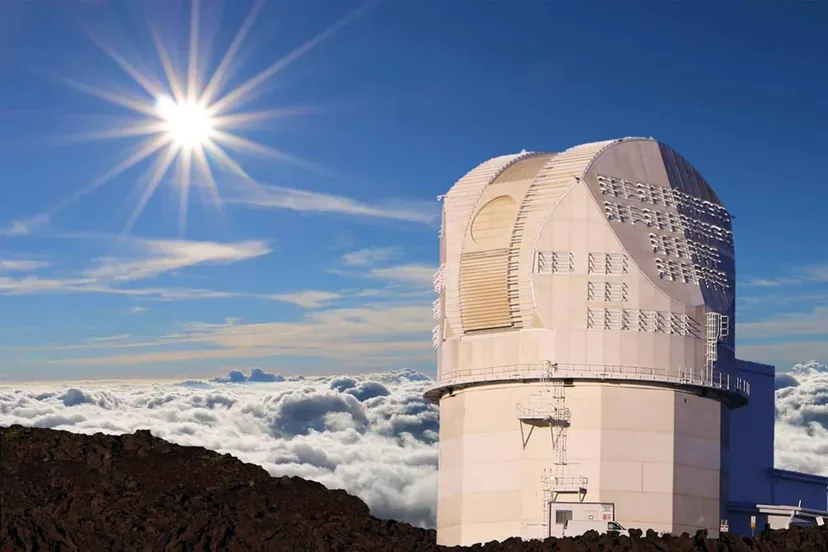
However, not all challenges to the Sun take place in space. On the ground, a different approach is being taken compared to the Parker probe. Instead of flying close to the Sun, the method involves refining the "eye" of the telescope to the extreme. At the pinnacle of this technology is the "Daniel K. Inouye Solar Telescope" (DKIST), built near the summit of Haleakalā on the island of Maui, Hawaii.
The Inouye Solar Telescope is the world’s largest solar telescope, with a primary mirror 4 meters in diameter. Since the Sun is already bright enough, why do we need such a giant mirror? The key is resolution, not brightness. The smallest structure size a telescope can distinguish decreases as the observation wavelength gets shorter and the mirror diameter increases. By observing at a 416-nanometer wavelength—near the blue light spectrum—with a 4-meter mirror, it is theoretically possible to distinguish structures on the solar surface as small as about 19 kilometers.
Collecting sunlight with a 4-meter mirror creates another problem: the solar energy entering the telescope reaches about 13 kilowatts. If this heat were focused directly, it could damage the precision optical equipment. The Inouye telescope removes light and heat unnecessary for observation near the focal point and manages the internal temperature with over 11 kilometers of cooling pipes. It even features a system that makes ice at night to be used for cooling during the day. The primary mirror was designed with an off-axis layout to reduce the phenomenon where light is blocked or scattered by the central structure.
Ground-based telescopes also face the obstacle of the atmosphere. As the temperature and density of the air constantly change, the wavefront of light fluctuates, causing the image to blur—the same principle that makes stars twinkle. The Inouye telescope corrects this vibration using a deformable mirror equipped with 1,600 actuators. When a wavefront sensor measures the distortion of incoming light at 1,521 points, the control system changes the shape of the mirror 2,000 times per second. This is adaptive optics technology, which deforms the mirror in the opposite direction every time the atmosphere blurs the image to restore the original clarity.
The Inouye telescope released its first observation images in 2020. Even then, the fine structures of granules and sunspots appeared with unprecedented clarity. However, the results published in 'Nature' this past August went a step deeper. The research team analyzed data collected over approximately 3 minutes, from 21:38 to 21:41 on April 14, 2025. The target was active region NOAA 14060, located near the center of the solar disk, which contained a "pore"—a small dark structure where strong magnetic fields are concentrated.
The observation used a narrow filter with a width of 0.5 nanometers that only passes 416-nanometer light, along with FastCam equipment. The area captured by the camera corresponded to about 5,800 by 4,350 kilometers on the solar surface, with each pixel representing about 6 kilometers. The exposure time was a mere 100 microseconds—1/10,000th of a second—per frame. The camera captured 740 frames per second.
However, the 740 original frames per second were not simply stitched together into a video. The research team simultaneously captured images that were in focus and images that were intentionally slightly blurred. By comparing the two, the wavefront errors caused by the telescope and the atmosphere could be calculated in reverse. A video restoration technique called multi-frame blind deconvolution was then applied. The final scientific video was created by combining 2,000 calibrated and processed original frames. The resulting final video has a time interval of 2.7 seconds. While it is not a "live broadcast" in the traditional sense, it is a high-speed, continuous observation that reconstructs 19-kilometer structures on the solar surface every 2.7 seconds.
It was in this footage that something previously unseen appeared. The boundary where granules meet strong magnetic fields was not a smooth line. Most of the boundaries were wavy like ripples, with small hooks and vortices appearing in succession. It looks as if Van Gogh had swirled the paint with a thick brush. But this pattern has a name: Kelvin–Helmholtz instability.
Kelvin–Helmholtz instability occurs when two fluids in contact flow at different speeds. If even a tiny curve forms at the interface, the velocity difference—the shear—magnifies that curve. The boundary gradually curls up and develops into wave-like or vortex-like structures. On Earth, this can be seen in striated clouds or on the surface of water blown by wind; it also appears as massive vortex structures in the atmospheres of Jupiter and Saturn. On the Sun, since it is plasma carrying magnetic fields rather than ordinary fluid, it must be handled through magnetohydrodynamics.
The phenomenon itself is not new physics. Helmholtz studied the instability of fluids flowing at different speeds in 1868, and Kelvin did the same in 1871. Chandrasekhar systematically organized how this instability changes in fluids with magnetic fields in 1961. Structures interpreted as Kelvin–Helmholtz instability have already been observed in the solar corona, coronal mass ejections, and chromospheric jets. However, this is the first time this phenomenon has been clearly confirmed on the Sun's visible surface—the photosphere. This is because the characteristic size was too small for existing solar telescopes with apertures of 2 meters or less to sufficiently resolve the boundaries.
The Sun rises looking the same every day, but on its surface, tiny vortices—which we have only just begun to see—are tirelessly twisting magnetic fields. What humanity discovered at the end of its Icarus-like approach toward the Sun was not just a single massive flame. It was the tiny, tens-of-kilometers-wide waves that might be preparing that very flame.
Reference
https://nso.edu/telescopes/inouye-solar-telescope
About the author, Ji Woong-bae: Loves cats and space. After watching 'Galaxy Express 999' as a child, he dreamed of sharing the beauty of the universe. He is currently an assistant professor in the Faculty of Liberal Arts at Sejong University, engaging in various science communication activities including lectures and writing. He has authored books such as 'On the Usefulness of Astronomers', 'We Are All Born Astronomers', and 'Strange Questions That Come to Mind When Looking at the Universe', and translated titles such as 'How I Killed Pluto', 'Quantum Life', and 'UFO'.