

[비즈한국] Consumers are expressing significant dissatisfaction over the lack of restrooms at some locations of the Chinese premium milk tea brand CHAGEE, which forces them to head to subway stations or other buildings to use the facilities. While CHAGEE Korea stated that "customers can normally use the restrooms located within the buildings at all locations," our on-site verification revealed a different reality. As CHAGEE has recently been showing signs of cutting costs and increasing operational efficiency, voices are being raised about the lack of convenience facilities for customers.
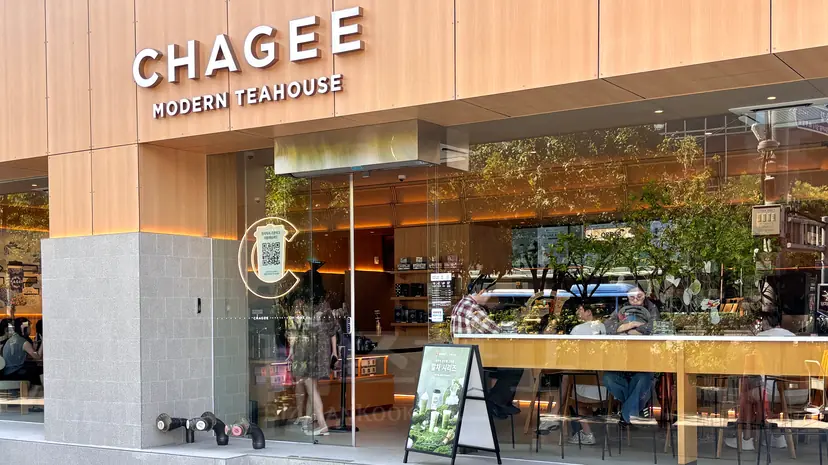
45-seat City Hall branch forces users to subway, Konkuk Univ. branch requires crossing a main road
When I visited the CHAGEE City Hall Station branch in Jung-gu, Seoul, on the afternoon of the 21st, it was difficult to find a seat even on a weekday afternoon in the 45-seat store. As of 2:00 PM, there were 65 beverage orders waiting to be prepared. When I asked a staff member where the restroom was, they told me to exit the store and go into the hallway between buildings. However, this restroom was not available for use by the public.
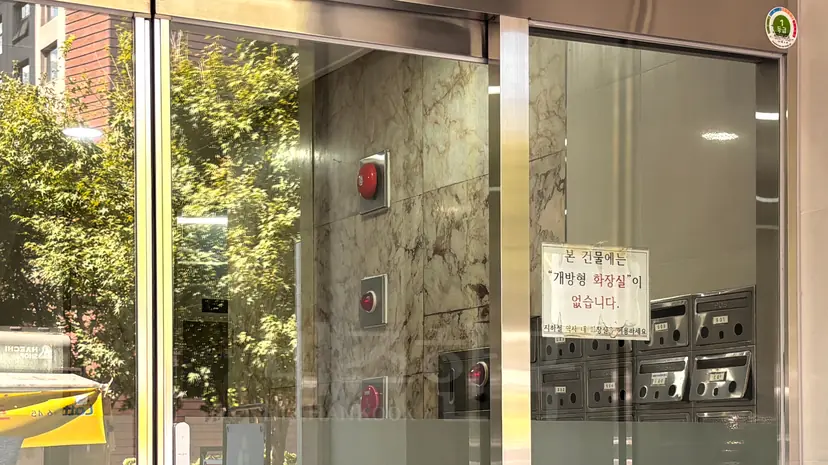
A security guard I met at the entrance of the commercial building said, "This is a building strictly for tenants, so there are no restrooms available for outsiders," and asked back, "Customers often come here, but doesn't the store have its own restroom?" In fact, a notice was posted at the entrance of the building stating, "There are no public restrooms in this building. Please use the restroom inside the subway station."
The CHAGEE Konkuk University (Konkuk Univ.) branch also lacks restrooms for customers inside the store or the building. When asked, a staff member explained, "There are no restrooms available for customers inside the building," and directed me to use the restroom at the nearby Konkuk University Medical Center commercial area.
It took me about 10 minutes to walk to the commercial building restroom suggested by the staff. I had to wait for the crosswalk signal and cross a major road. It is quite a distance to travel while drinking a beverage.
Similar complaints are also consistently being raised online. Users who visited branches such as the Gangnam Flagship store have posted that they had to use external facilities because there were no restrooms inside the store. A CHAGEE Korea representative stated, "At that time, the use of the customer restroom was temporarily restricted due to repairs and maintenance in the building where the Gangnam Flagship store is located, but it is currently available for normal use," claiming it was a temporary situation.
No separate standards based on store size
Known as the "Jang Won-young milk tea," CHAGEE has enjoyed popularity since its domestic launch in April, with long queues forming at every location. Currently, there are 9 locations in Korea: Gangnam Flagship, Yongsan I-Park Mall, Sinchon, Yeoksam, City Hall Station, Konkuk Univ., Shinsegae Department Store Gangnam, Jongno, and Lotte World Mall. Among these, only the Sinchon and Jongno branches have their own restrooms inside the store. Excluding the City Hall and Konkuk Univ. branches, the rest can use the restrooms of the buildings where the stores are located.
In a cafe, a restroom is a facility for customer convenience, but it also requires space and maintenance costs. If a store installs its own internal restroom, the area available for business decreases, and water bills and maintenance costs are incurred continuously. It is common for cafes in commercial or complex facilities to use shared building restrooms instead of having their own.
According to the facility standards for food service businesses under the Enforcement Rules of the Food Sanitation Act, rest restaurants must provide restrooms that customers can use. However, if there is a shared restroom in the same building or a public restroom nearby that customers can conveniently access, a separate restroom does not need to be installed. There are no standards that mandate the installation of internal restrooms based on store size or number of seats.
However, even when there is no legal issue, the inconvenience to customers can be significant depending on the distance to the restroom and the route. Kim Dae-jong, a professor of business administration at Sejong University, explained, "It is difficult to view it as mandatory if it is not an amenity that the workplace is legally obligated to provide," but added, "The burden can be greater for consumers who have difficulty moving, such as the elderly, children, and the disabled. It is desirable for franchise headquarters and franchisees to secure at least minimal convenience facilities by considering the actual environment for consumers rather than just checking whether it is a legal obligation."
BizHankook delivered the reports about the inability to use restrooms within the buildings to CHAGEE Korea, but the company only replied, "Customers can normally use the restrooms located within the buildings at all CHAGEE locations."