

[비즈한국] Mr. A, in his early 30s, and his wife, who signed a contract to purchase an apartment in Dongjak-gu, Seoul, for 1.1 billion won last June, worry every time they check their stock trading apps. They had planned to buy the house with a "maximum loan"—utilizing their current jeonse deposit and about 500 million won in stock investments—but with only two months left until the final payment, they have lost nearly 100 million won in their stock portfolio.
Although they managed to pay the intermediate installment, they have decided to use a line of credit to cover acquisition taxes, brokerage fees, and renovation costs. While they have a plan to secure about 100 million won through a line of credit to finalize the purchase, their anxiety is immense. Mr. A laments that he cannot sleep properly, worried about whether he will be able to secure a loan exceeding 500 million won from banks that have tightened their lending criteria, and whether the stock market will fall even further in the meantime.
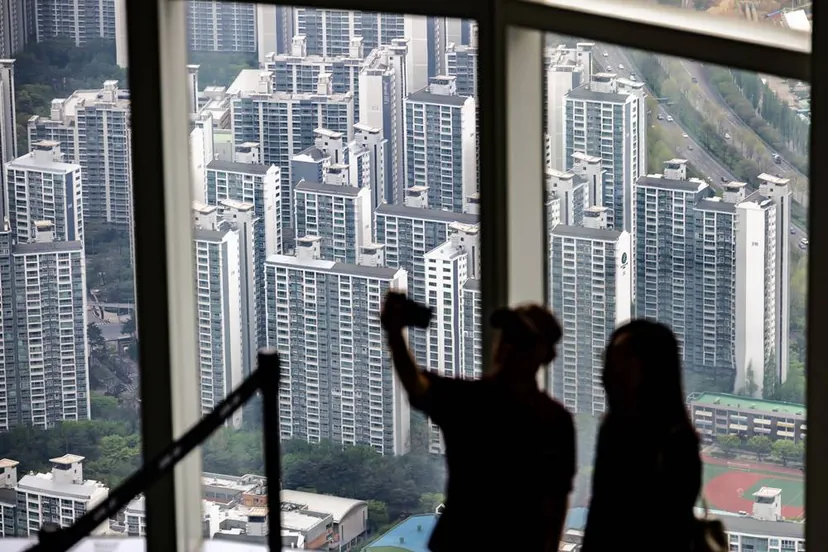
Stocks are falling, but they must buy a house...
As the stock market plummets, a red alert has been issued for the 2030 generation, the "primary customers" of the real estate market. This is because their plans to purchase property after growing their assets through stocks, like those of Mr. A and his wife, are being shaken.
In fact, an analysis by a media outlet of the first-half returns by age group for customers holding over 1 million won in Mirae Asset Securities accounts showed that investors in their teens and younger recorded the highest returns at 30–40%. While those in their 50s and 60s recorded 29% and those in their 40s recorded 27%, the returns for the 2030 generation were the lowest, in the low 20% range.
The problem is that the 2030 generation has been the "big spender" in the real estate market. In May of this year, more than one in three people who bought homes in Gyeonggi-do were from the 2030 generation. In Dongtan, where the average age of buyers is 37, the number of purchases by this age group increased 3.7 times in just one year.
According to the Supreme Court Registry Information Plaza, the number of ownership transfer registrations (sales) for collective buildings (apartments, villas, officetels) in Gyeonggi-do by the 2030 generation in May this year reached 10,534. The proportion of buyers in their 20s and 30s stood at 38.0%. This is the second-highest figure in the last five years since 2021 (the first being 38.5% in December 2024).
In Seoul, the proportion of buyers in their 30s is even higher. According to statistics on housing buyers by age group from the Korea Real Estate Board, the proportion of buyers in their 30s accounted for 41.2% of Seoul apartment transactions in May this year, leading the entire market. This means that 4 out of every 10 apartments in Seoul are being purchased by "those in their 30s."
Anxious as loans tighten
Stocks are falling, and commercial banks have tightened loan access across the board. This is why the 2030 generation is trembling with anxiety. KB Kookmin Bank significantly reduced its individual mortgage loan limit from 600 million won to 300 million won, and Woori Bank limited the monthly mortgage loan limit per branch to 1 billion won. Woori Bank had tightened this limit to 1 billion won in November last year to regulate the pace of household loans, then eased it to 3 billion won earlier this year; however, in just six months, it has slashed the limit back to one-third of that level. With other banks also restricting loan applications processed via loan solicitors, there are concerns that a "loan open-run" (scramble for loans) will occur in the second half of the year.
As a result, the use of lines of credit is increasing. The outstanding balance of lines of credit at the five major banks at the end of July was 44.4669 trillion won, an increase of 1.1857 trillion won from the end of June. This is the highest level since August 2022 (44.7699 trillion won).
Mr. A and his wife lamented, "We are told that we can only know if a loan is possible one month before the final payment is due, and since the loan amount is so large, we are very worried. Even when we ask the bank, the only answer we get is, 'You have to contact us again closer to the final payment date to know for sure.'"
Mr. B, a Samsung Electronics employee in his late 20s who purchased an apartment in Yongin, Gyeonggi-do, early this year, explained, "Recently, I've heard my colleagues at work say many times, 'I envy you for buying a house early.' With the stock market difficult and loans not easy to get, there is a lot of concern about investment among my unmarried colleagues. They are saying that the situation is such that the person who bought an apartment early with a maximum loan is the 'winner.'"