

[BizHanKook] With the token securities system scheduled to take effect in February 2027, a seminar hosted by ruling party lawmakers discussed measures for market activation and institutional improvement. The main task raised at the seminar was establishing a legal basis for the issuance of non-monetary trust beneficiary certificates based on assets such as real estate and copyrights. While such products are currently being issued via "backdoor" methods using the Asset-Backed Securitization Act, the amendment to the Capital Markets Act that would provide a formal legal basis remains pending in the National Assembly. The industry has urged the passage of the bill within the current regular session of the National Assembly so that products can be supplied in line with the system's implementation. Financial authorities stated that they are striving for passage within the year while reviewing investor protection measures to ensure investors can clearly understand the composition of underlying assets.
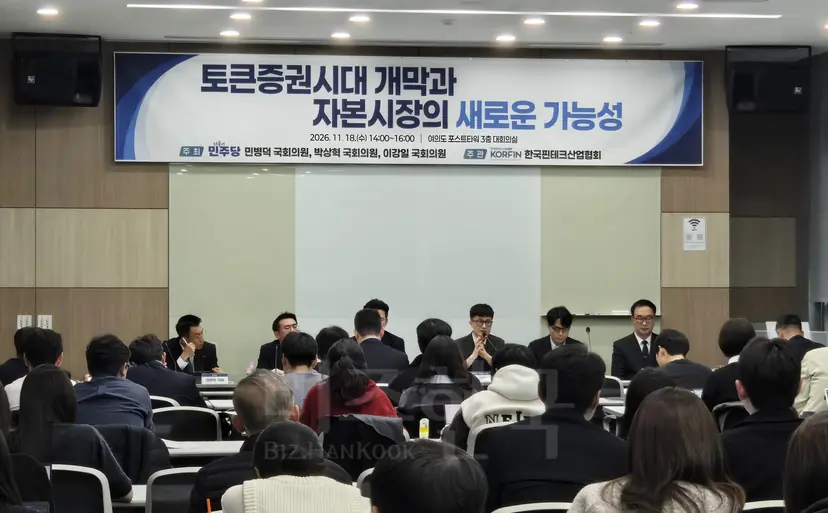
On November 18, the seminar "The Dawn of the Token Securities Era and New Possibilities for the Capital Market" was held at the Yeouido Post Tower. The seminar was hosted by Democratic Party of Korea lawmakers Min Byung-duk, Park Sang-hyuk, and Lee Kang-il, and organized by the Korea Fintech Industry Association. Under the amendments to the "Act on Electronic Registration of Stocks, Bonds, etc." (Electronic Securities Act) and the "Capital Markets and Financial Investment Business Act" (Capital Markets Act), token securities will enter the institutional framework on February 4, 2027, under the legal concept of "distributed ledger registered stocks, etc."
The seminar focused on the bill designed to establish the legal basis for the issuance of non-monetary trust beneficiary certificates. Non-monetary trust beneficiary certificates refer to arrangements where physical assets like real estate or Korean beef (Hanwoo) are entrusted to a trust company, and investors share in the profits. Currently, because there is no underlying legislation, companies are issuing these products indirectly through the Asset-Backed Securitization Act. The token securities industry is voicing the need to have the institutional framework ready by the time the token securities system is implemented.
In his opening remarks, Representative Lee Kang-il of the Democratic Party of Korea said, "The landscape of the global financial market is fundamentally changing. Beyond the traditional boundaries of stocks and bonds, assets such as real estate and intellectual property (IP) are entering the capital market through tokenization." He added, "We must continuously inspect and supplement the conditions under which diverse assets can be issued and distributed as financial products." Representative Lee spearheaded the Capital Markets Act amendment bill for the issuance of non-monetary trust beneficiary certificates last September.
Shin Beom-jun, CEO of Buysell Standard and head of the Token Securities Council at the Korea Fintech Industry Association, urged the passage of the bill, stating, "We are gathered here today with less than 80 days left until the token securities law takes effect. Although the token securities market opens in February 2027, the formal legal basis for non-monetary trust beneficiary certificates, which will be central to the market, is still stuck in the National Assembly. To include copyrights and real estate, one must go through the roundabout route of the Asset-Backed Securitization Act." He continued, "The bill that turns this detour into an official path is the Capital Markets Act amendment proposed by Representative Lee Kang-il last September. The key is time. If it is processed within this regular parliamentary session, we can narrow the gap between market opening and the actual supply of products."
While expressing anticipation, the securities industry noted that launching products immediately after the institutionalization of token securities would be difficult. Choi In-soo, head of the Digital Asset Department at Shinhan Securities, explained the tasks for activating the domestic token securities market under the theme "Changes in the Token Securities Market and the Future of the Capital Market."
Department Head Choi stated, "Even if the token securities system is implemented in February next year, it may be difficult for securities firms to immediately commercialize products. Nevertheless, we are considering product launches centering on private bonds and MMFs (money market funds that invest in short-term financial products)." He added, "One of the key issues for activation is the institutionalization of non-monetary trust beneficiary certificate issuance."
He further emphasized that token securities should move beyond simple asset issuance and distribution toward "on-chain finance." On-chain finance refers to conducting core financial processes such as issuance, trading, and settlement on a blockchain network. Choi explained, "We view the tokenization of assets as the expansion of on-chain finance that affects ledgers, payments, and markets. Currently, transaction records (ledgers) that are separated by institution can be recorded in real-time on a shared ledger, and payment settlements can also be made in real-time, 24 hours a day. Another added value of tokenization is market expansion. Most of the revenue for securities firms comes from domestic transactions, but tokenization can expand the market's borders, creating a good opportunity for the financial industry."
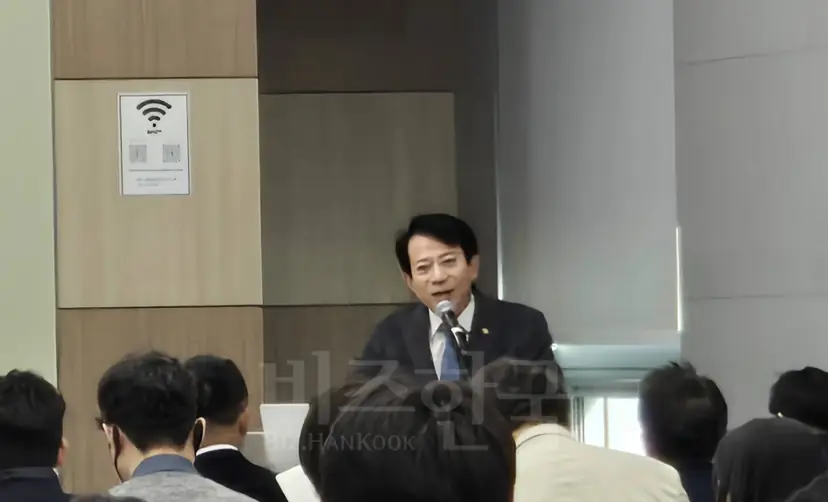
Hwang Hyun-il, an attorney at Bae, Kim & Lee LLC, pointed out the limitations of issuing non-monetary trust beneficiary certificates while presenting on the topic of "Current Status and Future Tasks of the Token Securities System." Under the current Asset-Backed Securitization Act, the scope of asset holders is limited to financial institutions or companies meeting certain requirements. For corporations subject to external audits, requirements such as having assets of 50 billion won or more and equity capital exceeding 50% of paid-in capital are applied. It was pointed out that these are conditions that are practically difficult for small and medium-sized venture companies to meet.
Attorney Hwang emphasized that based on the currently proposed bill, the legal basis for issuing beneficiary certificates, including non-monetary trusts, must be improved, and beneficiary protection after issuance must be strengthened. He remarked, "While the maintenance of the distributed ledger, account management, and distribution systems has been achieved, restrictions on the issuance channels remain. There is a need to establish a basis for the issuance of non-monetary trust beneficiary certificates through the swift passage of the bill."
In the subsequent discussion, industry representatives and financial authorities debated the institutional framework and current market conditions. Han Sang-hyung, head of the legal department at Buysell Standard, and Son Kyung-hwan, an executive at Naver Pay, presented their views from the perspective of market participants. Han mentioned the need to expand the scope of underlying assets and asset holders, stating, "With the amendment of the Capital Markets Act, financial and non-financial institutions can collaborate to professionally manage various underlying assets." Son remarked, "Current discussions on token securities have focused solely on the tokenization of physical assets. We should also consider converting existing unlisted stocks into token securities."
Financial authorities stated their commitment to amending the Capital Markets Act within the year while emphasizing investor protection. Lee Jung-chan, a deputy director at the Financial Services Commission’s Capital Markets Division, said, "In the case of non-monetary trust beneficiary certificates, there are limits to asset issuance if the Capital Markets Act cannot be amended. We are striving to pass the bill within this year." However, he added, "A concern is the issue of investor protection. Investors must clearly know what kind of underlying product they are investing in, and as a result, we are considering investor protection measures such as preparing guidelines for asset composition."
Deputy Director Lee noted, "Most securities firms seem to be focusing on the tokenization of standardized securities, while fractional investment firms are focusing on the tokenization of non-monetary assets. However, I think it is difficult to discuss the integration of the two types of platforms. Ultimately, we need to establish an on-chain system along with stablecoins, which requires various legislations." Regarding the tokenization of unlisted stocks, he explained, "Private bonds or MMFs have simple rights relationships, so token security issuance could be pursued first. However, stocks have complex rights relationships, making it difficult to pursue them at this time."