

[비즈한국] Black holes are often perceived as realms of death that swallow and destroy everything. But could you believe that new planets are actually being born around these very black holes? It turns out that a black hole might be a surprising site of creation where new planets sprout. Around a single supermassive black hole, not thousands or millions, but tens of millions of planets could be produced.
Normally, planets are born around stars. Our solar system also began 4.6 billion years ago from a disk of gas and dust surrounding the newborn Sun. Tiny dust grains in the disk collided and clumped together, growing into larger pebbles and rocks. These small planetesimals collided and merged, ultimately forming planets like Earth and Jupiter.
However, similar disks form around supermassive black holes. As the central black hole of a galaxy consumes surrounding gas and dust, the material does not fall directly into the black hole. Instead, it orbits at immense speeds, forming a flat, massive accretion disk. Active galactic nuclei (AGN), where the black hole voraciously devours matter, are extremely hot and bright in their inner regions. The gas emits powerful X-rays and ultraviolet radiation, and most dust evaporates under the intense heat. Naturally, planets cannot form in such an environment.
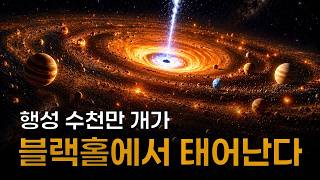
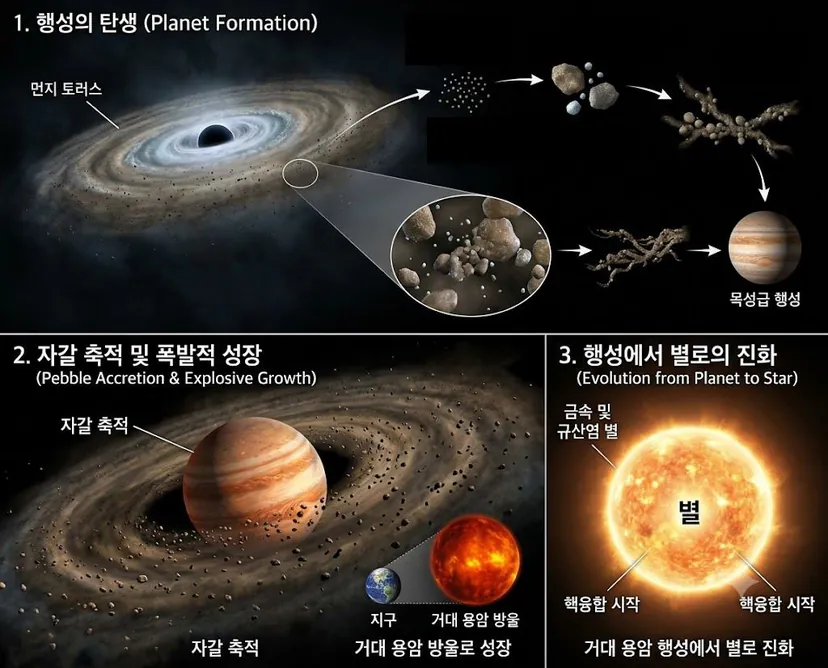
However, the situation changes completely when moving far enough away from the central black hole to the outer parts of the disk. At a distance of about 3 to 30 light-years from a supermassive black hole, there exists a region where temperatures drop significantly. Here, gas and dust surround the black hole like a dark, thick donut, which is why it is called a "dust torus." The powerful radiant energy leaking from the central black hole and the inner accretion disk is blocked by this thick torus. Beyond it, the temperature is low enough for silicates, metals, and ice to survive. And it is right here that planets can be born.
Protoplanetary disks around stars like our Sun usually remain within a scale of a few hundred AU. But the dust torus of an active galactic nucleus spans across several, or even tens of, light-years. By size alone, it is thousands of times larger than a typical planetary disk. Naturally, the amount of material within it is overwhelmingly greater. Recently, astronomers confirmed the possibility that an overwhelming number of planets could emerge from this very location.
Assuming a massive supermassive black hole with a mass 10 million to 1 billion times that of the Sun, researchers modeled a disk supported by magnetic fields. In fact, magnetic fields are a crucial factor in planet formation. If the gas and dust in the disk become too heavy, rather than forming individual planets, the entire disk might collapse as a single mass, making it difficult to form planets. However, if a strong magnetic field is maintained to inflate and support the disk, it prevents the entire disk from collapsing at once. This allows dust grains within the disk to survive and grow into independent planetary fragments.
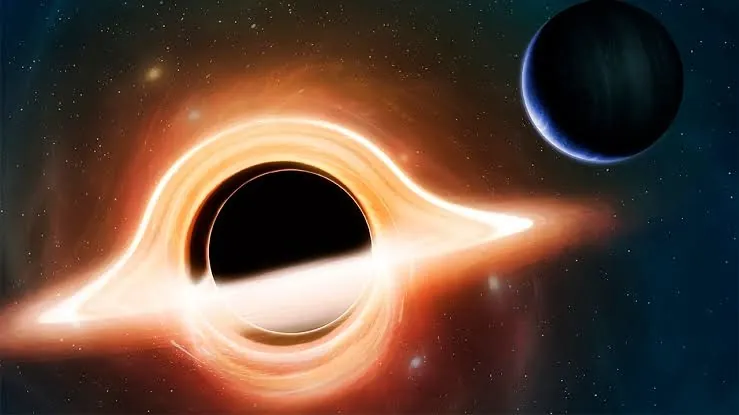
The process occurring in the black hole environment confirmed by this simulation is quite fascinating. Initially, tiny dust grains, only 1 micrometer in size—dozens to hundreds of times smaller than the thickness of a human hair—float around. As these tiny particles collide, they grow to millimeter and centimeter scales. The time it takes for these particles to grow varies greatly, from thousands to hundreds of millions of years, depending on the mass of the black hole and the distance from it.
But a new problem arises as the dust continues to grow. Gas within the disk gradually slows down due to pressure. Dust grains move while interacting with this gas. During this process, areas where more dust accumulates begin to attract even more dust from the surroundings with stronger gravitational pull. Much like cars slowing down on a highway leading to a traffic jam, dust grains begin to concentrate in specific regions of the disk. This accumulated dust densifies into an elongated shape, forming a filament.
The amount of pure dust contained in a single one of these filaments is surprisingly immense. It can reach tens of thousands to millions of times the mass of Jupiter, and potentially even equal the mass of the Sun. Such an enormous quantity of dust particles gathers in the middle of the disk, forming a long strip. However, this filament does not immediately coalesce into a single planet.
Once the density becomes high enough, the filament can no longer support its own gravity and collapses. It then fragments into numerous smaller chunks. While this is similar to the process of asteroid and planetesimal formation in our solar system, the scale is far larger. According to the simulation, the mass of planets formed through this process is generally Jupiter-class. And if you count all the planets born across the entire disk, the number can reach tens of millions. Around a violent black hole at the center of a galaxy, Jupiter-mass heavy planets are born in numbers equivalent to the population of South Korea.
Early planets formed this way continue to sweep up remaining small dust and pebbles. This process is called "pebble accretion." As a celestial body grows, its gravity becomes stronger, allowing it to capture more material. Through this, a planet can double its size within 1,000 to 10 million years. In a typical protoplanetary disk, this usually takes millions of years. But in the disk around an active galactic nucleus, material is abundant, so under certain conditions, a planet can rapidly grow in just 1,000 years.
This is where a significant difference between black hole environments and typical star systems arises. Planets around ordinary stars cannot grow indefinitely. A growing planet eventually clears its surroundings, creating a gap in the disk. Pebbles can no longer reach the planet, and its growth is limited. This is known as the "pebble isolation mass."
However, the environment around a black hole is more than abundant—it is overflowing with material. Because material is everywhere, the planet does not stop growing and continues to become heavier. It even exceeds the starting mass required for hydrogen nuclear fusion. In essence, the boundary between a planet and a star collapses. Although they begin as mere clumps of dust, pebbles, and rocks, they continue to grow until they become true stars. It is indeed possible for a planet to grow into a star around a black hole.
The chemical composition of these celestial bodies is even stranger. In astronomy, "dust" is different from simple soil dust. It refers to solid particles composed of elements heavier than hydrogen and helium, such as silicon, oxygen, iron, and magnesium. Therefore, a newly born celestial body around a black hole can be seen as a mass kneaded entirely out of these heavy elements. Its heavy element ratio is effectively 100%!
In certain areas within 3 light-years of a black hole, incredibly heavy solid bodies can form that are Jupiter-mass but consist entirely of rock and metal, rather than being gas giants. Beyond 30 light-years, pure rocky celestial bodies can be born that, from the start, exceed the mass required for hydrogen nuclear fusion. Surprisingly, these massive bodies have the mass of a star but are not plasma balls made of hydrogen! They are giant metallic chunks composed almost entirely of silicates and metal. Perhaps they are more similar to the "Death Star" from the movies.
What would they look like? The core might be extremely compressed, entering a degenerate state like a neutron star or a white dwarf. On the surface, radioactive isotopes like Aluminum-26 could release heat, melting the entire rocky surface. As a result, the surface might be covered in a magma ocean, with gases evaporated from the rocks forming a thin atmosphere. Astronomers call these strange celestial bodies that might hover around black holes "degenerate giant lava drops."
Is it possible to confirm the existence of these strange celestial bodies through observation? There is no straightforward way yet. Unlike planets orbiting ordinary stars, it is not easy to find planets orbiting the overwhelmingly powerful black hole. An active galactic nucleus is very far away, beyond our galaxy, and is so incredibly bright compared to a planet that directly observing small planetary fragments hidden around it is practically impossible. One could look for a type of "transit" where the X-ray brightness dips as a planet passes in front of small X-ray light sources near the black hole. While there have been studies suggesting planet candidates around black holes, there is no officially confirmed case yet.
However, looking at the physical conditions, a black hole might just be the most enthusiastic creator of planets in the universe. The alien planet visited by the protagonist in the movie 'Interstellar' was also in a strange environment where it maintained its temperature by receiving light from the black hole's accretion disk.
Perhaps we have been trapped in overly stale stereotypes when we think of "planets." A planet orbiting a central star like the Earth does around the Sun might be the rarest case in the entire universe. There are an overwhelming number of rogue planets drifting through space without a central star. There might even be new, stranger metallic planets being churned out endlessly around supermassive black holes at the centers of galaxies. If we measure based purely on numbers, planets orbiting stars like us might actually be the rare and strange worlds.
Reference
https://iopscience.iop.org/article/10.3847/1538-4357/ae6f0b
Who is Ji Woong-bae? He loves cats and the universe. After watching 'Galaxy Express 999' as a child, he dreamed of sharing the beauty of the cosmos. He is currently an assistant professor in the School of Free Major at Sejong University, engaging in various science communication activities including lectures and writing. He has authored books such as 'On the Uselessness of Astronomers,' 'We Are All Born as Astronomers,' and 'Strange Questions That Come to Mind When Looking at Space,' and translated works such as 'How I Killed Pluto,' 'Quantum Life,' and 'UFO.'