

[비즈한국] In this week’s top gainers, Starknet dominated the list, followed by projects equipped with institutional financial infrastructure, cross-chain services, and token buyback structures. Rather than capital being concentrated in one specific sector, buying pressure spread across the entire technical infrastructure, including Layer 1, Layer 2, data availability, and oracles. However, as Starknet’s surge significantly outperformed other tokens, it is difficult to view this as a market-wide rally across the top 100 cryptocurrencies.
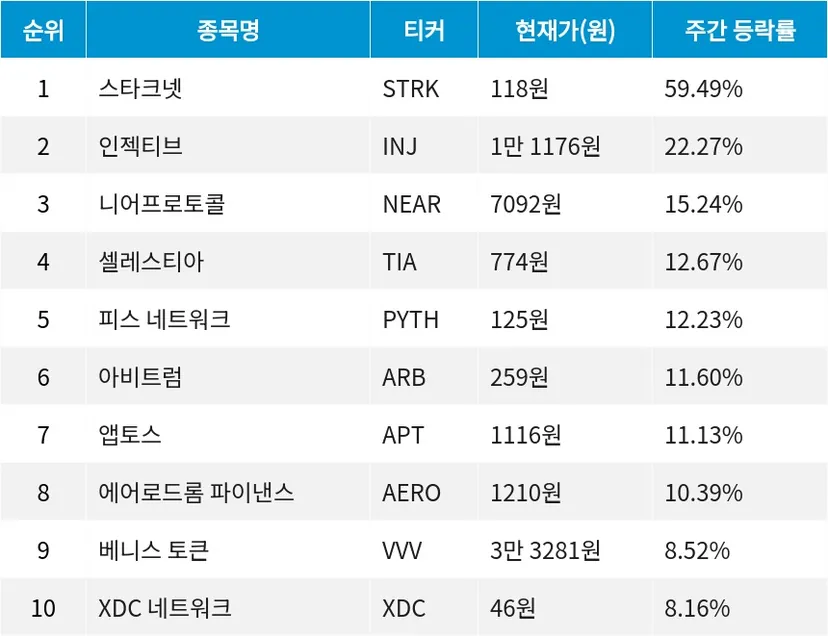
According to CoinMarketCap, a global cryptocurrency market tracking site, Starknet ranked first in the market with a weekly gain of 59.49% between 6:00 AM on October 9 and 6:00 AM on October 16. Its current price is 118 KRW, and it maintained strong short-term momentum with a 14.69% increase over the last 24 hours.
Injective ranked second with a weekly gain of 22.27%. Its current price is 11,176 KRW, having risen 9.94% over the last 24 hours. NEAR Protocol took third place, rising 15.24% over the week to 7,092 KRW, with a 24-hour gain of 10.03%.
Celestia ranked fourth with a weekly gain of 12.67%. Its current price is 774 KRW, up 5.11% in the last 24 hours. Pyth Network, in fifth place, traded at 125 KRW, up 12.23% over the week, with a 24-hour gain of 9.37%.
Arbitrum ranked sixth, rising 11.60% over the week to trade at 259 KRW. Aptos (7th) rose 11.13% to 1,116 KRW, and Aerodrome Finance (8th) climbed 10.39% to 1,210 KRW. Venus Token (9th) rose 8.52% to 33,281 KRW, and XDC Network (10th) traded at 46 KRW, up 8.16%.
Starknet Leads as ETF and Institutional-Grade Infrastructure Drive the Top Ranks
Starknet is a Layer 2 network that uses STARK, a zero-knowledge proof technology, to bundle and process Ethereum transactions. STRK is used for transaction fees, staking, and governance, and is linked to a dual-staking structure where Bitcoin holders participate in network security.
However, there were no specific new official announcements explaining the 59.49% weekly surge near the reporting period. It appears more likely that buying pressure rotated into this high-volatility Layer 2 asset, building on existing factors like Bitcoin-based finance, privacy features, and STRK staking. Given the double-digit gain in the last 24 hours, buying pressure persisted until the very end of the reporting period rather than retracting after an early-week spike.
Injective is a finance-specialized Layer 1 blockchain that integrates on-chain order books, derivatives, and tokenized asset trading into the blockchain itself. INJ is used for fees, staking, and governance, and it also features a buyback-and-burn mechanism funded by ecosystem revenue.
On October 8, Gulf Labs, an affiliate of Thailand’s Gulf Group, began operating an Injective validator. While the two sides have agreed to expand cooperation in areas like tokenization, stablecoins, and data centers, specific business plans are still under discussion. Subsequently, on October 14, an announcement was released explaining the difference between INJC, an exchange-traded product that holds and stakes INJ, and spot tokens. The highlight of accessibility to INJ through traditional brokerage accounts alongside institutional participation as validators appears to have contributed to the market-wide rebound.
NEAR Protocol is a Layer 1 blockchain that processes transactions in parallel by sharding and operates "NEAR Intents" to connect assets and orders between different blockchains. On October 14, Mert Mumtaz, CEO of Solana infrastructure firm Helius, joined the NEAR Foundation’s board. The following day, the HSP-007 program was announced, which covers the operating costs of multi-party computation nodes (for cross-chain signatures in NEAR Intents) using protocol issuance rewards rather than one-time grants.
This program rewards the 17 currently operational nodes based on performance and uptime, with a structure to expand participation to up to 21 nodes. The key is that it institutionalized the cost structure supporting cross-chain services rather than just being a personnel recruitment effort. The fact that a significant portion of the weekly gain occurred in the last 24 hours suggests that these announcements aligned with late-period buying. However, the overlap between announcement timing and price movement does not necessarily mean these news items were the sole drivers of the entire weekly gain.
Rotation Spreads to Real-World Utility, From Token Buybacks to Data Processing Performance
Celestia is a network focused on data availability, ensuring that transaction data on a blockchain has actually been published, rather than focusing on application execution. Rollup developers pay for data posting with TIA, while holders stake TIA to participate in network security and governance. Celestia Labs announced on October 1st that "Fibre," a high-speed data transmission technology, achieved a throughput of 3.07 terabits per second in a test with 120 validators. Validator signaling procedures for the version 10 upgrade also began this month. Apart from actual commercial demand, the technical milestone of being able to process massive amounts of data served as a backdrop for the rebound.
Pyth Network is an oracle that supplies price data generated by exchanges and financial firms directly to blockchain applications. On October 8, the Pyth DAO decided to use 100% of the revenue generated from its data products to buy back PYTH from the market and add it to its reserves. Previously, one-third of non-PYTH assets were injected monthly, but moving forward, 100% of product revenue will be used for buybacks. With a reported annualized revenue of $11.5 million as of September, the clear mechanism connecting actual revenue to token demand made it the project with the most tangible basis for growth among the top 5.
The composition of ranks 6 through 10 also shows that the scope of the rally has broadened. Arbitrum is a Layer 2 solution that handles Ethereum transactions externally, while Aptos is a smart contract platform focused on parallel execution. Aerodrome Finance is a decentralized exchange on the Base network, distributing transaction fees and voting rights to long-term stakers while paying AERO as liquidity mining rewards.
Venus Token is linked to the computing resources of the generative AI service, Venus. Users who stake VVV can secure computing credits to call AI models. XDC Network is a Layer 1 project targeting trade finance, real-world asset (RWA) tokenization, and inter-company payments. Since the top ranks include not only Layer 2s and Layer 1s but also decentralized exchanges, AI computing, and corporate financial networks, it is difficult to define this week’s flow as being driven by a single technical theme.
All top 10 tokens gained over the week, but their individual drivers differed. Injective and NEAR Protocol saw concrete institutional participation and infrastructure operational systems, while Pyth Network linked product revenue to token buybacks. Celestia highlighted data processing performance, whereas Starknet appears to have been driven more by capital flow targeting Layer 2s and high-volatility assets than by a single imminent announcement.
Notably, all top 5 tokens also rose over the last 24 hours, meaning the weekly momentum continued until the final reporting window. This distinguishes the market from a scenario characterized by uniform profit-taking following a spike. However, given that Starknet’s gains were overwhelming and most of the top-ranked coins are high-volatility altcoins, this result is best interpreted as a short-term recovery of risk appetite driven by a combination of individual news and technical infrastructure rotation, rather than a new overarching uptrend for the entire cryptocurrency market.
※ This article was written by Business Hankook and MetaVX’s generative AI.