

[BizHanKook] Despite the global popularity of K-pop, the lack of dedicated arena venues in Korea has led to many projects being rushed into planning in various locations. However, as conflicting interests have caused these projects to stall or face delays, numerous cases of taxpayer money being wasted have emerged. Appropriate solutions needed to be sought, but that has not been the reality. The R2 block in Zone 8 of the Songdo International City is a prime example of this.
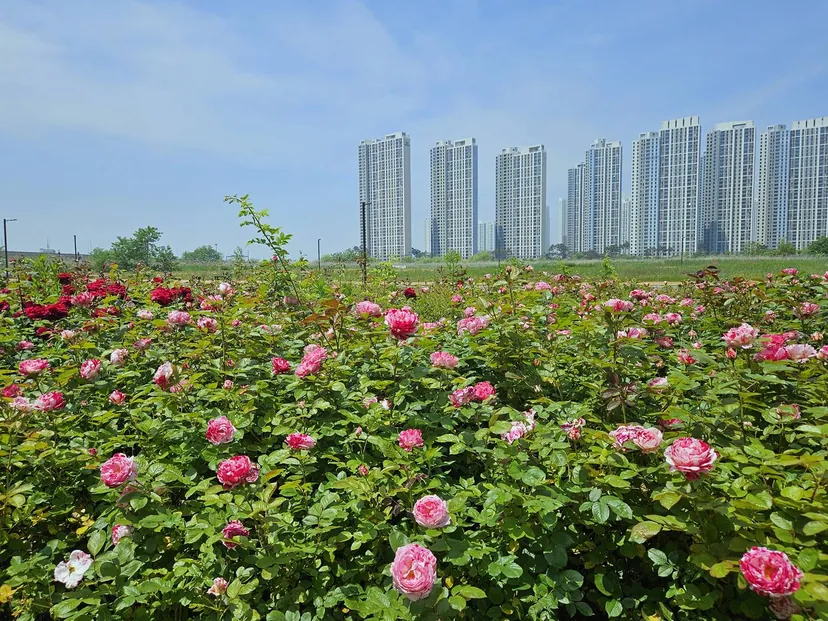
The R2 block in Zone 8 of Songdo International City, the former site of the K-Pop Content City, is a general commercial plot that the Incheon Urban Corporation (iH) received from Incheon City in 2013. For over 10 years, the site has been neglected, with a repetitive cycle of installing and tearing down flower beds and temporary photo zones. These expenses alone have amounted to 800 million to 1 billion won annually, wasting nearly 10 billion won to date. It is considered a representative case of administrative budget waste.
In 2023, the development of a K-Pop Content City was promoted to attract a world-class K-pop agency and build a dedicated K-pop arena, but it soon became embroiled in controversy. The push for a private contract, premised on a specific operator to cover construction costs through office development rights, sparked allegations of favoritism. The relevant agencies, the Incheon Free Economic Zone Authority and the Incheon Urban Corporation, also revealed disagreements. They held differing positions on various aspects, including the appropriate number of residential units (officetels, etc.), the capacity of infrastructure, and public contributions. Moreover, while construction costs skyrocketed, the downturn in the real estate market made private investment difficult.
Diagnosed as unsightly and potentially dusty due to being left abandoned, the site has been used since 2019 to create seasonal flower beds and one-off photo zones every spring and autumn. Costs continue to be poured into this cycle of installation and removal. This year alone, 760 million won was allocated for flower beds and 240 million won for photo zone facilities. This is not just for aesthetic reasons. Because the land is classified as "unused," it faces the risk of being subject to 15 billion won in punitive taxes, making these temporary measures a desperate act of self-rescue.
How can this space be utilized? The first step is to develop it as an outdoor concert venue. Even before formal development begins, it could be prepared as a K-pop cultural and artistic space, such as an outdoor stage. This is because it is in an ideal location for international visitors. Incheon has a passenger port and is conveniently accessible to foreign tourists and fans via Incheon International Airport. Until now, most foreign fans have had to travel to other regions after arriving at Incheon Airport to attend performances.
While hosting large-scale rock festivals might be difficult, the space could be configured for genres like jazz, blues, or ballads. The issue of noise reduction can be solved with "Virtual Noise Barrier" technology. Instead of erecting physical walls, this technology uses electrical signals and speaker control to prevent sound from diffusing or traveling, ensuring that noise does not spread toward residential areas. Furthermore, by adopting a grass-field model, the site could be used for other sports events or community amenities during the winter season.
If creating an outdoor concert venue is difficult, a "Tear-Drop" style venue could be built. This is a portable, modular concert structure constructed in the form of a large tent or an inflatable air dome. Shaped like a teardrop, it provides aerodynamic stability by reducing resistance to rain, snow, and wind. Because the dome shape allows for 360-degree viewing, there is no distance between the audience and the stage, resulting in maximum immersion and a sense of being right in the action. Since it is not a fixed building, it can be used for performances for a set period in large open spaces, parking lots, or parks, and then easily dismantled. It could easily accommodate K-pop fan meeting concerts. A "Tear-Drop" has already been installed at Dongjak Station on Seoul Subway Lines 4 and 9, hosting performances such as the musical "Dawn of the Eye" and the "Dongjak Spring Music Festival."
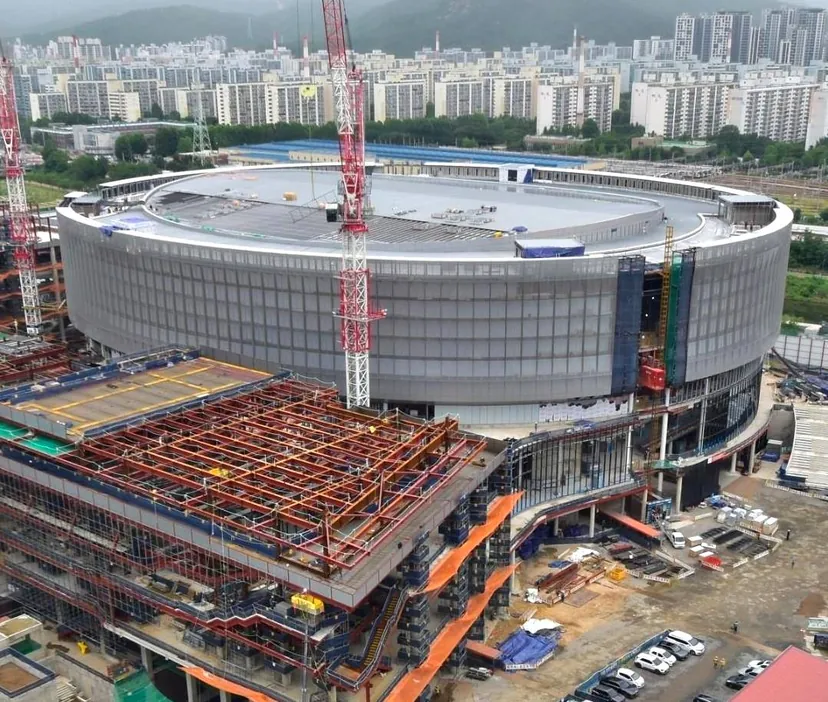
One could also create a hub for K-pop pop-up stores using a modular system. The modular method, which involves assembling standardized parts, allows for installation and removal within just a few hours. This is eco-friendly as it is reusable at any time, in addition to being cost-effective, aligning with ESG trends. Within a large site, one could create not only pop-up stores but also exhibition or performance facilities in a short period. Even if a formal development bid or commercial construction begins later, this approach would hold more value than repeatedly digging up flower beds every year. Moreover, creating a K-pop pop-up hub could help the local economy by attracting K-pop fandoms and tourists. It could even serve as a pre-promotional tool if an arena venue is built later.
Of course, to implement these alternatives, a responsible body and initial infrastructure development are necessary. One might hesitate due to initial costs, but projects that seemed imminent have been delayed for 10 years, and nearly 10 billion won has been poured into the ground. It is time to make a decision to ensure that budgets are used productively rather than being wasted any further. This does not apply only to the R2 block in Zone 8 of Songdo International City. K-pop concert venues are lacking nationwide, but there is no need to be fixated solely on building mega-arenas. Attempting appropriate solutions tailored to the circumstances of idle sites seems more important now than ever.
The author Kim Heon-sik has been wandering through or cutting through the forest of pop culture phenomena since his 20s, with the expectation that there is a way to make the world a better place through culture. He continues on the same path with the same belief, even in the 21st century, where artificial intelligence and quantum computers are at the forefront.