

[비즈한국] With the push for the early commercialization and export of Small Modular Reactors (SMRs), the issue of establishing ‘Emergency Planning Zones (EPZ)’—the safety buffer designed to protect residents near nuclear plants from radiation risks—has become a hot potato. A direct clash has emerged between the developers' vision of deploying nuclear plants near urban centers or large industrial complexes by reducing capacity and integrating safety systems, and the stance of civil society and regulatory experts who argue that protection zones must not be prematurely relaxed due to unproven safety claims.
On August 21, the controversy over SMR safety regulations took center stage at the nuclear safety seminar, "Beyond Promotion-Centered Nuclear Policy, Toward an Independent Safety Regulatory System," hosted by Representative Lee Ju-hwi of the Democratic Party of Korea and co-organized by the Citizens’ Institute for Environmental Studies and the Korea Federation for Environmental Movements.
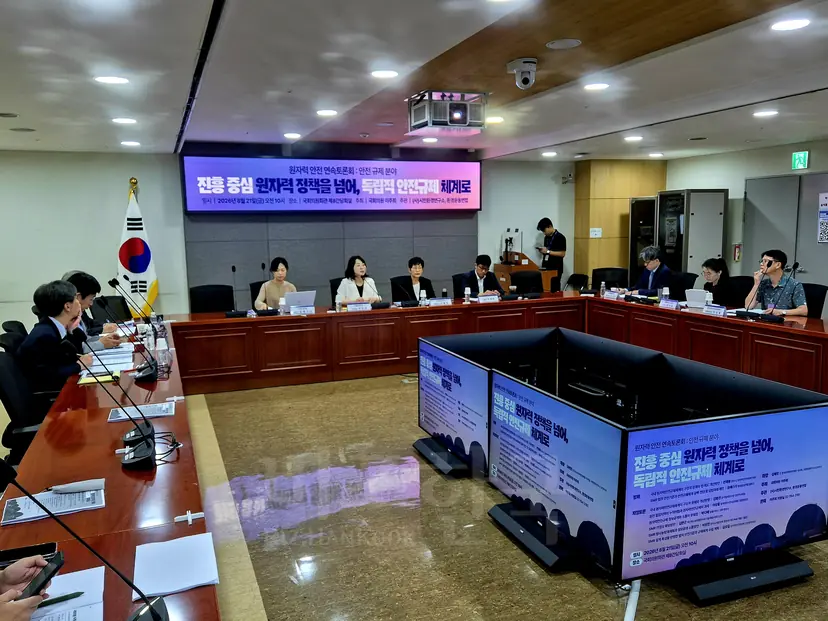
“Safer than existing plants… EPZ flexibility needed,” argue proponents
The Emergency Planning Zone (EPZ) is a legally designated area where evacuation and protective measures are pre-planned to minimize damage to human life and the environment in the event of a radiological emergency, such as a radiation leak at a nuclear power plant. Under the current ‘Act on Physical Protection and Radiological Emergency Management of Nuclear Facilities, etc.’, the zone is subdivided into the ‘Precautionary Action Zone (PAZ)’ within a 3–5km radius and the ‘Urgent Protective Action Planning Zone (UPZ)’ within 20–30km of the plant. In these zones, measures such as prompt evacuation and rescue system operations, pre-distribution and stockpiling of thyroid-blocking medication, management of disaster prevention materials, and maintenance of environmental radiation monitoring networks are carried out routinely, serving as the final line of defense for nuclear safety.
Nuclear operators, such as Korea Hydro & Nuclear Power (KHNP), argue that the current system acts as a major barrier to the commercialization and export of SMRs by applying a uniform 20–30km disaster prevention network regardless of a plant’s size or safety level.
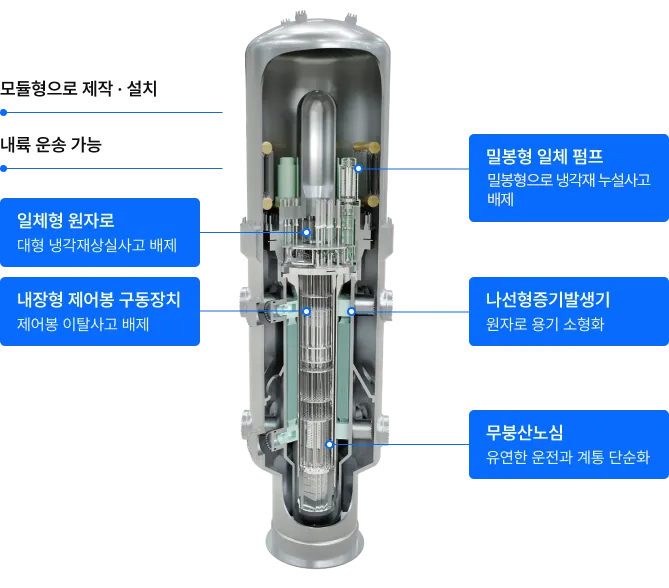
Traditional large-scale nuclear power plants have a structure where the reactor, steam generator, and coolant pumps are connected by numerous large pipes, necessitating constant preparation for large-scale loss-of-coolant accidents caused by pipe rupture. In contrast, the ‘Innovative SMR (i-SMR)’ being developed in Korea uses an ‘integrated design’ that houses all core reactor components inside a single steel containment vessel, effectively eliminating the connecting pipes themselves.
Furthermore, they have introduced ‘passive safety systems’ that cool the reactor using only natural phenomena like gravity and natural convection, without the need for external power or human intervention. The Innovative SMR Technology Development Agency explains that because the system can cool residual heat through natural circulation even if external power is cut off, the probability of a major accident is lower than that of large nuclear plants.
They emphasize that since the inherent high safety of the reactor itself minimizes the possibility of radioactive material leakage, legal grounds should be established to flexibly adjust emergency planning zones based on scientific verification rather than uniform distance regulations.
Lee Sung-jin, head of the SMR Development Group at KHNP’s Central Research Institute, who participated as a panelist, emphasized, “The i-SMR is being developed as a power source adjacent to electricity demand hubs like AI data centers, semiconductors, steel, and petrochemicals, with the goal of entering the global market in the 2030s,” adding, “Proximity to demand facilities is also necessary to directly utilize heat for applications like hydrogen production or regional district heating.”
He continued, “Potential overseas customer nations with limited land and high reliance on fossil fuels, such as Singapore, are demanding reactor models where the emergency planning zone is minimized to the level of the plant fence (site boundary),” arguing, “To compete with global models like NuScale or TerraPower from the U.S., we must establish scientific methodologies and flexible legal grounds that allow for the adjustment of emergency planning zones in proportion to safety.”
The proposal is to reduce the disaster prevention zone only when the operator can scientifically prove that even in a design-basis accident—an accident without significant damage to nuclear fuel—the radiation exposure to a resident just outside the plant fence (Exclusion Area Boundary, EAB) over 24 hours remains within safe limits (an effective dose of 10mSv or less) that cause no immediate harm to the human body, and that the containment vessel, the core defensive barrier, will not fail even in the worst-case scenario.
“Smaller output does not mean less risk”… Holes in evaluation criteria
However, civil society and regulatory experts are firm in their skepticism. They point out that reducing the disaster prevention zone solely because the power capacity has decreased is an act of underestimating the risk.
Yoo Esther, an activist from the Korea Federation for Environmental Movements’ Policy Change Team, criticized the proposal, stating, “SMRs are not just simple downsized versions of large nuclear plants; they are multi-module structures that operate several modules in one space. It is premature to discuss site-boundary EPZs without comprehensively evaluating the possibility of accident propagation from one module to adjacent ones, common-cause failures, and the total inventory of radioactive material from multiple modules.” She emphasized that if SMRs are added to areas already dense with nuclear facilities—such as the Kijang and Kori sites, which include decommissioned plants, operating plants, research reactors, and spent fuel storage—the cumulative risk for the entire region would inevitably increase exponentially.
Criticism was also directed at the conservative nature of the evaluation criteria. In the U.S., when the Nuclear Regulatory Commission (NRC) approved NuScale’s methodology for reducing emergency planning zones, they used the ‘total cumulative radiation dose (integrated dose)’ that nearby residents would be exposed to over 96 hours as a benchmark. They also imposed eight strict conditions, including worst-case accident scenarios where the containment vessel is breached or bypassed. In contrast, it is pointed out that domestic operators are setting the standard based on 24 hours and the assumption that the containment vessel does not fail, effectively excluding potential risks from the conclusion in advance. Activist Yoo Esther added, “We must be wary of the atmosphere where the site-boundary (inside the plant fence) EPZ—which is merely an operator’s ‘design goal’—is being treated as if it were a fixed regulatory standard.”
Residents living near nuclear plants also expressed their anxiety. Lee Sang-hong, executive director of the Gyeongju Citizens’ Coalition for Nuclear Phase-out, raised his voice, saying, “In a situation where the disaster prevention systems for existing large nuclear plants are operated only formally, the discussion on reducing SMR disaster prevention zones is a threat to the residents’ right to life.”
Director Lee proposed the establishment of a ‘buffer zone’ as an alternative to effectively strengthen resident protection. He suggested, “We should designate the closest villages (Ri-level) located on the border of the plant’s exclusion zone as a buffer zone, keep emergency disaster prevention supplies in every home at all times, and station dedicated disaster prevention educators who, like gas meter readers, would visit homes to inspect supplies and conduct regular evacuation drills.” He also emphasized the necessity of installing earthquake-resistant shelters for immediate evacuation in case of an emergency.
NSSC: Securing regulatory independence is key
The legal community emphasized the need to block the structural problem of safety regulations being weakened by the pressure for rapid technological development. Jin Jae-yong, a lawyer and commissioner of the Nuclear Safety and Security Commission (NSSC), suggested, “As the use of nuclear power expands, safety regulations must operate more independently and conservatively. We should codify fundamental prohibitions and strict exceptions in the ‘Nuclear Safety Act’ to prevent safety standards or emergency planning zones from being arbitrarily relaxed or exempted simply because it is an SMR or because automated designs are applied.”
Kim Sung-gil, Director of the Safety Policy Division at the NSSC, commented on this, stating, “Even if operators or developers propose that ‘this design is reasonable and safe,’ it is meaningless if the regulatory agency does not secure the independent R&D technology and analytical tools to verify it. Only with our own scientific and concrete evidence can we conservatively filter out the technical claims of operators and communicate with local residents.”