

[비즈한국] SK Hynix has once again broken its all-time quarterly record, posting an operating profit exceeding 60 trillion won in the second quarter of this year. This figure surpasses the total operating profit earned for the entire previous year (47.2063 trillion won) by more than 13 trillion won in just one quarter.
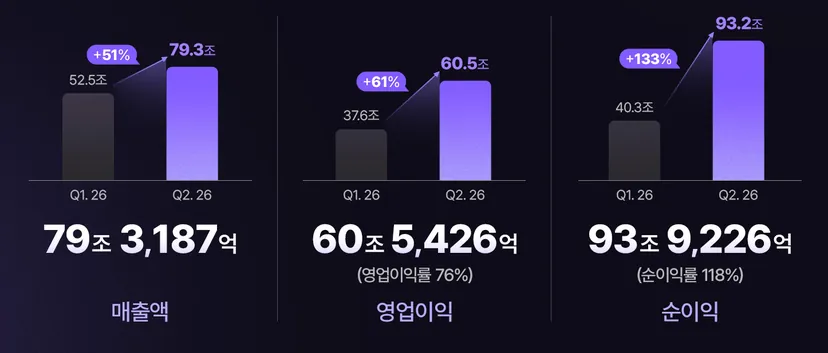
On the 29th, SK Hynix announced its preliminary consolidated earnings for the second quarter of this year, reporting revenue of 79.3187 trillion won and an operating profit of 60.5426 trillion won. Net profit stood at 93.9226 trillion won. Revenue increased by 256.8% and operating profit by 557.2% compared to the same period last year. Even when compared to the previous quarter, revenue grew by 50.9% and operating profit by 61.0%, breaking the record set just three months ago in the first quarter.
The operating profit margin rose by 4.8 percentage points from the first quarter (71.5%). This means that for every 100 won of revenue, 76 won remained as profit, a figure rarely seen in general manufacturing. This is due to the improvement in the product mix, driven by a significant rise in prices for DRAM and NAND general-purpose products—following the trend from the previous quarter—alongside an increased share of high-value products such as AI server DRAM and eSSD. With both prices and sales volumes rising in existing facilities, this is interpreted as a classic operating leverage effect, where a large portion of the increased revenue translates directly into profit.
Cumulative revenue for the first half of the year reached 131.895 trillion won, crossing the 100 trillion won mark for a half-year period for the first time, and cumulative operating profit also neared 100 trillion won at 98.1529 trillion won.
However, these results fell slightly short of market expectations, missing the market consensus (an operating profit of 63.5 trillion won) by 4.7%. Some suggest that because the outlook for expanded AI infrastructure investment and prolonged HBM supply shortages was already reflected in the stock price, even record-breaking earnings failed to exceed these high expectations.
Net profit reached 93.9226 trillion won, which is approximately 33 trillion won higher than the operating profit, even surpassing the total revenue. Financial stability has also improved significantly. At the end of the second quarter, cash and cash equivalents stood at 88 trillion won, an increase of 33.6 trillion won from the previous quarter, while borrowings decreased by 700 billion won to 18.6 trillion won. Net cash rose to 69.4 trillion won, nearly double the level of the first quarter (approximately 35 trillion won). There are forecasts that the "100 trillion won in net cash" goal announced by CEO Kwak Noh-Jung at the annual shareholder meeting earlier this year could be reached sooner than expected.
The market is now focusing on the possibility of increased shareholder returns based on this financial strength. It is widely expected that additional shareholder return policies, such as dividend hikes or stock buybacks and cancellations, may be introduced during the fourth quarter. Eugene Investment & Securities analyzed that if such measures are combined with the announcement of details regarding Long-Term Agreements (LTAs), it would boost confidence in the stability of long-term earnings and positively impact valuation.
The demand base is also expanding. SK Hynix stated that it has finalized negotiations for LTAs with over ten customers, including key accounts, and is continuing further negotiations with other major clients. The company explains that since Big Tech’s AI infrastructure investments are based on actual service revenue, the growth trend in demand is expected to continue.
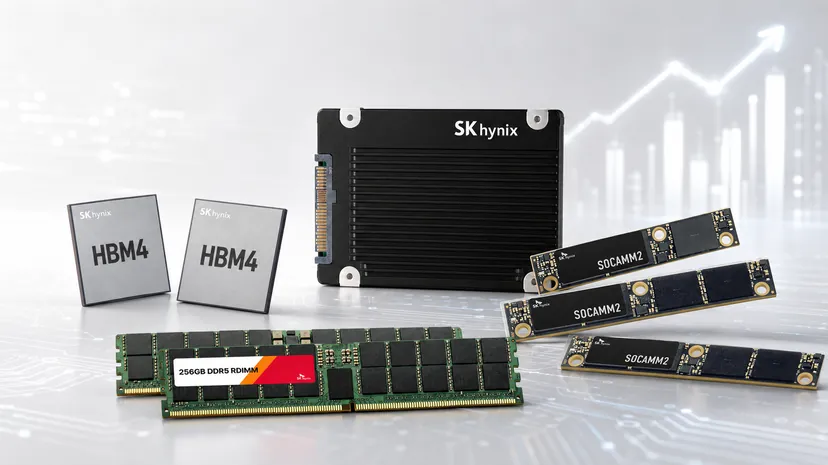
SK Hynix began mass production and shipment of HBM4 in the second quarter and plans to 본격적으로 (fully) expand production in the second half of the year. HBM4E, for which sample distribution was completed in the first half of the year, also utilizes an optimized process, and the production of SOCAMM2—a low-power memory module standard for AI servers—began in April, optimized for NVIDIA's "Vera Rubin." Sales of SOCAMM have increased significantly in the second quarter. For NAND, the company plans to raise the share of 321-layer products to 50% of its domestic production capacity by the end of the year.
Investment scale is also expanding. SK Hynix expects its capital expenditures (CAPEX) for this year to be in the high 40-trillion-won range, an increase of more than 15 trillion won from last year (30.173 trillion won). It is simultaneously moving up the mass production schedule for Cheongju's M15X and investing to expand production capacity in line with the opening of the cleanroom for the first phase of the Yongin fab in early 2027.
The company plans to push forward with mid-to-long-term investment plans—such as the recently announced advanced packaging plant P&T7, the NAND production base M17, and the creation of a new semiconductor cluster—in stages, while considering customer demand and investment efficiency.
These results demonstrate the pricing power SK Hynix has secured in the AI memory market, as well as the heightened market expectations for the semiconductor industry. However, as competitors such as Samsung Electronics and Micron are also increasing their investments in HBM and AI server memory, attention is turning to how long this exceptional level of profitability can be maintained.