

[비즈한국] SK Biopharmaceuticals is expanding the role of artificial intelligence (AI) in its drug research and development (R&D) process, shifting it from a tool that assists researchers to an entity that performs actual research. The company’s plan is to increase the speed and efficiency of drug discovery by building a system where AI agents carry out parts of the research process.
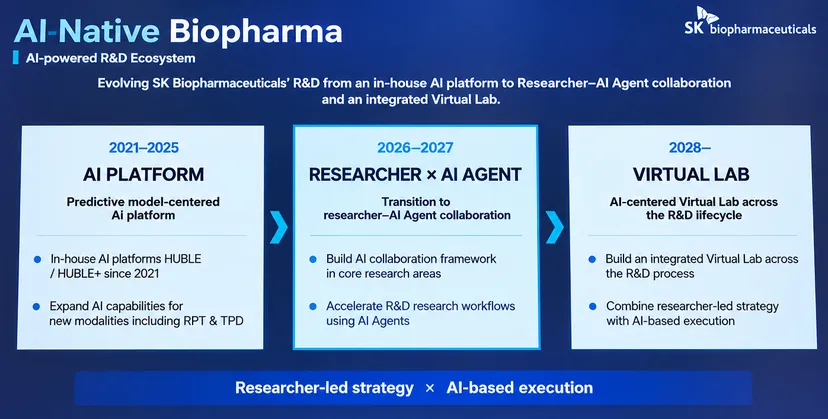
SK Biopharmaceuticals plans to implement its “Virtual Lab,” where AI agents perform drug research, to a certain level by 2028. This move realizes the step-by-step roadmap unveiled at Bio USA last June, which spans from the deployment of “AI Agents” in 2026–2027 to the realization of the “Virtual Lab” from 2028 onwards.
An official from SK Biopharmaceuticals stated, “It is not that we are starting construction in 2028, but rather that we are building it in stages based on our current AI infrastructure and research capabilities, with the goal of reaching a certain level of ‘Virtual Lab’ implementation by 2028.”
From Research Using AI Models to Research Conducted by AI
The core of the Virtual Lab lies in expanding the user of AI models from human researchers to AI agents.
Currently, researchers directly utilize AI tools such as *in silico* (computer-based virtual modeling) prediction models. In the future, AI agents will utilize the necessary models to carry out research tasks and propose results. Based on this, researchers will establish research strategies and oversee key decision-making processes.
The company also aims to establish a 24-hour research system where AI agents continue work regardless of human working hours. However, this does not mean that “physical AI”—where robots perform actual synthesis or experiments in a laboratory—will be implemented by 2028.
An SK Biopharmaceuticals official explained, “It is difficult to implement physical AI by 2028. We are first focusing on creating an environment where we can apply AI research tools to candidate discovery and synthesis tasks previously performed by humans, allowing research to continue without time constraints.”
The company is also moving in earnest to build the Virtual Lab infrastructure. Last September, it signed a contract to introduce computing resources equivalent to 128 NVIDIA B200 GPUs. SK Biopharmaceuticals plans to use these Blackwell-based AI accelerators to develop foundation models specialized for bio-healthcare, create proprietary optimized models, and embark on the AI transformation of translational research (TR-AX). An official noted, “The introduction of GPUs is indeed part of the process of building the Virtual Lab.”
Beyond Candidate Discovery to Preclinical Stages: Connecting Research Phases
The role of AI agents will not stop at candidate discovery. SK Biopharmaceuticals plans to extend the scope of AI utilization from initial discovery through to the development phase.
“While traditional virtual labs were focused on the discovery phase, the differentiating factor here is implementing agents to autonomously handle the entire preclinical process, from lead optimization and preclinical studies to the stage of applying animal-based results to humans,” said an official.
A key aspect is not just using AI at each stage, but connecting the entire research process. By linking the Virtual Lab and the translational research system via Large Language Models (LLMs), the company intends to consider how choices made in earlier research will affect subsequent preclinical and clinical stages. Ultimately, they aim for a research system that considers everything from candidate development to the future probability of clinical success.
However, this does not mean immediately replacing animal testing with AI. The plan is to perform necessary tests while using AI to select candidates with high potential, thereby reducing the number of experiments and gradually expanding the scope of replacement.
60% Reduction in Discovery Time; Expanding AI to In-Licensed Candidates and RPT
Some AI technologies are already being applied to actual research. According to SK Biopharmaceuticals, the ROR1 binder discovery research conducted in collaboration with SK Telecom reduced the duration by more than 60% compared to traditional methods.
While the company did not disclose figures regarding reductions in the number of experiments or costs, it explained that because conditions vary for each study, it is difficult to calculate a uniform reduction rate for experiments or costs.
The scope of AI utilization is expanding beyond in-house drug development to the introduction of external candidate substances. The company plans to support decision-making in the license-in review process by analyzing data related to candidates and targets, thereby increasing the efficiency of asset evaluation.
AI is also being incorporated into new modalities. In particular, the company is pursuing AI-based development for RPT (Radiopharmaceutical Therapy) and is reviewing the potential for AI utilization in the discovery, design, and evaluation processes for modalities like Targeted Protein Degraders (TPD).
AI Expansion Moves and Synergy with SK Group’s Drug Development
SK Biopharmaceuticals’ establishment of a Virtual Lab is aligned with the SK Group’s broader movement to spread AI across its subsidiaries’ business domains.
SK Telecom is reorganizing its business structure around telecommunications and AI, expanding its AI data centers, proprietary AI models, and B2B/B2C AI services. It is also accelerating infrastructure investment, such as establishing “SK Hyper,” a specialized company for AI data center business development, and pledging to invest 750 billion KRW by 2030.
SK Networks, positioning itself as an AI-centered business holding company, is pursuing investments in AI firms and the AI transformation of its existing businesses.
Points of intersection with the pharmaceutical and biotech sectors have also emerged. The 128 NVIDIA B200 GPUs introduced by SK Biopharmaceuticals are being utilized through a cloud subscription to “Haein,” a data center cluster built by SK Telecom. This is a case where SK Telecom’s AI infrastructure is linked to the foundation of SK Biopharmaceuticals’ drug development research. Furthermore, Phoenix Lab, a Silicon Valley AI startup established in cooperation with SK Networks, is targeting the pharma-bio market by developing “Chiron,” an AI operating system for drug programs.
SK Biopharmaceuticals CEO Lee Dong-hoon also highlighted the ability to leverage the group’s AI capabilities as a strength during the last Bio USA. He noted, “AI is one of the most important agendas for the entire SK Group, and we can receive help from the AI-related competencies within the group, such as SK Telecom and SK Hynix.”