

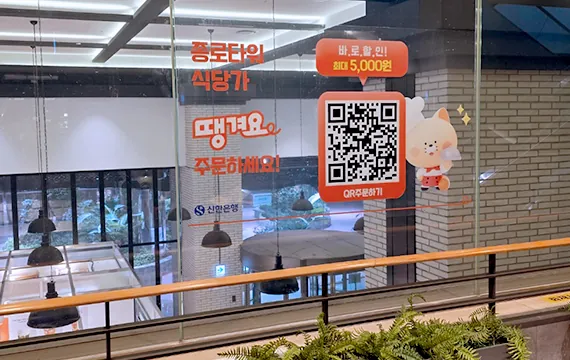
[비즈한국] Shinhan Bank’s delivery app ‘Ddaengyo’ has withdrawn its plan to increase customer delivery fees just one day after its introduction, following backlash from small business owners. While Shinhan Bank had intended to address rider shortages and delivery delays through delivery fee adjustments, the plan's collapse has left it with the task of finding alternative solutions to improve dispatching issues.
‘Riders not being picked up’ leads to fee hike… stopped by small business owners’ opposition
‘Ddaengyo’, the delivery app operated by Shinhan Bank, pushed for a plan starting September 1 to increase the customer-borne delivery fee for its proprietary delivery service, ‘Ddaeng-Delivery’, from the existing 900 won to a maximum of 2,100 won. Until last month, customers using Ddaeng-Delivery paid a flat 900 won regardless of the delivery distance, but the plan was to switch to a tiered fee system based on distance starting in September.
As the revised plan became known, concerns were raised among small business owners that an increase in customer-borne delivery fees would ultimately lead to higher costs for store owners. As opposition in the field grew, Ddaengyo re-examined the fee restructuring and eventually announced that it would scrap the plan on September 2, just one day after it took effect.
The Seoul Metropolitan Government, which operates the public delivery project alongside Ddaengyo, understood that the delivery fee hike stemmed from concerns over securing riders and improving delivery quality. A Seoul city official said, “In a situation where competition to secure riders to improve delivery quality is fierce, it appears Shinhan Bank also agonized over response measures. In this process, there was an aspect where the attempt to find a self-rescue measure was implemented somewhat clumsily.”
A Shinhan Bank official stated, “The intention was to improve the profitability of delivery riders and preserve the local delivery agency market. However, we determined that there were aspects of the implementation process where the burden on ordering customers and franchise owners was not carefully considered, and thus we decided to withdraw it.”
Complaints regarding dispatch delays have been consistently raised by small business owners and customers using Ddaengyo. One small business owner said, “When an order comes in through Ddaengyo, it takes a minimum of 40 to 50 minutes for a delivery rider to be assigned. On rainy days, it has even taken 2 hours,” adding, “Ultimately, customers cancel their orders, causing significant losses to small business owners.”
Industry analysts suggest that the contraction of the delivery agency market is exacerbating Ddaengyo’s dispatch delay issues. Unlike Baemin (Baedal Minjok) and Coupang Eats, which operate their own rider networks, Ddaengyo relies on external delivery networks, meaning the decline of local agencies directly impacts rider availability.
An industry official stated, “As Baemin and Coupang Eats expanded their own delivery services, orders that used to go to local delivery agencies dropped significantly, and the declining volume led to lower profitability, causing more agencies to close down,” adding, “There used to be 4 or 5 agencies in one area, but now there are areas where only one remains. Ultimately, the local agency network that supplies riders has weakened, making dispatching difficult.”
Cannot raise fees and deliveries remain slow… what is Ddaengyo’s next move?
Small business owners also agree that Ddaengyo’s dispatch delay issue must be addressed. However, they are raising questions about whether increasing customer delivery fees will actually lead to securing more riders and improving dispatching.
An official from the Association for Fair Platforms stated, “Just because the delivery fee paid by customers and store owners increases, it does not mean that the full amount is offered to riders from the start. They use a method where they attempt dispatching with a lower amount and then gradually increase the price if no rider picks it up,” adding, “Ultimately, it is difficult to see how higher delivery fees for customers would immediately speed up dispatching.”
There is also deep concern that the customer delivery fee hike would eventually return as a cost burden on small business owners. The association official explained, “On Ddaengyo, store owners must cover the customer’s delivery fee to set it as ‘free delivery’ in order to be exposed at the top of the list,” adding, “As the visibility of a delivery app depends on top-tier placement, store owners have no choice but to try and maintain the ‘free delivery’ title even if they have to pay additional costs. In the end, if customer delivery fees rise, it is highly likely that the increase will be passed on to the store owners.”
Since last year, Ddaengyo has begun focusing on acquiring users by expanding marketing efforts such as coupons and promotions. According to Mobile Index, Ddaengyo’s monthly active users (MAU) increased from 1.63 million in June of last year to 3.55 million in December. However, the upward trend has since broken. The number of users has been steadily declining this year, falling to 2.25 million as of August. The gap with Baemin and Coupang Eats remains significant. As of August, the MAU of Baedal Minjok was 24.4 million, and Coupang Eats was 14.44 million.
The Seoul Metropolitan Government believes that for public delivery apps to keep private platforms in check and secure long-term self-sustainability, they need to increase their market share. A Seoul city official said, “If public delivery apps are to play a role in checking market-dominant operators, they need to expand their market share,” adding, “Platforms find it difficult to achieve self-sustainability if they cannot secure a certain level of users. As we cannot continue to pump in budget policy-wise, they must grow to a level where they can operate independently.”
Securing stable delivery competitiveness is considered the top priority for Ddaengyo to expand its market share. However, specific alternatives to replace the withdrawn delivery fee hike plan have not yet emerged. A Seoul city official said, “It is a difficult situation to find an immediate, effective solution in the field,” adding, “I understand that they are considering various measures.”
A Shinhan Bank official stated, “Currently, rather than re-promoting a delivery fee hike, we are looking for ways to improve dispatching issues. We are continuously reviewing ways to shorten delivery times, such as increasing rider recruitment and improving the efficiency of dispatch operations, and we plan to improve inconveniences that occur during the use of our delivery service as well.”