

[BizHanKook] A neatly dressed bank teller on the screen says, “Let me inform you of the precautions.” She raises her hand and tilts her head slightly. Can you distinguish whether the bank teller on the screen is a real person or an artificial human (AI human)? This question, which arose during the 2022 Shinhan Bank “AI Bank Teller Advancement” project bidding, led to a lawsuit spanning about four years.
As the project required AI technology, the bidding process included a task to submit a “recorded video using an artificial human.” However, an allegation was raised that the video submitted by the company selected as the preferred bidder was a “human video, not AI,” and an analysis commissioned by the court also suggested that it was highly likely to be a live-action video. Nevertheless, the party that lost the lawsuit was the company that raised the objection. Why did the analysis results and the court ruling differ? We examine the four-year dispute surrounding the AI bank teller advancement project bidding.
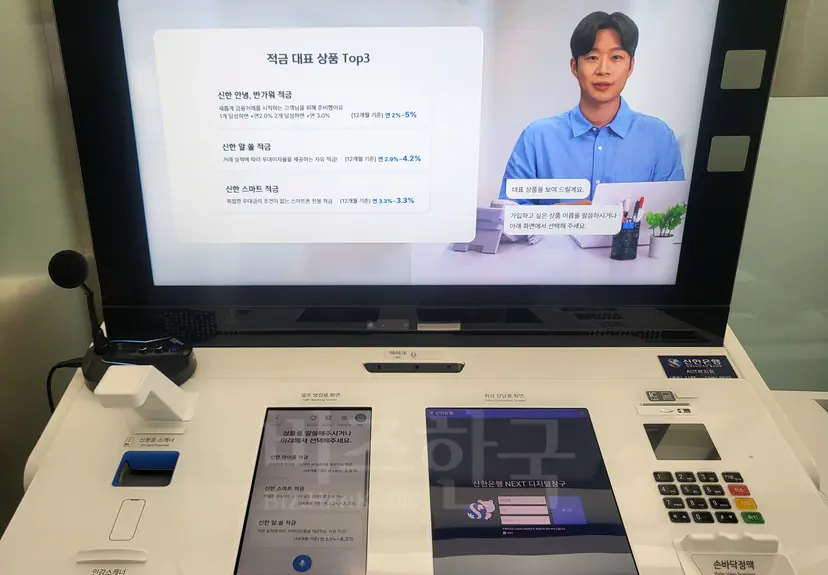
“Live-action video” controversy erupts in AI bank teller bidding
On September 18, the 22nd Civil Division of the Seoul Central District Court ruled in favor of Shinhan Bank in a lawsuit for confirmation of the invalidation of the preferred bidder selection, filed by Maum AI against Shinhan Bank, with DeepBrain AI participating as a defendant intervener. Maum AI also requested 1.5 billion KRW in damages, but this was not accepted either.
Maum AI is a KOSDAQ-listed company that conducts agent AI, robot, and physical AI businesses. At the time of listing, the company name was Minds Lab, but it changed to its current name in March 2023. DeepBrain AI is an AI video generation and conversational AI service company based on AI human technology.
Maum AI’s claims were mainly twofold. First, the selection of DeepBrain AI as the preferred bidder was invalid because Shinhan Bank violated evaluation criteria during the June 2022 “AI Bank Teller Advancement Project” bidding; and second, Shinhan Bank caused losses by unfairly conducting the bidding process, violating its obligations as a bidder.
The legal dispute between Maum AI and Shinhan Bank/DeepBrain AI began in November 2022. Shinhan Bank, which opened the industry’s first unmanned branch with an AI bank teller in September 2021, conducted the bidding for the advancement project in June 2022. Two companies competed in the bidding, and after a technical evaluation, DeepBrain AI was selected as the preferred bidder on June 23, 2022.
On the day the preferred bidder was announced, Maum AI immediately raised an objection. It was not just a protest against being eliminated. What Maum AI demanded was “video verification.” They raised suspicions that the video submitted by DeepBrain AI during the bidding process was not a recording of an artificial human, but a “live-action video” filmed with a real person.
Since the AI bank teller must provide financial services on behalf of staff, it requires technical capability to naturally implement human expressions and movements. The task for the AI bank teller specified in the Request for Proposal (RFP) was jeonse (charter) loan consultation. The AI bank teller had to greet customers, check waiting numbers, receive identification cards, and connect customers with consultation staff.
During the selection process, Shinhan Bank required companies to submit a video “recorded by applying an artificial human to a specific screen within a digital desk” and an “artificial human for mobile/PC.” The task required meeting a certain quality level in areas such as the naturalness of the artificial human, model expressions, facial movements, voice tone, speech reflecting emotions and expressions, lip-syncing, and behavioral motions.
At the time, it was common to use “Speech to Face (STF)” technology when creating artificial humans. STF technology involves filming a human model’s movements and various speech segments, then training an AI model with video data of the movements, voice, and mouth area motions. After the learning and post-processing stages, the artificial human can generate a video that looks as if the actual model is speaking according to the entered text. Maum AI had submitted an artificial human video using STF technology.
The suspicion regarding the live-action video arose while playing the videos created by each company on Shinhan Bank’s digital devices. Maum AI, having viewed the video submitted by DeepBrain AI, concluded it was a live-action video. After the announcement of DeepBrain AI as the preferred bidder, Maum AI objected to Shinhan Bank, claiming that the video verification method was unfair. Maum AI proposed a verification method of running an AI server on-site to reproduce the same video as the submission, but Shinhan Bank did not accept it.
With no video verification taking place, Maum AI eventually filed a lawsuit. In 2024, while the trial was ongoing, the case took a new turn when the court commissioned the “Legal Video Analysis Institute” to conduct an analysis of the video submitted by DeepBrain AI. The Legal Video Analysis Institute is led by Hwang Min-gu, a renowned domestic video analysis expert, and is a company that scientifically analyzes evidence videos requested by courts, police, the military, and fire departments.
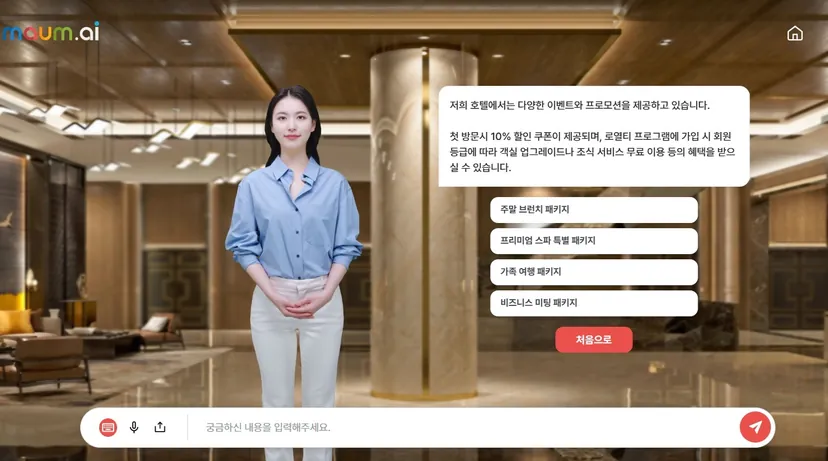
The analysis results released by the Legal Video Analysis Institute in May 2025 supported Maum AI’s claim. The opinion stated that the video submitted by DeepBrain AI was highly likely to be a live-action video filmed with a person rather than an artificial human recording.
According to court analysis reports and expert opinions obtained by Biz Hankook, the Legal Video Analysis Institute based its findings on: △the fact that the encoding process for outputting video after artificial human production could not be confirmed, △the presence of video glitches unlike regular artificial human videos, △observed eye movements of the model reading text when reading long sentences, and △shadows occurring around the mouth according to the speaker’s hand gestures. They concluded that “many patterns exist that are difficult to appear in artificial human technology” and “it is more likely to be a live-action video than an AI video via deepfake.”
Bidding invalidation not recognized despite live-action controversy
However, despite the court’s analysis, the lawsuit ended in defeat for Maum AI. While the court acknowledged that DeepBrain AI did not submit an artificial human video, it did not view this as sufficient reason to overturn a contract between private companies. It also noted that Shinhan Bank reflected various qualitative and quantitative evaluation factors of the technical assessment in addition to the video when selecting the preferred bidder.
The court judged, “Maum AI’s claims or evidence alone do not prove that Shinhan Bank’s verification of DeepBrain AI’s submission and the process of maintaining the preferred bidder status violated the principle of good faith,” adding, “It is more important whether an appropriate level of verification procedure was conducted at the time than whether DeepBrain AI’s submission was a live-action video.” Regarding Shinhan Bank, it ruled, “It is difficult to see that the fairness of the bidding was harmed to the extent of infringing upon the plaintiff’s legal interests due to a violation of good faith.”
As Maum AI gave up on an appeal, the ruling was finalized on October 3. When asked about the reason for giving up the appeal, Yoo Tae-jun, CEO of Maum AI, replied, “It was because we confirmed through the court analysis that the opposing company had submitted a live-action video. The bid project is already over. We saw that it would be difficult to overturn the result legally.”
CEO Yoo emphasized, “With this ruling, I believe ordering organizations will further strengthen and include their own autonomy in selection in their Requests for Proposal. I think there needs to be a limit to prevent ordering organizations, which already hold significant power, from wielding unilateral authority over bidding companies.”
Meanwhile, DeepBrain AI and Shinhan Bank unveiled a new, advanced AI bank teller in July 2024 while the trial was ongoing. Created by filming five employees working at Shinhan Bank and synthesizing their video and voice, the artificial human has been deployed in smart kiosks and digital desks at Shinhan Bank branches nationwide.
When asked for their position on the lawsuit, DeepBrain AI responded, “The submitted video was produced using our AI human technology. It is a method of generating facial and mouth movements according to speech using a dedicated model trained on a specific person’s data, then combining it with motion video; this is still widely used in the AI human industry. We sufficiently clarified this during the trial process,” and added, “We have been supplying AI bank tellers to major domestic banks. The Shinhan Bank AI bank teller unveiled in 2024 was modeled after actual branch employees, making expressions and movements more natural, and it has been upgraded to handle various consultation tasks at digital desks.”
Shinhan Bank stated, “It is a matter that has been concluded by the court as the trial is over,” and “It is difficult to comment as there is a possibility of further disputes.”