

[BizHanKook] It has been confirmed that a store in Shanghai, China, bears a striking resemblance to the Korean fruit mochi brand Hanjungsun—known for causing "open-runs" (queues before opening)—in terms of its trade name, store layout, and packaging. The store uses the sign '韩贞仙,' which is the simplified Chinese character version of Hanjungsun's Korean name, '韓貞仙.' Locally, trademarks with the same name have already been registered or filed across various sectors, including food, beverages, and restaurants. As stores imitating Korean brands appear overseas, riding the wave of K-Food popularity, the issue of trademark protection for domestic brands preparing for global expansion is being highlighted once again.
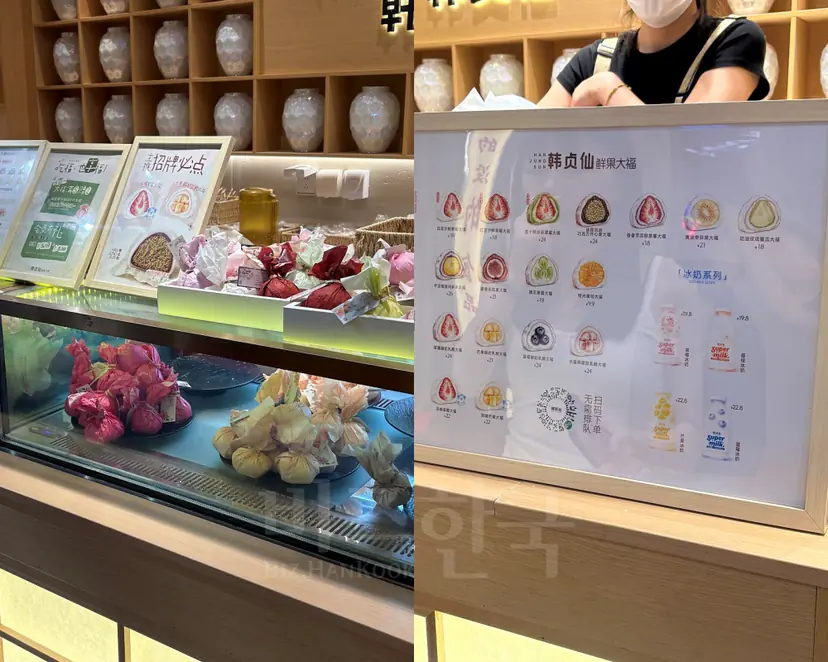
Similar store layout, even uses 'HANJUNGSUN' in English
The Shanghai store recently opened in the Raffles City shopping mall in the North Bund area. It is also operating under the name '韩贞仙' on local Chinese map and delivery apps.
Looking at the interior, the front wall is filled with wooden lattice shelves, and ceramic containers are placed in each compartment, mirroring the layout of the domestic stores. The English notation on the signboard is also 'HANJUNGSUN,' the same as the domestic stores. It is a direct phonetic transcription of the Korean name without spaces, which differs from the pronunciation of the Chinese characters in Chinese, "Han Zhen Xian."
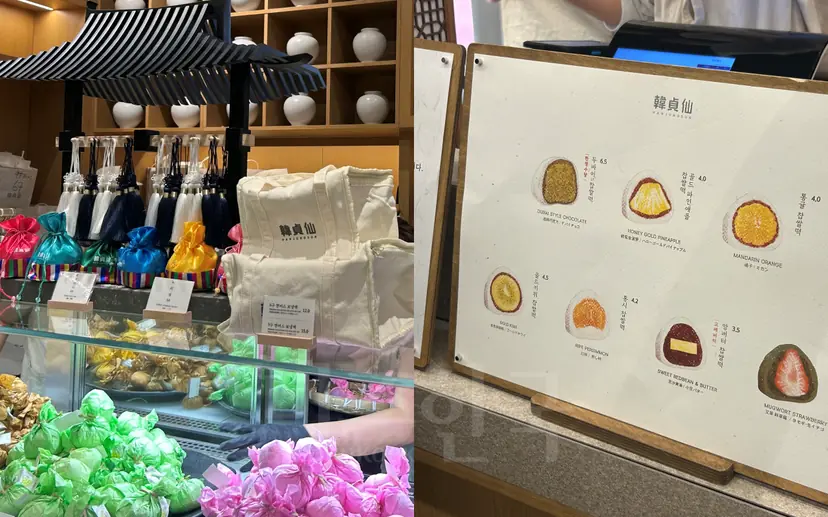
Similarities are also found in product packaging and display methods. Both stores sell mochi wrapped individually in differently colored paper, gathered and tied at the top in a pouch style. The practice of color-coding the packaging by product and arranging them by flavor in refrigerated display cases is the same. In the case of the menu boards, both use a format that displays the product name and price next to an illustration depicting the cross-section of the mochi. However, there are differences: the Shanghai store uses the Japanese term 'Daifuku' (大福) for its product names and has added menu items reflecting local tastes, such as durian and taro.
The menu boards and price tags at domestic stores list product names in Chinese and Japanese alongside Korean and English. A store official explained, "Among our foreign customers, those from Northeast Asian countries like China and Japan outnumber those from Western countries."
Hanjungsun stated, "The store located in Shanghai, China, is not an official branch of Hanjungsun, and we have not approved the opening of the store or the use of our brand."
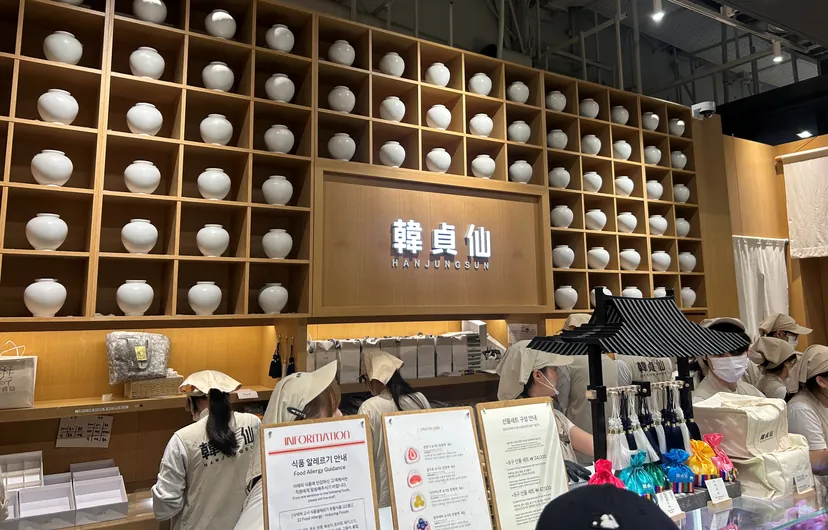
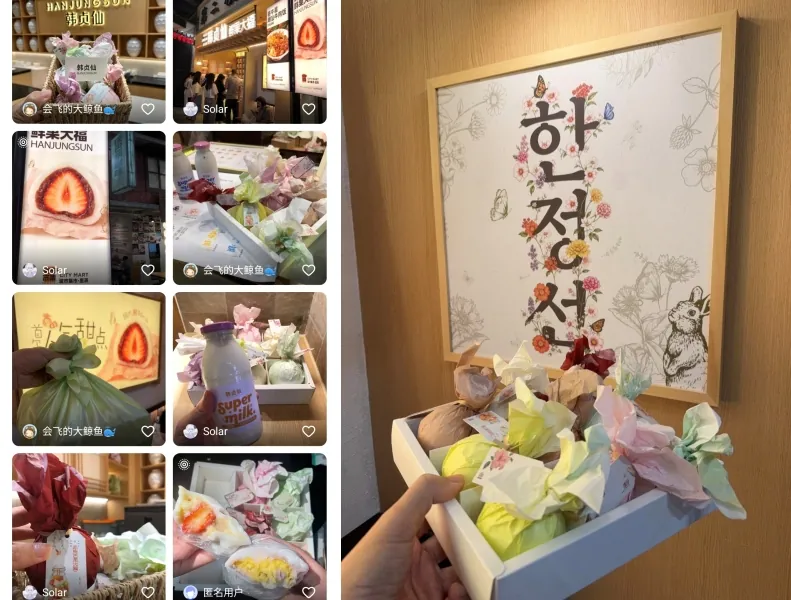
Hanjungsun is a fruit mochi specialty brand that began in Seongsu-dong, Seoul. As products containing whole fresh fruits like strawberries, tangerines, and shine muscat inside mochi went viral on social media, the brand expanded its sales footprint into department stores and complex shopping malls.
Local trademark filings and registrations for ‘韩贞仙’ follow
According to Chinese trademark registration information, five trademarks with the identical Chinese characters '韩贞仙' have been identified as filed or registered. These involve securing similar trademarks across different product and service sectors such as food, beverages, and restaurants. Trademarks are registered by category of goods and services; among these, the food (Class 30) and beverage (Class 32) sectors have already completed registration.
The Class 32 trademark was filed by a Shanghai-based company in February 2025 and registered in August of the same year. The trademark includes the Chinese characters along with the English 'HAN JUNG SUN,' a transcription of the Korean pronunciation. The Class 30 trademark was filed by an individual in November 2025 and registered in June of this year. Under the same individual's name, filings have also continued in advertising/sales (Class 35) and restaurant/lodging (Class 43) sectors. The Class 35 filing was made last July and publicly announced for initial review on September 20, while the Class 43 filing was made last August and is currently under review.
Separately, a trademark in Class 43 was identified that was filed on October 31, 2023, and registered on April 14, 2024. This was registered under a different company name. The relationship between these five applicants and the operators of the Shanghai store has not been determined.
China adopts the "first-to-file" principle, which grants trademark rights to the party that files first. Consequently, domestic companies that have not secured local trademark rights in advance may face restrictions on trademark usage or business expansion during their overseas entry process.
The shaved ice franchise Sulbing entered China in 2015 but shut down its business around 2017 after being blocked by similar trademarks like 'Sulbing Yuan Su,' which had been registered first by local firms. It had to return approximately 960 million won in contract fees to local partners. Sulbing only managed to get the 'Sulbing Yuan Su' trademark invalidated by the China Trademark Office in 2021. In January of this year, an 'ONLY YOUNG' store appeared in Changsha, Hunan Province, which was controversial for its similarity to Olive Young in terms of brand name, logo, signboard color, and product display method.
Institutional changes are also on the horizon. China will implement a comprehensively revised Trademark Law starting January 1, 2027. This law allows for warnings and fines of up to 100,000 yuan (approximately 22 million won) to be imposed on those who file applications with the intent to imitate or preemptively register the trademarks of others while knowing they belong to someone else. Acts of filing large quantities of trademarks without the intent to use them and significantly exceeding normal business needs are also specified as grounds for refusal of registration.
The Intellectual Property Office has advised that since the revised law emphasizes the actual use of trademarks, it is necessary to systematically manage evidence of trademark use, such as sales, advertising, and distribution data within China. On July 30, the government opened the 'Fake K-Brand Reporting Center,' where people can report overseas counterfeit goods, unauthorized trademark preemption, and cases of copycat store atmospheres with photos.
According to the Intellectual Property Office and the Korea Intellectual Property Protection Agency, the number of suspected unauthorized K-brand trademark preemptions overseas increased from 5,015 in 2023 to 9,520 in 2024, and to 11,485 in 2025. This is a 2.3-fold increase over two years. By industry, franchises accounted for the most cases last year, with 1,973. Out of 5,038 cases identified across 10 countries from January to July this year, China accounted for approximately 39% with 1,964 cases.