

[비즈한국] The Bank of Korea's Monetary Policy Board raised the base interest rate by 0.25 percentage points to 3.00% per annum on the 27th. This marks two consecutive months of hikes, following the July increase, and the first back-to-back rise in three years and seven months. The primary reason was inflation. Although the consumer price index in July fell to 2.8%, core inflation actually rose to 2.6%, leading the Bank of Korea to revise its annual core inflation forecast upward from 2.4% to 2.5%. Crucially, the growth outlook was raised by 0.7 percentage points, from 2.6% to 3.3%. This suggests that if the semiconductor-led growth remains this robust, the burden on the economy from higher interest rates will be mitigated, while inflationary pressure on the demand side, fueled by income and consumption, will intensify.
However, inflation alone does not explain everything. Eight out of ten bond market experts predicted a freeze. Most of them did not deny the possibility of further hikes but believed the BOK would take a break in August and hike in October or November—they differed on the timing, not the direction.
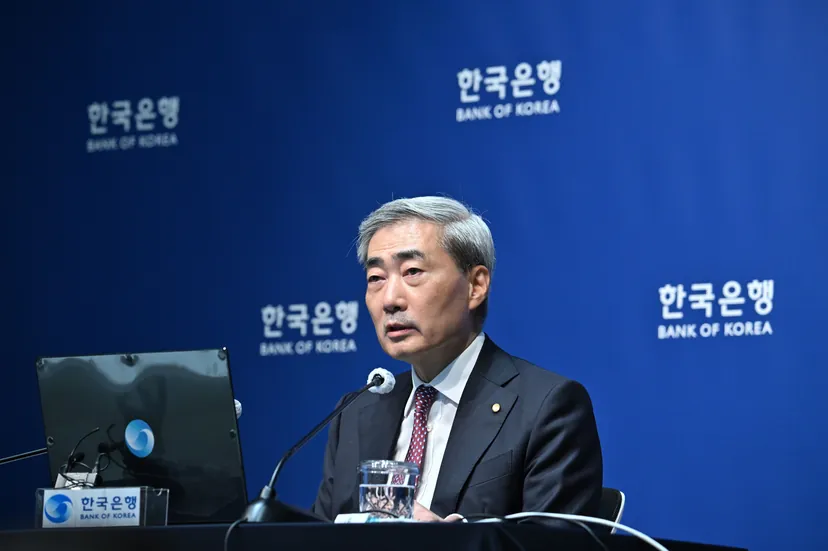
Governor Shin Hyun-song explained the basis for this weighting at a press conference in Seoul on the 27th and again at Jackson Hole on the 28th (local time). It is the Financial Vulnerability Index (FVI). This index aggregates 64 indicators across three pillars—credit, asset prices, and financial institution resilience—into a single figure. A value of 100 represents the second quarter of 1997, just before the Asian financial crisis. The index hit 79.5 during the global financial crisis and 65 just before the Legoland crisis, then dropped to the 37 level before rising sharply to reach its long-term average today. Governor Shin predicted that the figure to be released during the September review is highly likely to exceed this level.
What is particularly noteworthy is that the Governor treated this index as a problem entirely different in nature from inflation. Governor Shin stated that inflation can be managed eventually, even if late. Much like Paul Volcker, one could hike rates to 20% and endure a recession, but prices can be brought under control. However, he argued that financial vulnerability is different. Once austerity is implemented after the vulnerability is already heightened, it is like "bursting it with a needle"—if you miss the chance to handle it with a hoe, you won't be able to handle it with a spade later.
The market interpreted this decision as a signal of speed adjustment. The resolution statement omitted language indicating continued hikes, and among the 21 dots on the forward-looking dot plot for the next six months, 3.25% is the most common, appearing 10 times. Securities firms generally expect a freeze in October. However, views on the timing of the next hike are split between November and the first quarter of next year, and there is disagreement on whether the terminal rate will be 3.25% or 3.50%.
However, the FVI's breakout above its long-term average, which Governor Shin forewarned, is set for September. A breakout itself does not automatically mean a hike. Governor Shin noted he would look at housing prices, credit, and leverage, along with the index level and its rate of growth, and said he would check the August/September inflation data and preliminary Q2 GDP before the October Monetary Policy Board meeting. Still, if a sharp upward trend is confirmed in September and housing prices in the metropolitan area and household debt do not stabilize, the market's timeline of waiting until next year could be shaken.
The same goes for rate cuts. Looking only at consumer prices is insufficient to gauge the timing. Even if core inflation and growth slow down, if housing prices, household debt, and the FVI continue to rise, cuts could be delayed beyond expectations. This is why the September financial stability review material has become as important a schedule as the inflation announcement.
The U.S. is headed in the same direction. On the same day, Federal Reserve Governor Kevin Warsh stated at Jackson Hole that inflation has exceeded the target for 65 months, the target is 2% PCE inflation, the tool is short-term interest rates, and therefore, there is work left to do. Governor Shin interpreted this as a significant hint regarding the September Federal Open Market Committee (FOMC) meeting. However, he clarified that just because the U.S. hikes rates does not mean we must automatically follow suit, nor is it a matter of calculating the interest rate spread using arithmetic.
What is noteworthy is Warsh's comment on reducing "constant forward guidance." The logic is that the more a central bank speaks, the more the market loses its ability to discover prices on its own—and one of the academic foundations for this, coincidentally, is Governor Shin's own research. In a situation where there is less reliance on central bank announcements, investors must directly bear the potential for the consensus to be wrong and the shocks that follow. It is a question not of what to buy or sell, but of how large to bet.
For starters, if you have a new mortgage, it is worth recalculating the proportion of fixed rates. Investors who bought U.S. long-term bond ETFs in anticipation of rate cuts should see the warning light regarding strategies that significantly increase duration. Furthermore, if the possibility of additional interest rate hikes remains, the strategy of rolling over short-term maturities may be maintained for the time being.
Finally, there is the exchange rate. The won-dollar exchange rate closed at 1,372.5 won in the daytime session on the 28th. This is the lowest in 13 months and a new yearly low. Governor Shin said in Seoul on the 27th that there is room for further appreciation of the won, and at Jackson Hole the next day, he assessed that while the exchange rate is still high compared to historical averages, the appropriate level is for the market to decide. He dismissed concerns that $200 billion in U.S. investment would drive up the exchange rate, noting that the annual execution limit is at most $20 billion—and even that is just a "maximum"—and that it can be handled by investment returns from foreign exchange reserves alone. For investors who have calculated the exchange rate as part of their profits, setting currency gains to zero is not enough. It is time to recalculate by including how much currency loss might occur due to the strengthening won. Preventing trouble with a hoe while you still can is not just the job of the central bank.