

[비즈한국] According to the Seoul Real Estate Information Plaza, an analysis of residential real estate transactions in Seoul from 9:00 AM on October 19 to 9:00 AM on October 23 shows that high-priced apartments in Gangnam-gu and Seocho-gu topped the list. A 6th-floor unit at Shin-Hyundai 12th in Apgujeong-dong, Gangnam-gu, with a dedicated area of 182.95㎡, recorded the highest weekly transaction price at 9.2 billion KRW. However, while high-priced transactions in the Gangnam area dominated the top rankings, overall price indicators for Seoul showed a downward trend in Gangnam-gu and Seocho-gu.
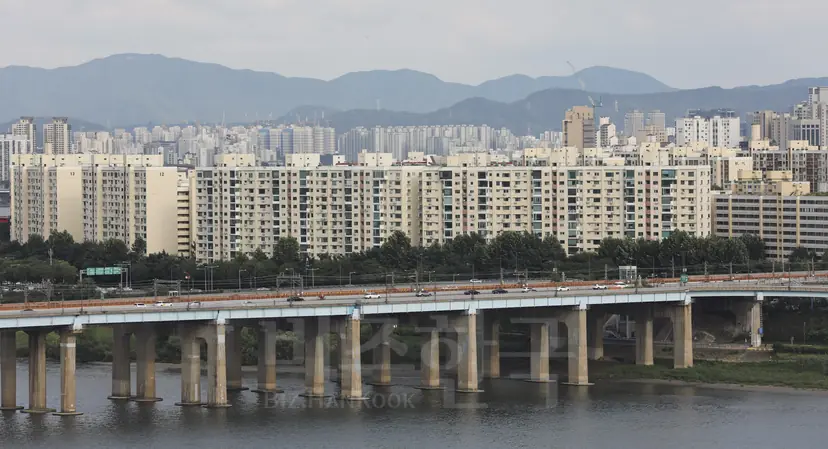
The No. 1 transaction, a 6th-floor unit of 182.95㎡ at Shin-Hyundai 12th in Apgujeong-dong, Gangnam-gu, sold for 9.2 billion KRW. Compared to the same unit on the same floor that sold for 8.8 billion KRW on October 14, this represents a 400 million KRW increase in just one week. However, it is 2.05 billion KRW lower than the 11.25 billion KRW recorded by 10th and 11th-floor units in July. While it rebounded from the previous transaction, it is difficult to see this as a recovery to the summer peak. Since it is difficult to verify individual unit conditions such as orientation and interior status solely from publicly available data, one must also consider the variance in recent transaction prices.
The transaction price for Shin-Hyundai 12th translates to approximately 166 million KRW per pyeong (approx. 3.3㎡), which is about 2.8 times the Seoul apartment average of 59.259 million KRW per pyeong reported by KB Real Estate last December. While the absolute price of high-end, large-area properties remains high, this transaction is closer to a price adjustment within the existing high-price bracket rather than a new record high.
Ranked 2nd was a 21st-floor unit of 84.98㎡ at The H Bangbae in Bangbae-dong, Seocho-gu, which sold for 3.85 billion KRW. This is 1.1 billion KRW higher than the 2.75 billion KRW transaction for a 6th-floor unit of the same size in January this year. As a new complex with 3,064 households that moved in during September 2026, price ranges for specific floors and unit types are currently being established as initial transactions accumulate. The price per pyeong for this transaction was about 149.77 million KRW, significantly higher than the Seoul average. However, given that floor and unit type details differ from previous transactions, it is too early to generalize that the entire complex has seen price increases of this magnitude.
The 3rd-ranked transaction was a 1st-floor unit of 165.08㎡ at Hyundai 2nd in Gaepo-dong, Gangnam-gu, which sold for 3.7 billion KRW. The same unit type traded for 3.93 billion KRW on the 2nd floor on September 5 and 3.9 billion KRW on the 7th floor on September 7. Since this price is more than 200 million KRW lower than the previous high, it is difficult to classify this as an upward trend. The price per pyeong was approximately 74.09 million KRW, exceeding the Seoul average, but the possibility that its status as a large-area, 1st-floor unit influenced the price cannot be excluded.
4th place went to a residential property in Seongsu-dong 2-ga, Seongdong-gu, with a dedicated area of 75.14㎡, which sold for 3.7 billion KRW. Prices for non-apartment housing vary significantly based on land size, road frontage, building condition, and zoning. As it is difficult to verify all detailed conditions from public data, it is hard to judge the overall price direction of the Seongsu-dong residential market from a single transaction.
The 5th-ranked transaction was a 23rd-floor unit of 59.98㎡ at Gaepo Xi Residence in Gaepo-dong, Gangnam-gu, which sold for 2.96 billion KRW. This is 160 million KRW higher than the previous transaction of 2.8 billion KRW for an 11th-floor unit in August, but 145 million KRW lower than the 3.105 billion KRW recorded for a 23rd-floor unit in July. While it rebounded from the previous low-floor transaction, it did not reach the recent high for the same floor, suggesting a trend where prices for 59㎡ units show variation in the high 2-billion KRW range depending on the property.
Ranked 6th, a unit of 84.87㎡ at Mapo Xi The Centridge in Yeomni-dong, Mapo-gu, traded for 2.4 billion KRW. This is 20 million KRW higher than the 2.38 billion KRW sale of the same unit type on October 2, but lower than the 2.47 billion KRW recorded in February this year. Recent 84㎡ unit transactions have been hovering around the high 2.3-billion to 2.4-billion KRW range, maintaining previous high-price levels.
The 7th-ranked transaction was a unit of 84.98㎡ at Mok-dong Park Xi in Sinjeong-dong, Yangcheon-gu, which sold for 2.12 billion KRW. This is 40 million KRW higher than the 2.08 billion KRW transaction for the same size in August, setting a new record high for the complex. It is also 60 million KRW higher than the 2.06 billion KRW recorded for a 13th-floor transaction in June. This is a rare case among the top transactions where the upper price limit has actually increased, demonstrating a trend of 2-billion KRW transactions occurring for 84㎡ units outside the Gangnam area.
In Dongjak-gu, both 84㎡ and 59㎡ units made the top rankings. 8th-ranked, an 84.61㎡ unit at Hillstate Sangdo Central Park in Sangdo-dong, sold for 1.99 billion KRW. The same size traded for 2 billion KRW on the 16th floor in August and 1.925 billion KRW on the 13th floor in September, with the recent upper price limit forming around 2 billion KRW. 9th-ranked, a 59.94㎡ unit at Isu Hillstate in Dongjak-dong, sold for 1.88 billion KRW. This is 110 million KRW higher than the previous transaction of 1.77 billion KRW in October 2025, but similar to the 1.9 billion KRW recorded for a 60㎡ unit this February.
The 10th-ranked transaction was a unit of 84.98㎡ at Magok 13-danji Hillstate Master in Magok-dong, Gangseo-gu, which sold for 1.8 billion KRW. This is 32 million KRW higher than the 1.768 billion KRW transaction in September, but 100 million KRW short of the 1.9 billion KRW recorded in August. While it rebounded within recent transaction ranges, it does not represent a new higher price ceiling.
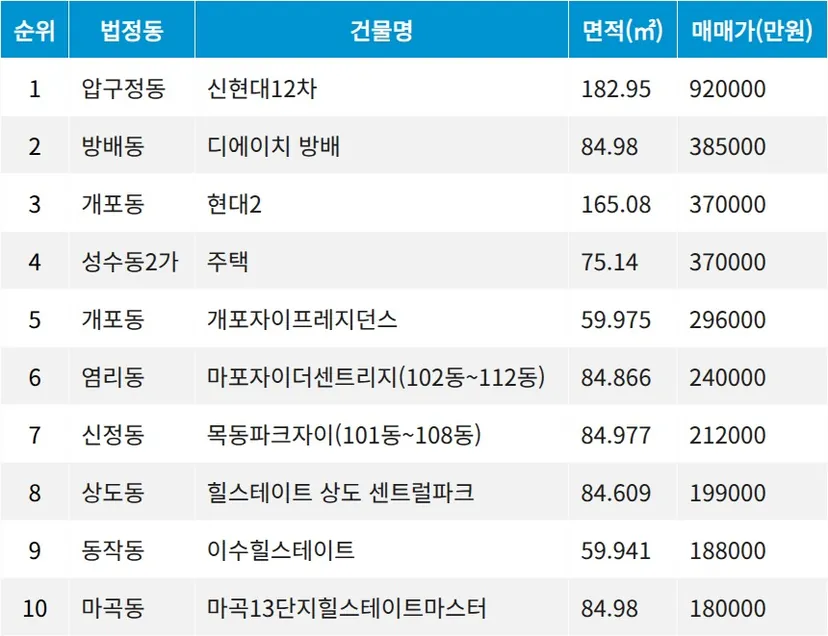
Of these top 10 transactions, 6 occurred outside of Gangnam and Seocho, specifically in Seongdong-gu, Mapo-gu, Yangcheon-gu, Dongjak-gu, and Gangseo-gu. According to the Korea Real Estate Board’s weekly price trends for the third week of October, Seoul apartment prices as of October 19 rose 0.13% from the previous week, but the rate of increase slowed from 0.16% the week prior. While Seongbuk-gu and Seodaemun-gu rose 0.36% each, Gangseo-gu 0.29%, Mapo-gu 0.26%, and Yangcheon-gu 0.17%, Gangnam-gu fell 0.31%, Seocho-gu 0.32%, and Songpa-gu 0.13%. Even though ultra-high-priced transactions in Apgujeong and Bangbae topped the weekly rankings, the overall price rise in Seoul was actually driven by small-to-medium-sized complexes in the Gangbuk and outer regions.
Unlike prices, transaction volume has remained constrained. According to the Seoul Real Estate Information Plaza, the number of apartment transactions in Seoul in September was 3,288, a 62% decrease compared to the same month last year. While it is difficult to compare October’s figures definitively as the reporting period remains open, the fact that price growth and transaction volume are moving in different directions indicates a persistent gap in price expectations between sellers and buyers. Under the October 15 housing market stabilization measures applied throughout Seoul, the mortgage loan limit for homes priced between 1.5 billion and 2.5 billion KRW is capped at 400 million KRW, and 200 million KRW for homes exceeding 2.5 billion KRW. As seen in the top transactions, the share of self-funded capital inevitably has a significant impact on whether transactions succeed for homes over 1.8 billion KRW. However, rather than concluding that individual transactions were specifically affected by loan regulations, it is more accurate to view the current market as one where transactions by buyers with significant capital liquidity have a disproportionately large impact on price indicators due to reduced overall volume.
※ This article was written by Bizhankook and MetaVX's generative AI.