

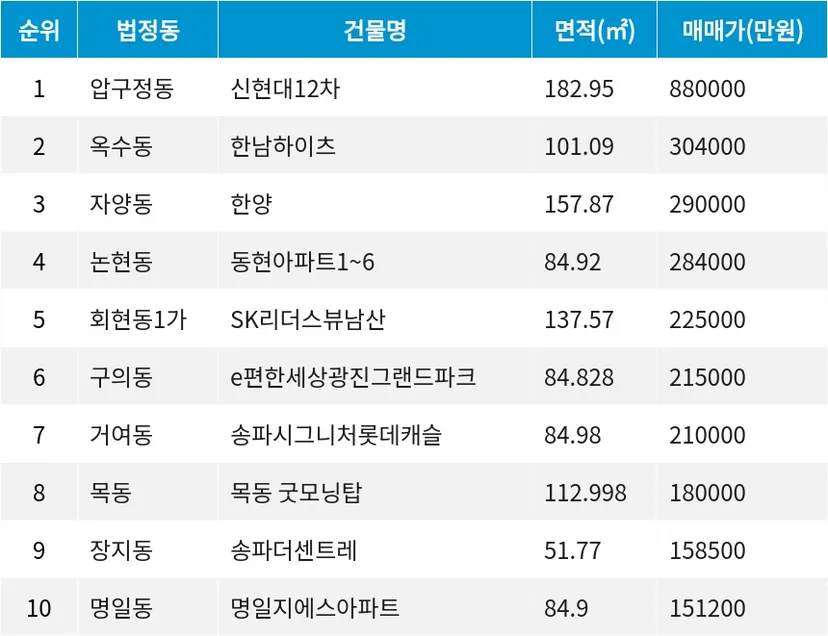
[비즈한국] According to the Seoul Real Estate Information Plaza, an aggregation of actual transaction prices for residential properties in Seoul from 9:00 AM on October 12 to 9:00 AM on October 16 shows that the highest weekly transaction was a 182.95㎡ (exclusive area) unit on the 6th floor of the Shin-Hyundai 12th complex in Apgujeong-dong, Gangnam-gu, which sold for 8.8 billion KRW. While high-end apartments in Gangnam-gu, Seongdong-gu, and Gwangjin-gu dominated the top rankings this week, price trends varied, showing a mix of new highs, maintenance of previous high levels, and declines compared to the most recent transactions.
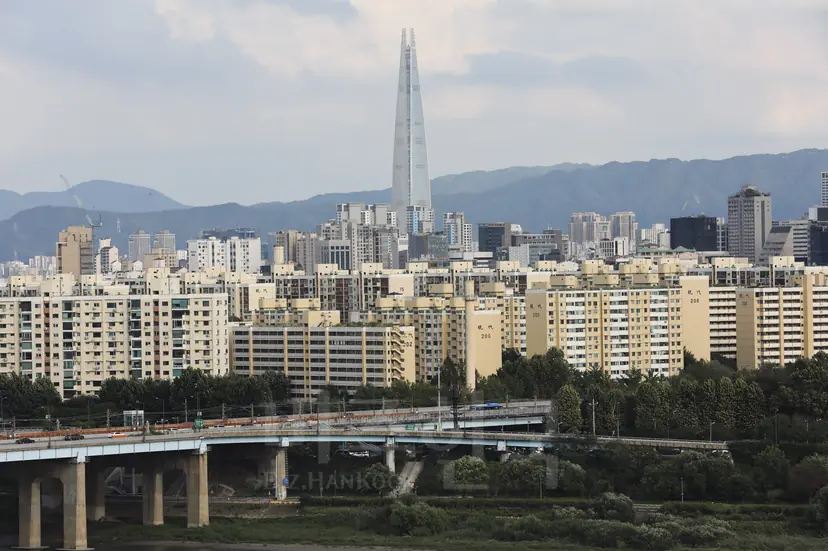
The 1st place transaction, a 182.95㎡ unit on the 6th floor of the Shin-Hyundai 12th complex in Apgujeong-dong, sold for 8.8 billion KRW. It was the only transaction this week to exceed 8 billion KRW. However, the same area sold for 10 billion KRW on the 3rd floor on September 23, and for 11.25 billion KRW on the 10th and 11th floors in July. As this transaction is 1.2 billion KRW lower than the previous sale and 2.45 billion KRW lower than the recent peak, it is difficult to view this as a sign of price appreciation. Since it is difficult to confirm conditions like orientation and interior state from public data alone, it is important to note that aside from the high absolute prices of large-area units in Apgujeong, there is significant price variance between individual listings.
The price per pyeong for this transaction was approximately 159 million KRW. This is more than double the average price per pyeong for Seoul apartments (59.259 million KRW) reported by KB Real Estate last December. Although Shin-Hyundai 12th, part of the Apgujeong Zone 2 redevelopment project, is currently undergoing reconstruction, the large gap in recent transaction prices for the same area suggests that the price cannot be explained solely by reconstruction expectations.
2nd place went to a 101.09㎡ unit on the 12th floor of Hannam Heights in Oksu-dong, Seongdong-gu, which sold for 3.04 billion KRW. The same area sold for 3 billion KRW last August, and a 101.12㎡ unit with a negligible size difference also sold for 3.04 billion KRW in September of last year. This effectively confirms the previous high-price level in the 3 billion KRW range. The price per pyeong was approximately 99.41 million KRW, well above the Seoul average.
3rd place was a 157.87㎡ unit on the 12th floor of Hanyang Apartment in Jayang-dong, Gwangjin-gu, which sold for 2.9 billion KRW. The same area sold for 3.25 billion KRW on the 4th floor in March and 3.15 billion KRW on the 7th floor in July of this year. This price is 250 million KRW lower than the July transaction and below the recent peak. The price per pyeong is approximately 60.73 million KRW, which is higher than the Seoul average, but compared to recent transactions of the same area, it is difficult to interpret this as an upward shift in the price ceiling.
4th place was an 84.92㎡ unit on the 10th floor of Donghyeon Apartment 1-6 in Nonhyeon-dong, Gangnam-gu, which sold for 2.84 billion KRW. The same area sold for 2.85 billion KRW on the 12th floor on August 20. With a difference of only 10 million KRW, the recent price range for 84㎡ units appears to be holding steady in the mid-2.8 billion KRW range.
5th place went to a 137.57㎡ unit on the 16th floor of SK Leaders View Namsan in Hoehyeon-dong 1-ga, Jung-gu, which sold for 2.25 billion KRW. A similar 137.53㎡ unit on the 15th floor sold for 2.12 billion KRW in June. This transaction is 130 million KRW higher than that. While it is difficult to conclude a direction for the entire complex due to low frequency of sales for this unit size, it is a case where the price ceiling has been raised among recent confirmed transactions.
6th place, an 84.83㎡ unit at e-Pyeonhansesang Gwangjin Grand Park in Guui-dong, Gwangjin-gu, sold for 2.15 billion KRW. Similar 84㎡ units have shown variance, trading at 2.15 billion KRW in May, 2.17 billion KRW and 2.29 billion KRW in June, and 2.04 billion KRW in July. Although 140 million KRW lower than the June high, this transaction still falls within the early-to-mid 2 billion KRW range.
7th place, an 84.98㎡ unit at Songpa Signature Lotte Castle in Geoyeo-dong, Songpa-gu, sold for 2.1 billion KRW. The same area traded multiple times for 2.1 billion KRW in August and September. While it does not reach the August peak of 2.14 billion KRW, the 2.1 billion KRW range is being repeatedly confirmed for 84㎡ units.
8th place was a 113.00㎡ Good Morning Top officetel in Mok-dong, Yangcheon-gu, which sold for 1.8 billion KRW. Unlike apartments, price variance for officetels is significant depending on residential/office use and the condition of the individual unit. Recent sales samples for this area are limited, making it difficult to judge price direction based on a single transaction, but it is notable as the only officetel and the only large-scale residential officetel in the top 10.
9th place, a 51.77㎡ unit at Songpa The Centre in Jangji-dong, Songpa-gu, sold for 1.585 billion KRW. A 16th-floor unit of the same size sold for 1.56 billion KRW on July 31. This transaction is 25 million KRW higher than that, slightly pushing up the price ceiling for smaller units.
10th place, an 84.90㎡ unit at Myeongil GS Apartment in Myeongil-dong, Gangdong-gu, sold for 1.512 billion KRW. This is a complex-high, 37 million KRW higher than the 1.475 billion KRW sale of a 3rd-floor unit of the same size on June 11. However, since there has been only one transaction for the same area in the last three months, it is necessary to verify if subsequent transactions will continue at the same level.
Looking only at the top transactions, the 8.8 billion KRW large apartment in Apgujeong and the 2-3 billion KRW transactions in Seongdong and Gwangjin were prominent. However, in the Korea Real Estate Board's weekly survey as of October 12, while Seoul apartment prices rose 0.16%—an increase from the previous week's 0.12%—Gangnam-gu fell 0.35%, Seocho-gu 0.26%, and Songpa-gu 0.21%. Conversely, Jungnang-gu rose 0.44%, Seongbuk-gu 0.43%, and Seodaemun-gu 0.42%. Just because the highest-priced transactions were concentrated in the Gangnam area does not mean that prices across the entire Gangnam region have risen; in fact, weekly indicators show an adjustment in the "Gangnam 3-gu" occurring alongside a rise in the outskirts of Seoul and non-Gangnam areas.
Transaction volume should be interpreted more cautiously than price indicators. According to public transaction data, 2,951 Seoul apartment sales were reported in September, and 670 have been reported through October 16; however, since there is a time lag between contract and reporting, monthly figures continue to rise. Nonetheless, since prices are rising in some regions while overall transactions remain lower than in summer, it is difficult to generalize this as strong buying interest across all of Seoul.
Currently, for the metropolitan area and regulated areas, the mortgage loan limit for residential property purchases is a maximum of 400 million KRW for homes exceeding 1.5 billion KRW up to 2.5 billion KRW, and a maximum of 200 million KRW for homes exceeding 2.5 billion KRW. All top 10 transactions this week exceeded 1.5 billion KRW, and the top 4 exceeded 2.5 billion KRW, suggesting that demand with a high proportion of personal capital may have a relatively larger impact. However, there is no evidence to conclude that these individual transactions were dictated by loan regulations, and it is necessary to continue monitoring future transaction volumes and follow-up transactions for the same areas.
※ This article was written by Bizhankook and MetaVX's generative AI together.