

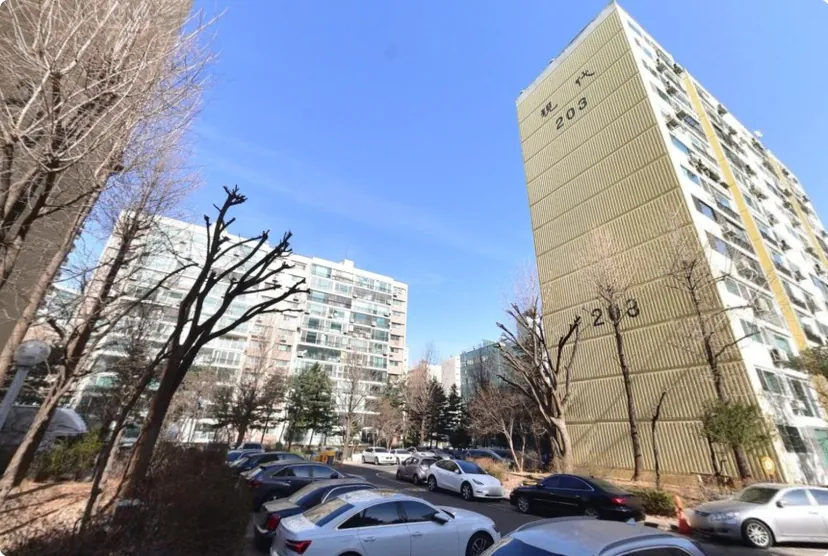
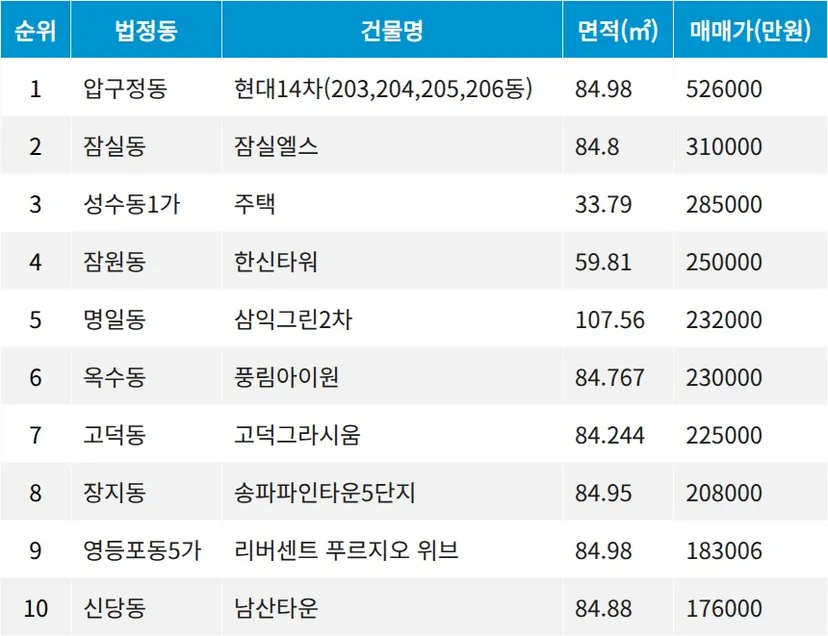
[BizHanKook] Based on a compilation of residential property transaction prices in Seoul from November 9 to November 13, the highest weekly transaction was recorded for a 5th-floor unit of Hyundai Apartment Complex 14 in Apgujeong-dong, Gangnam-gu, with a dedicated area of 84.98㎡, which sold for 5.26 billion KRW. The price per pyeong is approximately 204.62 million KRW. This is 1.34 billion KRW lower than the record high for the same area, which was set in May when a 7th-floor unit sold for 6.6 billion KRW. However, the price of that 7th-floor unit was nearly 1 billion KRW higher than other contracts at the time, so it does not appear to be a standard transaction. Similarly, as it is difficult to confirm individual property conditions such as orientation or interior state from public data alone, this transaction cannot be interpreted as a sign of a price rebound.
The second-highest transaction was for a 22nd-floor unit (84.80㎡) at Jamsil Els in Jamsil-dong, Songpa-gu, which sold for 3.1 billion KRW. The price per pyeong is approximately 120.85 million KRW. The median transaction price for the same area over the last year was in the 3.3 billion KRW range, and the October transaction price was confirmed at 3.2 billion KRW. Since this price is lower than those figures and also differs from the recent peak of 3.7 billion KRW, it is difficult to interpret this as a continuation of high-priced trades or an increase in the price ceiling. It is more likely a case where price variance has widened based on individual property conditions amidst adjustments in the Jamsil area.
The third-highest was a house in Seongsu-dong 1-ga, Seongdong-gu, with a dedicated area of 33.79㎡, which sold for 2.85 billion KRW. The floor level was not disclosed. Calculated based on the dedicated area, the price per pyeong is approximately 278.82 million KRW, the highest among the top three properties. However, for non-apartment housing, price differences vary significantly depending on land size, road frontage, building condition, and zoning. Since it is difficult to confirm detailed conditions such as land size and road accessibility from public data alone, one cannot judge whether there is a price increase based solely on the price per dedicated area.
The prices per pyeong of the Apgujeong Hyundai 14 and Jamsil Els are more than three times and two times higher, respectively, than the average Seoul apartment price per pyeong of 59.259 million KRW reported by KB Real Estate last December. Although the Seongsu-dong 1-ga house also shows a large gap from the Seoul apartment average based on a simple calculation, it should not be evaluated by the same standard as apartments, as it is a non-apartment transaction where the value of both the land and building is reflected.
The fourth-highest, a 5th-floor unit (59.81㎡) at Hanshin Tower in Jamwon-dong, Seocho-gu, sold for 2.5 billion KRW. This is 50 million KRW lower than the 2.55 billion KRW sale of a 12th-floor unit of the same area last April. This transaction did not deviate from the recent price range of 2.5 billion KRW, and since the price is lower than the previous high-floor transaction, it is difficult to classify this as an uptrend.
The fifth-highest was a 13th-floor unit (107.56㎡) at Samik Green 2-cha in Myeongil-dong, Gangdong-gu, which sold for 2.32 billion KRW. For the same area, a 6th-floor unit sold for 2.29 billion KRW and a 13th-floor unit for 2.32 billion KRW in October. This sale price is at the same level as the recent upper price range for the same area. While the complex is undergoing reconstruction, there is insufficient evidence to conclude that project progress alone drove this price.
The sixth-highest was a unit (84.77㎡) at Punglim I-Want in Oksu-dong, Seongdong-gu, which sold for 2.3 billion KRW. The same area previously sold for as high as the upper 2.4 billion KRW range earlier this year, so this price is lower than the annual peak. The seventh-highest, a unit (84.24㎡) at Godeok Grassium in Godeok-dong, Gangdong-gu, sold for 2.25 billion KRW. Compared to the 2.55 billion KRW transaction for the same area in October, this is 300 million KRW lower, showing that even among high-end transactions in Seongdong-gu and Gangdong-gu, contracts lower than recent highs are appearing.
The eighth-highest, a unit (84.95㎡) at Songpa Pine Town Complex 5 in Jangji-dong, Songpa-gu, sold for 2.08 billion KRW. A similar unit (84.93㎡) sold for 2.19 billion KRW in July, meaning this transaction is 110 million KRW lower than the recent peak. However, compared to the 1.7 billion KRW range for the same area in January, the price level itself has increased. As it is a complex with low transaction volume, it is necessary to observe further trades to see if this is a price adjustment from a recent peak or if the 2 billion KRW range is establishing itself as a new transaction bracket.
The ninth-highest, a unit (84.98㎡) at Rivercent Prugio Weve in Yeongdeungpo-dong 5-ga, Yeongdeungpo-gu, sold for 1.83006 billion KRW. The same area sold for 1.82 billion KRW last year, 1.99546 billion KRW in September, and 1.73 billion KRW in October. This price sits in the middle of the recent transaction range, showing price variance per contract rather than a clear upward or downward trend.
The tenth-highest, a unit (84.88㎡) at Namsan Town in Sindang-dong, Jung-gu, sold for 1.76 billion KRW. The same area sold for 1.74 billion KRW in September, and a low-floor unit sold for 1.595 billion KRW in October, with the annual high in the upper 1.8 billion KRW range. This sale price is similar to the September transaction but does not reach the annual high, so it is difficult to say it has recovered to its previous peak.
Looking solely at the prices of the top 10 transactions, high-end deals in Apgujeong, Jamsil, Seongdong-gu, and Gangdong-gu were prominent, but official price indices showed a different trend. According to the Korea Real Estate Board's weekly apartment price trend for the second week of November, Seoul apartment prices as of November 9 rose 0.07% from the previous week. While the 14 districts in Gangbuk rose 0.20%, the 11 districts in Gangnam fell 0.04%. Seongbuk-gu rose 0.39% and Gangbuk-gu rose 0.32%, whereas Songpa-gu fell 0.35%, Seocho-gu fell 0.26%, and Gangnam-gu fell 0.25%. Seongdong-gu and Gangdong-gu also shifted to a decline of 0.02% and 0.01%, respectively. The fact that many of this week's top transactions were lower than recent highs shows that it is necessary to distinguish between a few high-priced deals and the overall price direction of Seoul.
Trading volume also shows a temperature difference from price indices. In government statistics, Seoul apartment transaction volume decreased from 8,900 in May to 7,700 in June, 6,600 in July, 4,600 in August, and 3,900 in September, falling below the five-year average of 4,100 for September. However, as of November 11, the number of apartments for sale in Seoul exceeded 80,000, an increase of over 40% from the beginning of the year.
Currently, the limit for housing mortgage loans for the purpose of purchasing a home in the metropolitan area and regulated areas is restricted to 600 million KRW for homes priced at 1.5 billion KRW or less, 400 million KRW for those between 1.5 billion and 2.5 billion KRW, and 200 million KRW for those exceeding 2.5 billion KRW. Accordingly, for homes in the 2 billion to 5 billion KRW range, such as those in this week's top list, it is highly likely that buyers with a high proportion of their own capital are leading the transactions. However, it cannot be concluded that individual contracts were signed due to loan regulations, and in a situation where transaction volume is decreasing and inventory is increasing, the difference in price expectations between sellers and buyers is expected to dictate market trends for the time being.
※ This article was written by Bizhankook and MetaVX's generative AI.