

[비즈한국] In the Seoul residential real estate market during the fourth week of July, reconstruction complexes in Daechi-dong and Mok-dong led the top of the transaction value rankings. High-priced transactions continued in areas with excellent school districts, proximity to workplaces, and large-scale residential environments, such as Irwon-dong and Gaepo-dong in Gangnam-gu, Gyeonghuigung Xi in Jongno-gu, and Dangsan-dong in Yeongdeungpo-gu.
The trend was clear: demand was concentrated in representative complexes that are difficult to replace, rather than transaction volumes being spread evenly across the market. While Seoul apartment prices maintained an upward trend, the weekly growth rate for the third week of July was 0.27%, down from 0.30% the previous week. While the pace of growth has slowed slightly, selective buying continues, centered on school districts, areas near subway stations, and regions with development expectations.
According to the Seoul Real Estate Information Plaza, based on the compiled actual transaction prices of residential properties in Seoul from July 20 to July 24, a first-floor unit at Eunma Apartment in Daechi-dong, Gangnam-gu, with an exclusive area of 84.43㎡, sold for 3.695 billion won, taking the top spot for weekly transactions.
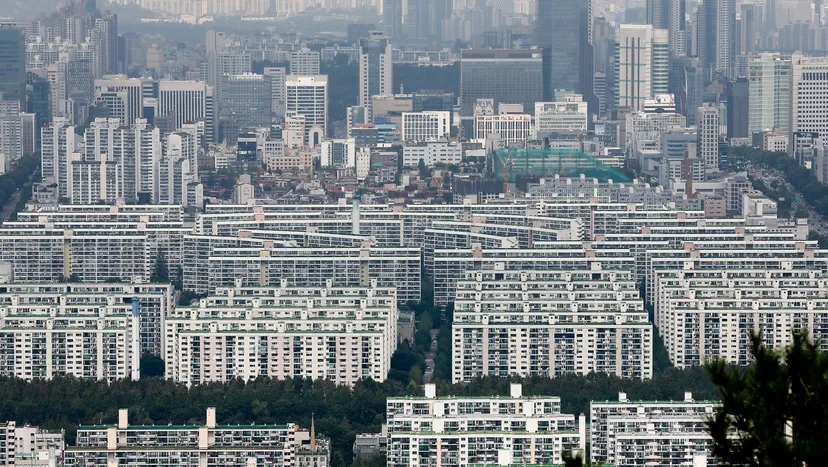
The transaction price per 3.3㎡ of exclusive area at Eunma is approximately 144.67 million won. This is about 2.4 times the average sale price per 3.3㎡ of Seoul apartments in December of last year, which was 59.259 million won as announced by KB Real Estate. The fact that it recorded the highest weekly price despite being a low-floor unit reaffirms the price competitiveness of a representative complex that combines the Daechi-dong school district with reconstruction expectations.
Coincidentally, on July 24—the last day of the transaction collection period—Eunma announced a series of bids for reconstruction-related services, including building demolition planning, environmental impact assessments, and construction project management. While this cannot be definitively cited as the direct cause of individual transactions, signs that the project is moving into administrative and practical stages can serve as a backdrop supporting market interest in reconstruction complexes.
The second spot went to Mok-dong Complex 6 in Mok-dong, Yangcheon-gu, where a ninth-floor unit with an exclusive area of 95.03㎡ sold for 3.1 billion won. The price per 3.3㎡ of exclusive area is approximately 107.83 million won.
Mok-dong Complex 6, along with Eunma, was a reconstruction complex that exceeded 3 billion won this week. Although Daechi-dong and Mok-dong are different regions, they share commonalities: excellent school districts, expectations for large-scale urban renewal, and being rare large-scale complexes. Even in a situation where transactions across Seoul are shrinking, complexes where the two types of demand—education and reconstruction—overlap have maintained relatively high prices.
The Seoul Metropolitan Government continues to designate major reconstruction complexes and candidate sites for urban renewal as land transaction permit zones to prevent speculative demand in areas with high development expectations. In these permit zones, transactions for housing exceeding a certain area require approval from the head of the district office, and residential properties must be purchased for actual residency. The fact that representative reconstruction complexes are still included in top transactions despite regulations limiting speculative entry shows that demand for actual residency and long-term ownership is supporting prices.
A fourth-floor unit at Woosung 7 in Irwon-dong, Gangnam-gu, with an exclusive area of 84.06㎡, sold for 3.03 billion won, ranking third. The price per 3.3㎡ of exclusive area is approximately 119.16 million won.
Unlike Eunma, Woosung 7 is not a reconstruction complex with significant symbolic status, but it shares the Gangnam lifestyle, school district, and transport/medical infrastructure. This transaction shows that demand for high-end properties is not limited to famous reconstruction complexes but is extending to mid-to-large-sized apartments in the Gangnam area with stable actual living conditions.
Fourth place went to Gyeonghuigung Xi in Hongpa-dong, Jongno-gu, where a ninth-floor unit with an exclusive area of 84.84㎡ sold for 2.73 billion won. A 15th-floor unit at Mok-dong Complex 13 in Sinjeong-dong, Yangcheon-gu, with an exclusive area of 98.63㎡, sold for 2.59 billion won, ranking fifth.
Preferences for the 6th place and below remained similar. Yuwon Jeil 2nd in Dangsan-dong 5-ga, Yeongdeungpo-gu (exclusive area 123.76㎡) sold for 2.25 billion won. Hyundai Parkville in Gwangjang-dong, Gwangjin-gu (exclusive area 84.81㎡) sold for 2.13 billion won, and Gaepo Jugong Complex 5 in Gaepo-dong, Gangnam-gu (exclusive area 53.98㎡) changed hands for 2.11 billion won.
Centras in Hawangsimni-dong, Seongdong-gu (exclusive area 59.93㎡) sold for 1.98 billion won, and Lotte Castle in Sinjeong-dong, Yangcheon-gu (exclusive area 84.73㎡) sold for 1.94 billion won.
The factors running through the top 10 transactions cannot be explained by reconstruction alone. While reconstruction expectations supported Eunma, Mok-dong complexes, and Gaepo Jugong 5, school districts and stable residential environments supported Woosung 7 and Hyundai Parkville, and downtown accessibility supported Gyeonghuigung Xi and Centras. Yuwon Jeil 2nd even possessed the scarcity of a large unit size of 123.76㎡.
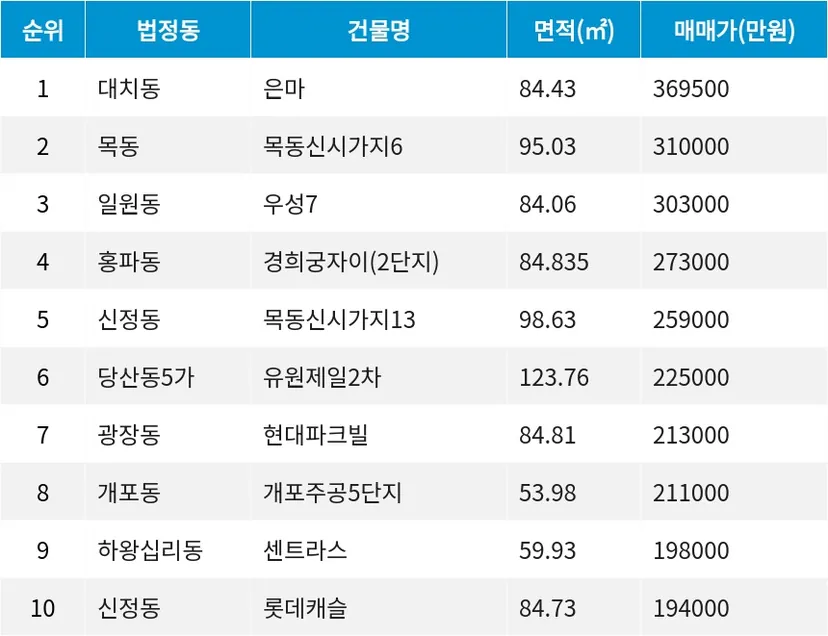
Price ranges and sizes also varied. Gaepo Jugong 5, at 53.98㎡, was the smallest among the top 10, yet exceeded 2.1 billion won, while Yuwon Jeil 2nd sold for 2.25 billion won with its large size of 123.76㎡. In Seoul's high-end market, larger homes are not unconditionally more expensive; rather, the price per area varies significantly depending on reconstruction expectations, land value, school districts, and access to business districts.
The policy environment is causing transaction volume and prices to move in different directions. According to the Seoul Metropolitan Government, applications for apartment land transaction permits in June reached 5,382, down about 40% from April and 10.9% from May. Conversely, the applied price rose 2.67% from the previous month, marking the largest monthly increase since the entire city of Seoul was designated a land transaction permit zone. The Seoul Metropolitan Government analyzed this as the result of owner-occupier-centered buying continuing after a significant portion of "fire sale" properties—which emerged ahead of the end of the deferral of the heavy capital gains tax for multi-homeowners—was absorbed, while general listings maintained their existing asking prices.
This means that while the number of properties on the market and the number of participants in transactions have decreased, prices may actually be higher in some preferred complexes where transactions are successfully completed. Even if regulations reduce the volume of transactions, they cannot eliminate scarce conditions such as good school districts, reconstruction potential, and proximity to workplaces. Sellers have no reason to rush to lower prices, and buyers choose complexes with few substitutes, creating a structure where high-priced contracts remain at the top.
The top 10 actual transactions this week are less a sign that all Seoul home prices have surged in unison, and more a cross-section of a market where limited transactions are concentrated in representative complexes. If Eunma and the Mok-dong complexes demonstrated demand for reconstruction and school districts, Gyeonghuigung Xi and Centras highlighted the value of downtown accessibility, and Hyundai Parkville and Woosung 7 revealed the value of stable residential environments.
In a situation where declining transactions and rising prices appear simultaneously, rather than expanding one or two high-priced contracts to interpret the direction of all of Seoul, it is necessary to examine in which regions and complexes transactions are actually being completed. This week, the answer was concentrated in four conditions: reconstruction, school districts, proximity to workplaces, and large-scale complexes.
※ This article was written by Biz Hankook and MetaVX's generative AI.