

[비즈한국] In the Seoul residential real estate market, transactions of ultra-high-priced detached houses and major apartments in the Gangnam and Yongsan districts drew equal attention. According to the Seoul Real Estate Information Plaza, an analysis of actual residential transaction prices in Seoul from August 3 to August 7 revealed that a house in Sadang-dong, Dongjak-gu, with an exclusive area of 1012.93㎡, was sold for 13.81733 billion KRW, ranking first in weekly transactions.
The fact that an ultra-large house with an exclusive area of 1012.93㎡ was actually traded despite a policy environment characterized by increasing burdens from loans and taxes demonstrates that the impact of regulations is not felt equally across all high-value assets. In particular, for detached and multi-family houses, which have fewer comparable listings than apartments, price formation is significantly more influenced by the specific characteristics of the asset—such as the scale of the land and building, usage, and independence—rather than general price-per-pyeong averages. This transaction can be interpreted not as a sign of rising prices for large houses in general, but as an instance where demand with relatively low reliance on loans is opting for highly scarce assets, even in a market where transaction volume is suppressed.
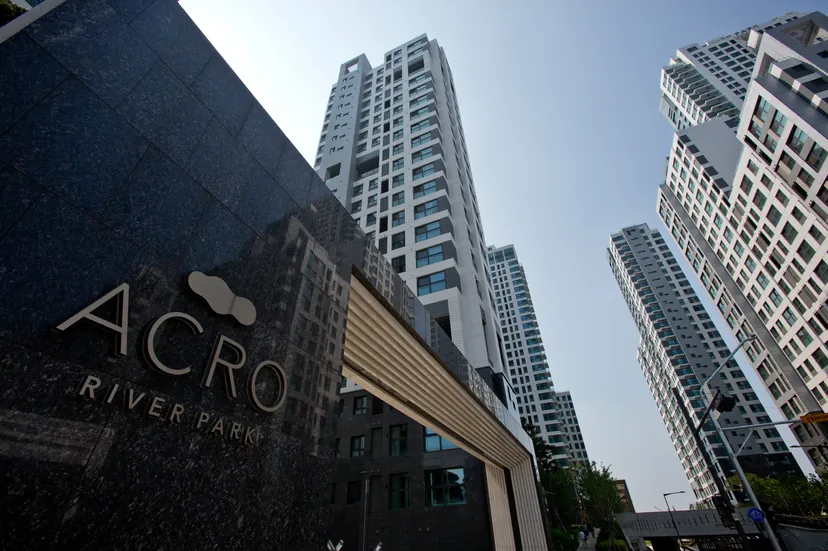
Following this, a 13th-floor unit in Acro River Park, Banpo-dong, Seocho-gu, with an exclusive area of 84.97㎡, was sold for 5.39 billion KRW. It ranked second this week, marking one of the major high-priced apartment transactions in Banpo-dong.
A 9th-floor unit of Shindonga in Seobinggo-dong, Yongsan-gu, with an exclusive area of 166.98㎡, sold for 4.2101 billion KRW. A 13th-floor unit of Banpo Le-El in Jamwon-dong, Seocho-gu, with an exclusive area of 59.944㎡, changed hands at 3.54 billion KRW.
While recent trades for 84㎡ units at Acro River Park have consistently hovered around 5.6 billion KRW, and the KB Real Estate general market price for late July 2026 was recorded at 5.55 billion KRW, this transaction at 5.39 billion KRW can be viewed as being near the lower end of the recent price range. Conversely, the Shindonga in Seobinggo-dong has had its reconstruction plan for approximately 1,840 households, with heights up to 50 stories, confirmed following the notification of the maintenance zone designation; therefore, the price is analyzed to reflect both the scarcity of existing large-area units and expectations for the progress of the project.
A 2nd-floor unit of Gaepho Raemian Forest in Gaepho-dong, Gangnam-gu, with an exclusive area of 59.92㎡, sold for 2.9 billion KRW. A 3rd-floor unit of Cheongdam 2nd I-Park in Cheongdam-dong, Gangnam-gu, with an exclusive area of 113.21㎡, was traded for 2.5 billion KRW.
Additionally, a unit of Mokdong New Town 13 in Sinjeong-dong with an exclusive area of 70.73㎡ was traded for 2.3 billion KRW. A unit of Hyundai Superville apartment in Seocho-dong with an exclusive area of 185.02㎡ also sold for 2.3 billion KRW. A unit of CJ Nine Park apartment in Munbae-dong with an exclusive area of 97.24㎡ sold for 1.87 billion KRW, while a unit of Raemian Weave in Dapsimni-dong with an exclusive area of 84.98㎡ traded for 1.67 billion KRW.
The price of the house in Sadang-dong was approximately 45.09 million KRW per pyeong. This is below the average apartment transaction price per pyeong in Seoul of 59.259 million KRW, announced by KB Real Estate last December. Meanwhile, Acro River Park in Banpo-dong traded at approximately 209.7 million KRW per pyeong, and Shindonga in Seobinggo-dong traded at approximately 83.34 million KRW per pyeong, both exceeding the Seoul average.
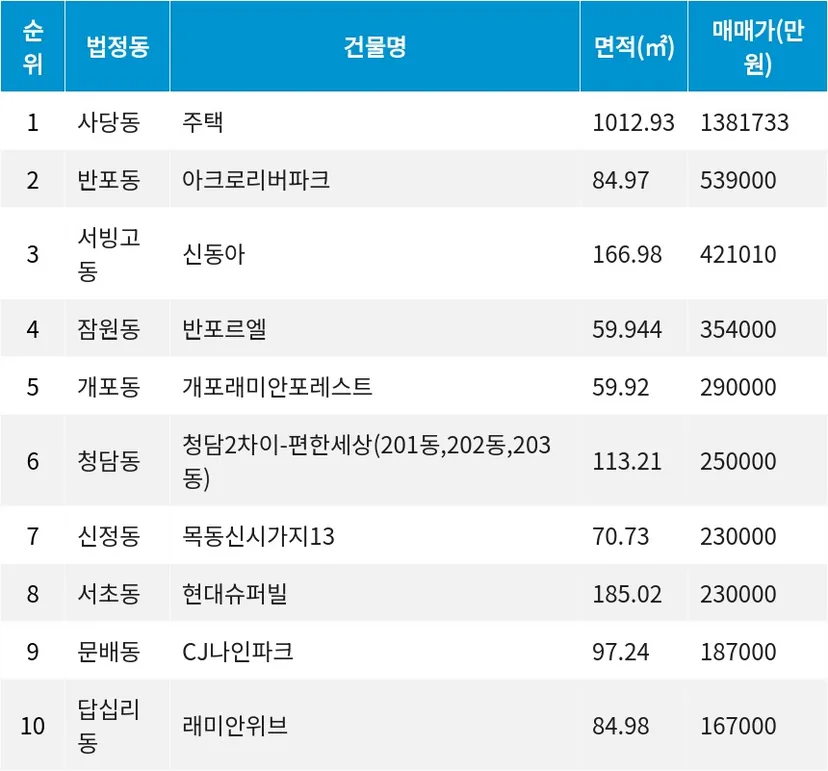
Excluding the ultra-large house in Sadang-dong, the top 10 transactions were concentrated in medium-to-large sized or core complexes in preferred areas such as Banpo, Yongsan, Gangnam, Yangcheon, and Seocho, illustrating a trend where demand with significant cash reserves is selectively purchasing scarce housing.
According to the Korea Real Estate Board, the Seoul apartment sales price index rose by 0.26% in the first week of August, expanding its growth, but a regional temperature difference was confirmed, as the rate of increase slowed in some high-priced areas like the "Gangnam 3" districts, while rising transactions remained centered on reconstruction sites, large complexes, and areas near subway stations.
While the government's tax reform plans focusing on actual residency and asset value, along with policies to strengthen property taxes for high-priced homes, act as a burden on owners of ultra-high-priced and non-residential properties, the shortage of supply and instability in the jeonse and monthly rental markets continue to support the prices of homes in core locations. Therefore, it is assessed that these high-priced transactions should be interpreted not as a uniform shift toward rising prices across all of Seoul, but as a result of demand with the financial capacity to continue trading despite regulations focusing on properties with high marketability and scarcity.
※ This article was co-written by Bizhankook and MetaVX's generative AI.