

[비즈한국] In the first week of September, Seocho-gu recorded the highest weekly transaction price for residential real estate in Seoul. However, properties with exclusive areas of 59–84㎡ in non-Gangnam districts, including Mapo-gu, Yangcheon-gu, and Yeongdeungpo-gu, also exceeded 2 billion KRW. According to the Seoul Real Estate Information Plaza, among the residential property transactions confirmed between 9:00 AM on August 31 and 9:00 AM on September 4, a 10th-floor unit of Seocho 1st e-Pyeonhansesang in Seocho-dong, Seocho-gu, with an exclusive area of 130.53㎡, was sold for 2.7 billion KRW, marking the highest price of the week.
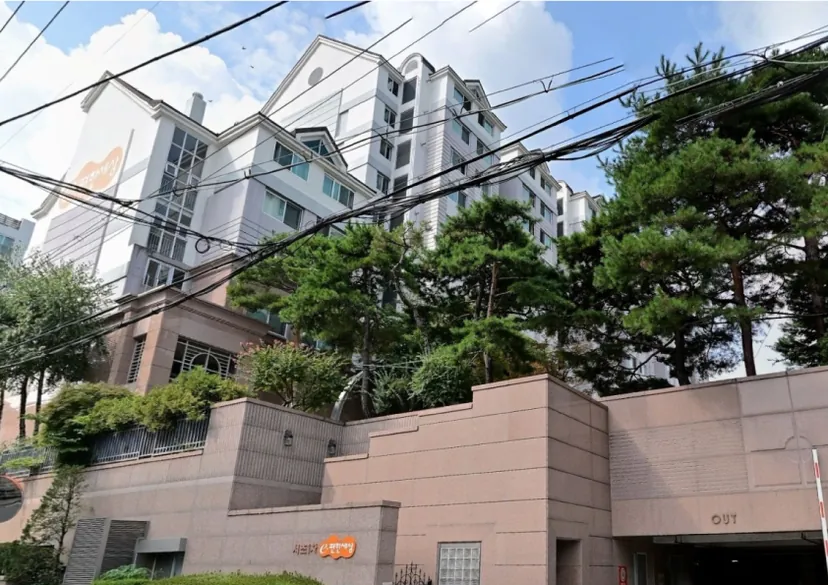
The transaction price for the 130.53㎡ unit at Seocho 1st e-Pyeonhansesang was 2.7 billion KRW, making it the only property among those confirmed to be in the late 2-billion KRW range. The price per pyeong is approximately 68.38 million KRW. A 6th-floor unit of the same area was traded for 2.25 billion KRW in June 2025, making this recent contract 450 million KRW higher. However, since this is a large-scale housing type with low transaction frequency, it is difficult to conclude the overall upward trend of the complex based on a single transaction. It is also difficult to verify individual property conditions such as orientation, floor, and interior state solely through publicly available data.
The second-highest transaction was a 59.38㎡ exclusive area unit at Mapo I-Park Foret in Sinsu-dong, Mapo-gu, which sold for 2.128 billion KRW. The price per pyeong was approximately 118.48 million KRW, the highest among the top 10 transactions. While there are not many sales samples for the 59㎡ range in this complex, considering that a 59.75㎡ unit sold for 2.005 billion KRW in June 2026 and a 59.38㎡ unit recently traded at the 2.12 billion KRW level, this transaction shows that the upper price limit for smaller units is forming in the 2.1 billion KRW range. Compared to 84㎡ units in the same apartment, which traded between 2.445 billion and 2.59 billion KRW from July to August 2026, the total amount for smaller areas is lower, but the price per area is higher.
The third-ranked transaction was for a 66.24㎡ unit at Mok-dong New Town Complex 11 in Sinjeong-dong, Yangcheon-gu, which concluded at 2.05 billion KRW. The price per pyeong is approximately 102.31 million KRW. The same unit type traded for 2.045 billion KRW (12th floor) in July 2026 and 2 billion KRW (6th floor) in June. This price is 5 million KRW higher than the previous transaction, slightly breaking the recent record, but it is closer to a rise in the upper end of a price range that had been repeating around 2 billion KRW rather than a sharp short-term increase.
The fourth spot went to an 84.98㎡ unit at Boramae SK View in Singil-dong, Yeongdeungpo-gu, which sold for 2.04 billion KRW. This is the highest-priced sale among Yeongdeungpo-gu properties traded in the same week. The same area traded for 2.02 billion KRW in July 2026, while a 1st-floor unit sold for 1.855 billion KRW at the end of August; this latest contract was for an 18th-floor unit. The difference from the previous transaction could be influenced by the floor level, and it is a case that has reset the upper price limit amidst the recent trend where mid-to-high floor transaction prices have risen from the high 1-billion KRW range to the low 2-billion KRW range.
The fifth-ranked transaction was for a 59.85㎡ unit at e-Pyeonhansesang Sinchon Complex 2 in Bukahyeon-dong, Seodaemun-gu, which sold for 1.965 billion KRW. The same area sold for 1.88 billion KRW (2nd floor) in July and 1.75 billion KRW (2nd floor) in April. This latest transaction is 85 million KRW higher than the July price. Compared to a 7th-floor unit that sold for 1.84 billion KRW in September 2025, the upper price limit has increased. However, given the difference in floors, it is better to view this as a high-priced transaction for a mid-floor unit rather than interpreting the entire increase as a shift in the complex's market value.
Sixth was a 95.24㎡ unit at Mok-dong Paragon Officetel in Mok-dong, Yangcheon-gu, which sold for 1.86 billion KRW. The same area sold for 1.745 billion KRW (6th floor) in May 2026, making this contract 115 million KRW higher. It falls at the upper end of prices for the same area confirmed over the last three years. However, officetels have different area calculations and product compositions compared to apartments, making simple comparisons with average Seoul apartment prices difficult.
The seventh-ranked transaction was for an 84.94㎡ unit at Songpa Pine Town Complex 11 in Jangji-dong, Songpa-gu, which sold for 1.85 billion KRW. The transaction price for the same area in June 2026 was 1.82 billion KRW, making this contract 30 million KRW higher. Given that there have not been many sales reports for this area over the past 12 months, it is difficult to conclude there is an upward trend for the entire complex, but it has raised the upper price limit based on confirmed transactions.
Eighth was a 60.70㎡ unit at Sang-a Apartment Complex 1 in Ogeum-dong, Songpa-gu, which sold for 1.7 billion KRW. As the complex was completed in 1984 and there are few recent sales samples for the same area, it is difficult to determine a clear direction based on a single price. The fact that a 60.70㎡ unit, which is smaller than large-sized units, traded for 1.7 billion KRW is an example that confirms the high price per area of small to medium-sized housing within Songpa-gu.
The ninth-ranked transaction was for a 76.74㎡ unit at Rivercent Prugio Weve in Yeongdeungpo-dong 5-ga, Yeongdeungpo-gu, which sold for 1.6628 billion KRW. The highest pre-sale price for a 76㎡ unit when this complex was supplied in 2025 was around 1.5393 billion KRW, and occupancy is scheduled for January 2029. While this transaction price is higher than the initial supply price, options and contract conditions can affect the final amount, so the simple difference should not be considered entirely as a market value increase.
The 10th spot was a 59.99㎡ unit at Jangwi Jai Radiant in Jangwi-dong, Seongbuk-gu, which sold for 1.41 billion KRW. Compared to a 12th-floor unit of the same area that sold for 1.62 billion KRW on May 14, 2026, this price is 210 million KRW lower. Complexes like Jangwi Jai Radiant, which have diverse initial occupancy transactions and ownership rights, can show significant price differences based on building, floor, and contract conditions, so it is difficult to view this contract as a case of price increase.
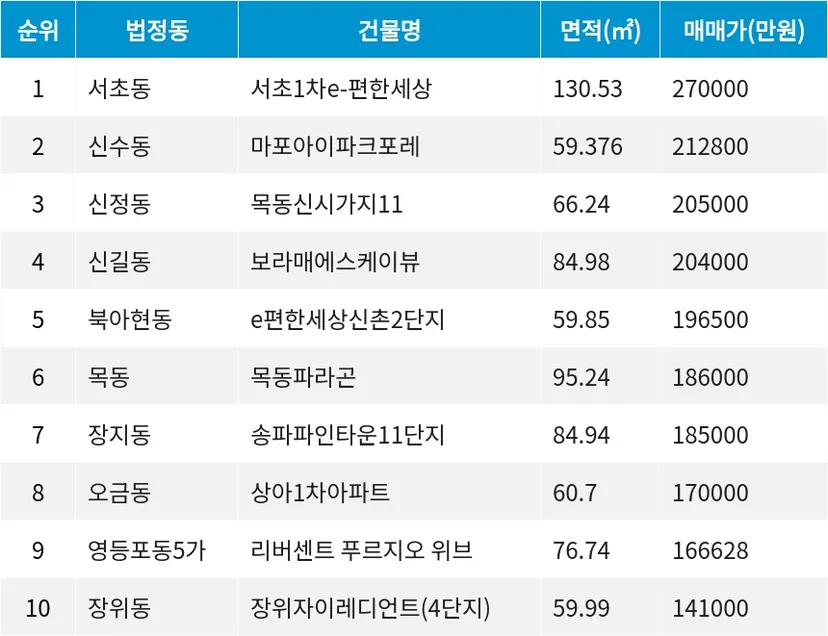
In this week's top 10 transactions, a large-sized unit in Seocho-gu took the top spot in absolute price, but among the four transactions exceeding 2 billion KRW, three came from Mapo-gu, Yangcheon-gu, and Yeongdeungpo-gu. It is also notable that Mapo I-Park Foret (59㎡ range) and Mok-dong New Town Complex 11 (66㎡ range) exceeded 2 billion KRW. However, one must distinguish between the trends of a few high-priced transactions and the direction of the entire Seoul market.
In a weekly survey by the Korea Real Estate Board as of August 31, Seoul apartment sale prices rose by 0.22%, a smaller increase than the previous week's 0.29%. Seocho-gu fell by 0.23%, Gangnam-gu by 0.41%, and Songpa-gu saw only a 0.01% increase. Conversely, Seongbuk-gu rose by 0.54% and Seodaemun-gu by 0.40%. Given that the index for Seocho-gu, where the weekly highest price occurred, fell, while Seongbuk-gu, where Jangwi Jai Radiant (included in the top 10) is located, recorded a high increase rate, it shows that individual high-priced transactions do not necessarily align with the overall price trends of autonomous districts.
Transaction volume showed signs of slowing before prices did. The Seoul apartment sales transaction volume for July 2026, compiled by the Seoul Metropolitan Government as of August 18, was 5,234 units, a 0.6% decrease from the previous month, lower than the 8,000-unit range seen in April and May. In July's transactions, the proportion of housing priced at 1.5 billion KRW or less was 81.2%, an increase of 4.9 percentage points from the previous month. With limited funding capacity due to loan regulations, transaction centers have shifted to relatively lower-priced housing, but sales exceeding 1.5 billion KRW continued in some complexes. As high-priced transactions are relatively more influenced by demand with high self-financing proportions, it is necessary to approach the market without generalizing a strong upward trend, while observing the maintenance of high-end transaction prices and the overall slowdown in Seoul's transaction volume together.
※ This article was written by BizHankook and MetaVX's generative AI together.