

[BizHanKook] In Seoul's rental market, the trend of shrinking "jeonse" (lump-sum deposit) households and increasing monthly rent households is becoming distinct. Over the past five years, the gap between jeonse and monthly rent households has widened from approximately 110,000 to 500,000. The proportion of monthly renters among all rental households has surpassed 60%. This is analyzed as a complex result of the rise in single-person households, housing demand in Seoul, and a growing preference for monthly rent.
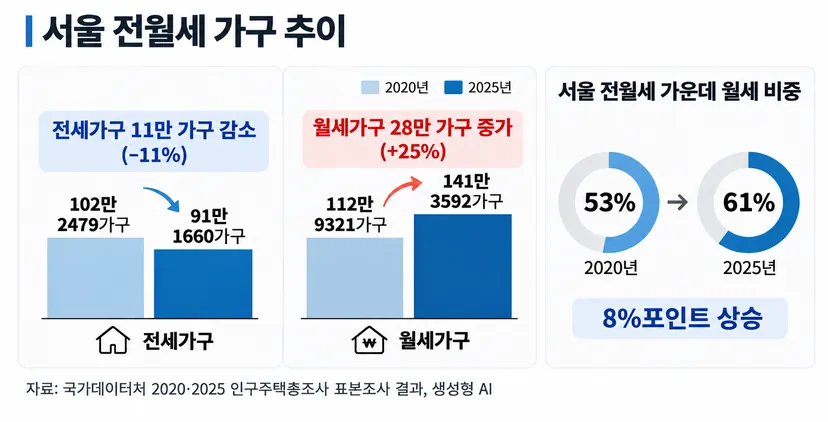
On the 24th, Bizhankook analyzed the "2025 Population and Housing Census Sample Survey Results" from the National Data Agency and found that the number of jeonse households in Seoul decreased from 1,022,479 in 2020 to 911,660 in 2025, a decline of 110,819 (11%). During the same period, the number of monthly rent households increased from 1,129,321 to 1,413,592, an increase of 284,271 (25%). The proportion of monthly renters among rental households in Seoul rose by 8 percentage points, from 53% to 61%.
The decline in Seoul's jeonse households was notable even from a national perspective. Nationwide, jeonse households fell from 3,251,620 in 2020 to 2,997,991 in 2025, a reduction of 253,629 (8%). Seoul accounts for 44% of this total decline. Within the capital region, Gyeonggi's jeonse households decreased by 35,392 (4%), while Incheon's increased by 2,819 (2%). Out of the 143,392 total decline in jeonse households in the capital region, Seoul accounted for 77%.
The rise in monthly rent households in Seoul was driven by rent with security deposits. Households paying monthly rent with a deposit increased from 1,043,941 in 2020 to 1,334,793 in 2025, a rise of 290,852 (28%). Conversely, households paying monthly rent without a deposit decreased from 75,792 to 72,526, a drop of 3,266 (4%). "Sageolse" households—those paying several months of rent in advance without a deposit—also fell from 9,588 to 6,273, a decrease of 3,315 (35%).
In Seoul, the ratio of jeonse to monthly rent varied by housing type. In 2025, monthly rent households in Seoul's detached and multi-family houses numbered 520,294, which is 2.6 times the number of jeonse households (200,275). For non-residential living quarters, which include officetels, monthly rent households reached 249,311, about three times the number of jeonse households (84,114). In contrast, for apartments, the number of jeonse households (401,604) remained higher than that of monthly rent households (354,603).
Meanwhile, the proportion of owner-occupied households in Seoul declined. Out of 4,194,215 total households in 2025, 1,762,329 (42%) were owner-occupied, down 2 percentage points from 2020 (44%). While the number of owner-occupied households increased by 31,658 over the same period, the total number of households grew by 211,925, causing the overall proportion to fall. Seoul's owner-occupancy rate is 15 percentage points lower than the national average (57%), the lowest among the 17 cities and provinces.
The decline in jeonse households and the increase in monthly rent households are analyzed to be influenced by changes in household structure and concerns over jeonse fraud. Single-person households, which have a high rate of monthly renting, increased by 24% from 6.643 million in 2020 to 8.244 million in 2025. A paper published this year in "Housing and Urban Finance Research" indicated that after the strengthening of requirements for jeonse deposit return guarantees in 2023, the proportion of monthly rent in Seoul's lease contracts rose from 47% to 56%.
Recently, a shortage of jeonse properties has also persisted in the capital region. According to data released on the 16th by the KB Financial Group Management Research Institute, as of the 13th, there were approximately 38,000 jeonse listings in the capital region, a 24% decrease from the same month last year. The institute pointed to the reduction in new supply and the conversion of existing homes to owner-occupancy as causes for the supply-demand imbalance. According to the Korea Real Estate Board, apartment jeonse prices in Seoul rose 9.43% from the start of the year through November 16.
Kyung Eun-sook, head of the Population Census Division at the National Data Agency, explained, "Since 2015, the proportion of monthly rent has overtaken jeonse nationwide, and it has continued to rise since then. We believe the increase in single-person households—who have a high propensity for monthly rent—along with housing demand in Seoul and a shift in preference toward monthly rent have all played a complex role."