

[비즈한국] On September 18, President Lee Jae-myung held his seventh press conference since taking office at the Blue House Guest House, declaring that escaping from a "real estate republic" is this administration's most central task. He cited four reasons for rising housing prices: the fundamental causes are the capital-centric system and the myth that real estate is an invincible investment, compounded by increased liquidity following economic growth and, as a short-term factor, a contraction in supply.
The controversial part was the last point. The President stated that from 2022 to 2025, when the Yoon Suk Yeol administration took office and Mayor Oh Se-hoon was elected, permits and housing starts were cut nearly in half. He dismissed the argument that this was the fault of former Mayor Park Won-soon as an excuse, and noted that the lifting of land transaction permit zones last year triggered price spikes in specific areas.
The numbers are correct. But the causality is wrong
First, we must acknowledge what is true. The fact that permits and housing starts have plummeted since 2022 is confirmed by statistics. The problem lies in the cause. 2022 was a year when base interest rates rose sharply, the project financing (PF) market froze due to the Legoland crisis, and construction costs skyrocketed. What stopped the construction was not the policies of the President or the Mayor, but project sites losing their economic viability. The fact that housing starts decreased everywhere in the country during the same period proves this. A mayor of Seoul cannot dictate housing starts across the entire nation.
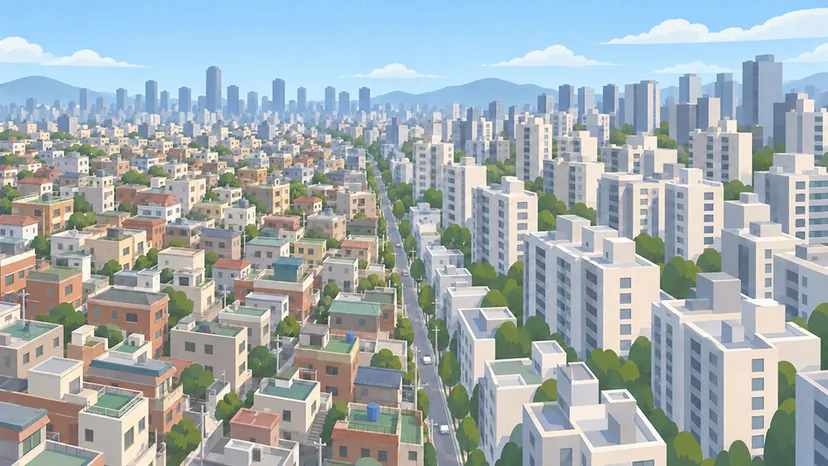
More importantly, there is the timeline. The majority of Seoul's apartment supply comes from redevelopment and reconstruction. These urban renewal projects take at least 10 years, and usually 15 years, from zone designation to completion. The volume that could have started construction in 2022–2025 represents projects that should have been designated as zones and moving forward in the early to mid-2010s. To explain today’s supply cliff, one must turn the clock back 10 years.
What happened in Seoul 10 years ago?
During that period, the Seoul Metropolitan Government canceled nearly 400 renewal zones under the name of an "exit strategy for New Towns." Redevelopment was labeled an evil that displaces original residents, and those spots were filled with murals and urban regeneration projects. Jamsil Jugong 5-danji, Eunma Apartments, Seongsu Strategic Maintenance Zone, and the comprehensive development of Yeouido were stuck at the threshold of deliberation for years. The inlet of the pipeline was blocked.
The central government also blocked the inlet. In 2018, the Moon Jae-in administration raised the structural safety weighting in safety diagnostics from 20% to 50%. This made it impossible to even begin reconstruction unless there was a risk of collapse. The administration revived the Reconstruction Excess Profit Recovery Act, and in speculative zones, it prohibited the transfer of union member status after the establishment of a union for reconstruction projects and after the management and disposal plan authorization for redevelopment projects. On top of that, a price ceiling on new apartment sales was added. Each of these was a major obstacle slowing down project speed.
We must also look at the records from the other side. After returning to office, Mayor Oh Se-hoon introduced the "Rapid Integrated Planning," which reduced the time required for zone designation from the usual 5 years to around 2 years, and shortened the duration for architectural reviews and project implementation authorizations by over a year through integrated deliberation. This is why the sentiment that "permits must be finished within Mayor Oh’s term" has become established wisdom among union members. The Yoon Suk Yeol administration eased safety diagnostic standards in 2023, and as a result, complexes in Mok-dong, Sanggye, and Irwon crossed the threshold for reconstruction one after another. The first generation of new towns, including Bundang, took their first steps under the Special Act on the Improvement of Old Planned Cities. It is difficult to find policies from this period intended to reduce supply. However, the time when zones designated during this period will lead to move-ins is the 2030s. In urban renewal, the person who plants the seeds is different from the person who harvests.
Of course, the current Seoul city government is not flawless. Last year's move to lift land transaction permit zones in Jamsil, Samseong, Daechi, and Cheongdam, only to re-designate them a month later, was a clear blunder that sent the wrong signal to the market. It is also true that the Yoon Suk Yeol administration’s 2.7 million housing supply plan has failed to gain speed in the face of high interest rates. However, "lacking execution" and "reducing supply" are entirely different matters. One cannot weigh those who blocked the pipeline on the same scale as those who tried to clear it but only partially succeeded.
The danger of the term "leveling"
The President interpreted the recent trend of price decreases in the Gangnam area and increases in the outskirts as a form of "leveling." However, this is not leveling; it is a balloon effect. As transaction of high-priced markets was locked down by loan regulations and land transaction permit systems, demand was pushed down to price ranges where loans are still possible. The regulatory line does not act as a price ceiling but as a gathering place for demand. The people who have to buy homes at that gathering place are not wealthy asset holders, but ordinary people with actual housing needs. For the common person, seeing prices in Nowon and Guro rise by 100 million won is far more painful than seeing prices in Gangnam fall by 100 million won.
The President stated that detailed policies are being prepared and implemented for the difficulties faced by tenants. However, the jeonse (lump-sum deposit rental) market is a leading indicator for the sales market. New supply is shrinking, jeonse listings are drying up due to mandatory residence requirements, and multi-homeowners are exiting as rental providers. When jeonse prices rise, the lower bound of sales prices is pushed up. As long as jeonse and monthly rent are viewed as mere "niche" issues, market stability will remain elusive.
Five things the government must do now
First, stop the blame game. The authority for permits in Seoul’s urban renewal projects lies with the Seoul Metropolitan Government and the autonomous districts, while laws and finance are under the central government. There is no way to increase supply in Seoul while keeping the city government in the defendant's seat. Supply is a product of collaboration.
Second, change the performance indicators. The President said he would soon release data showing that building permit numbers are increasing. However, a permit is not a house. The numbers the market trusts are construction starts and completions, and among them, the occupancy volume of Seoul apartments. If receiving weekly reports, he should be looking at construction starts and relocation statuses, not just permits.
Third, remove the "major obstacles." The President promised to rapidly increase reconstruction and redevelopment. It makes no sense to keep the Reconstruction Excess Profit Recovery Act, restrictions on transferring union member status, price ceilings on new sales, and relocation loan regulations in place while making that promise. It is like stepping on the accelerator while the brakes are engaged. What determines the speed of urban renewal is not slogans, but the project viability for the union members.
Fourth, recognize rental providers. Most of Seoul’s jeonse and monthly rentals are supplied by the private sector. If you define all multi-homeowners strictly as speculators, jeonse listings will disappear, and the cost will be borne by the tenants.
Fifth, distinguish between timeframes. Balanced national development and moving the administrative capital are the right directions, but they are 20-year prescriptions. A jeonse crisis next spring will not be solved by Sejong City. Long-term prescriptions should not be used to fill the void of short-term measures.
Conclusion
Supply lasts longer than a political administration's term. An apartment moving in today was someone's decision 10 years ago, and today's decisions will return as move-ins in 2035. Therefore, the question of who is responsible for a supply shortage should always be directed not at those currently in office, but at those from 10 years ago. For the same reason, the person who will be held responsible for Seoul's supply 10 years from now is this current government. You cannot build a single apartment by blaming others.