

[BizHanKook] The market moves in sequence. The first half of 2026 belonged to Seoul. Now, in the second half, it is Gyeonggi-do's market. Statistics from the first week of November show that Gangnam-gu and Seocho-gu have seen declines for 13 consecutive weeks, and the heat has shifted to the southern Gyeonggi region. So, what comes next? I believe Incheon's market will begin to rise starting in 2027.
Let me be clear from the start: this is not an article advising you to blindly buy in Incheon. Incheon is the highest-risk market in the Seoul metropolitan area. Therefore, it is a region that requires selection, and it is land that presents opportunities only to those who have done their homework.
Why Incheon Now: The Supply Crunch
Price is determined by supply. There is only one reason why Incheon has been the weakest performer in the capital area over the past few years: volume. From 2022 to 2024, approximately 117,000 households moved into Incheon over three years. No city can withstand that level of supply. It was the aftermath of this that caused Incheon to be the only area in the capital region to shift to a downward trend earlier this year.
That supply is coming to an end. According to real estate analytics, the planned move-in volume for the three years from 2025 to 2027 is about 48,000 households, less than half of the previous three-year period. Furthermore, in 2028, the supply will drop to around 8,000 households. Looking at Incheon as a whole, it stands at an inflection point, moving from an era of oversupply to one of undersupply.
The signals have already emerged. Even while apartment sale prices fluctuated or remained stagnant this year, jeonse (charter rent) and monthly rent prices in Incheon consistently rose. Jeonse is a leading indicator of sale prices. In June, sale prices also shifted to an upward trend, led by Yeonsu-gu. Added to this is the demand from those who can no longer afford the price burden in Seoul and core parts of Gyeonggi-do. The pattern of Seoul rising, followed by Gyeonggi-do, and then Incheon, is not just a simple prediction; it is a trend that has repeatedly occurred in the capital area market.
Jobs: Incheon Is No Longer Just a Bedroom Community
The first condition of a location is jobs. Any perspective that sees Incheon merely as a bedroom community for Seoul is now incorrect.
The key is Songdo. Where Samsung Biologics and Celltrion were already established, SK Bioscience moved its headquarters and research center from Pangyo to Songdo this past January. Lotte Biologics' Plant 1 aims for commercial production by 2027. Songdo's biopharmaceutical production capacity is expected to expand to 1.16 million liters, making it the world's number one in terms of a single city. This means high-income research and production personnel are commuting within the city. Quality jobs create demand for quality housing.
Yeongjong has the airport economic zone, Namdong and Bupyeong have industrial complexes, and Gyeyang is building a 3rd generation new city with self-sufficient land. This is where the first standard for selection arises: you must distinguish between regions with their own jobs and regions that must rely on Seoul for jobs. For the former, focus on the quality of jobs; for the latter, you must also look at transportation.
Transportation: ‘Opening’ vs. ‘Planned’
The point where most people fail in Incheon investment is transportation. Lines drawn on a map are not a positive factor. Only running trains count as a benefit. Let’s look at what is reliable. The Incheon-originated KTX began comprehensive test runs in September, with an opening target of June 2027. The Incheon Line 1 Geomdan extension already opened in June last year. The GTX-B, which began main construction in August last year, is targeting a 2031 opening; once open, it will take 23 minutes to get from Songdo to Yeouido and 29 minutes to Seoul Station. It will also stop at Incheon City Hall Station and Bupyeong Station. The Seoul Line 5 extension to Geomdan and Gimpo has passed the preliminary feasibility study.
You must look at the opposite cases as well. The first phase of the Line 7 Cheongra extension, originally scheduled to open in the second half of next year, is now facing an inevitable three-year delay, with completion expected in the second half of 2029. The second phase is expected to be pushed back to the first half of 2033. The Incheon Line 1 extension to Songdo District 8 showed significantly lower economic feasibility in the first preliminary feasibility review. One must empathize with those who purchased based on faith in that single route.
The principle is simple: opening dates can always be delayed. Therefore, you must rank your positive factors: opened, under construction, passed preliminary feasibility, or planned. Only the first two stages secure prices. And you must verify which job hubs in Seoul the route leads to. Lines that connect to Yeouido, Seoul Station, or Gangnam have a different value than those that do not.
New Apartments and Infrastructure: Not All ‘New’ Is Created Equal
Incheon is a city with many new apartments. That was its weakness for the past three years, but it could be its strength for the next three. This is because a new city that has absorbed its supply transforms into a "new apartment complex with established infrastructure," featuring completed schools, commercial districts, and parks.
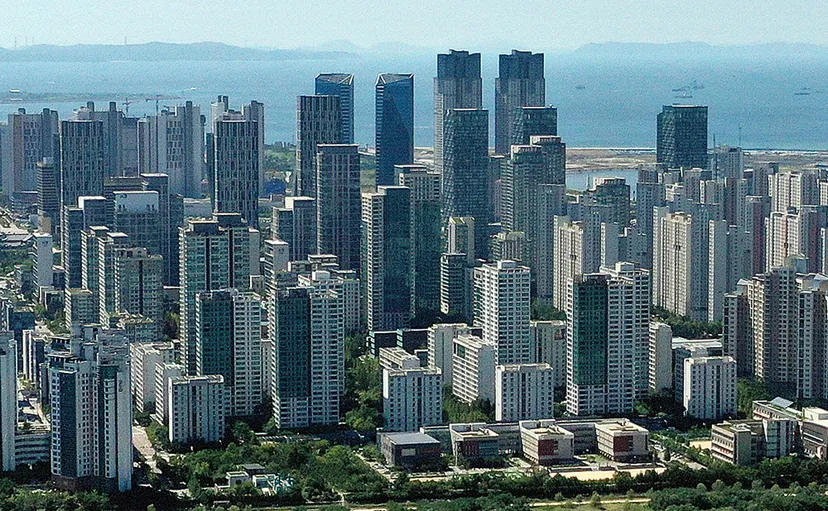
Songdo has effectively zero supply this year, and only about 1,000 households in 2027. It is a supply vacuum. However, even within Songdo, apartment complexes near Incheon National University Station are trending toward previous highs, while areas flooded with supply have hardly risen. You should not buy the "Songdo" name, but the specific location of the complex.
Geomdan is the opposite. Through the first half of next year, about half of Incheon's move-in volume is concentrated in the old Seo-gu area. Short-term supply pressure is clearly a risk. However, the time when supply is at its peak is also when prices are likely the cheapest. Since railroads have arrived and a legal town is being built, one must visualize what the area will look like after the move-in wave settles.
For older city centers, pay attention to large new complexes. New developments in Bupyeong, Guwol, and Juan inherit the existing lifestyle infrastructure. Conversely, stand-alone apartments and small-scale complexes may be left behind even if an Incheon bull market arrives.
Strategy by District
· Songdo (Yeonsu-gu): The leader of Incheon, where jobs, GTX-B, KTX, and a supply vacuum all overlap. Complexes with good access to Incheon National University Station are the top priority; outer districts with uncertain transportation should be evaluated at a lower tier.
· Cheongra, Luwon, Gajeong (Seo-gu): The key is how much the Line 7 delay is reflected in the price. Prioritize complexes that can actually utilize the Airport Railroad and Incheon Line 2.
· Geomdan (Geomdan-gu): Periods when jeonse prices are suppressed by the move-in wave can be entry opportunities. Limit your search to large complexes near stations.
· Bupyeong, Guwol, Gyeyang: Regions that compete based on accessibility to Seoul. The target should be large, new complexes within the living zones of Line 7, Line 1, and GTX-B stations.
· Yeongjong (Yeongjong-gu): Airport jobs are a strength, but accessibility to Seoul is a weakness. Approach this area conservatively from the perspective of an end-user.
Incheon Is a Market of Skill, Not a ‘Buy-Anything’ Market
Before purchasing in Incheon, ask three questions. Where do the people living in this area earn their money? Is the transportation to those jobs currently in operation? Is this complex a new build that people will want to live in even five years from now? If you only keep the places that can answer all three questions, there are fewer candidate sites in Incheon than you might think.
That is the essence of Incheon. Seoul is a market where time solves everything, regardless of where you buy. Incheon is not. Only the places that should rise will rise, and if you choose the wrong location, you will be left behind even in a bull market. The fact that there is a lot of risk means it is not easy for everyone to enter, and it means the gap between those who have studied and those who have not will be the widest.
2027, Incheon's time is coming. That time belongs to those who have prepared.