

[비즈한국] The median apartment price in Seoul is 1.3 billion won. Even with the maximum possible loan, you need 600 to 700 million won in cash. We have entered the era of 2.1 billion won for a 84㎡ apartment in Seoul. It has doubled in five years. On top of this, land transaction permit zones have expanded, requirements for actual residency have tightened, and loan regulations have been layered on. The path to entering the Seoul market using a "jeonse" (lump-sum deposit) lease has been blocked, and the path to entering with cash was never an option for the average salaried worker to begin with. Seoul is no longer a "market you want to buy in," but a "market you cannot buy in." The door is closed. Lining up in front of a closed door is not a strategy. Finding an open door is the strategy. That door is Gyeonggi-do.
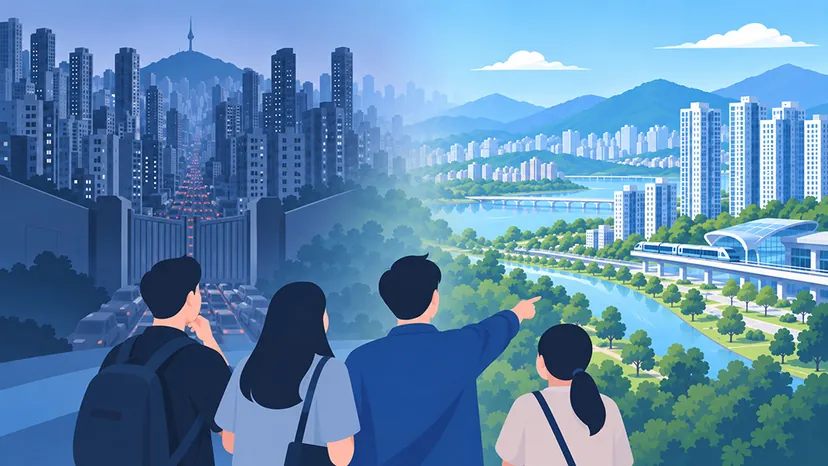
First, people and money are leaving Seoul
The population of Seoul is 9.36 million. It has decreased by 760,000 in 10 years. This is not because of the birth rate, but because of housing costs. People pushed out of Seoul have moved to Incheon and Gyeonggi. When the population moves, demand moves, and when demand moves, prices follow. However, supply has failed to keep up with this migration. Over the past five years, the supply shortage compared to the increase in the number of households in the capital area is 210,000 households. Excluding the 60,000-household shortage in Seoul alone, 150,000 households of the shortage occurred in Gyeonggi and Incheon. In 2025 alone, 49,000 newlywed couples, 10,000 divorcees, and 30,000 people moving in from the provinces were looking for new homes. Shortage equals price. This is not a prediction; it is simple arithmetic.
Second, the jeonse market spoke first
Jeonse is a leading indicator of purchase prices. Actual demand moves first, and investment demand follows. Look at the cumulative rise in apartment jeonse prices in 2026: 7.6% in Seoul. However, Gwangmyeong is at 12.5%, Hwaseong Dongtan at 11.7%, Yongin Giheung at 10.6%, and Suwon Yeongtong and Hanam are nearing 10%. Gyeonggi’s southern region jumped earlier and more significantly than Seoul. Purchase prices follow where jeonse prices rise. There has never been an exception to this until now. In Seoul, jeonse listings have vanished by 12% in a year, with a 71% evaporation in Jungnang-gu and 68% in Dongdaemun-gu. Where will the demand that couldn't find jeonse in Seoul go? To Gyeonggi. Seoul’s jeonse crisis is a trailer for Gyeonggi’s purchase demand.
Third, tax reform changed the direction of demand
The core of the 2027 tax reform is increasing taxes on ultra-high-priced homes and regulations on non-residential single-home ownership. For properties with a market value of 3.5 billion won or more, taxes will increase regardless of residency, and elderly long-term owners will be hit hardest. The comprehensive real estate tax on an apartment with an officially assessed price of 5 billion won and a market value of 7 billion won will jump from 9.37 million won this year to 32.96 million won in 2028. The result is clear: the ultra-high-end market will remain weak until 2027, and bargain properties will be picked up by the children of the wealthy who have cash. Gangnam will become a fortress where only the truly rich remain.
And where does the displaced demand go? To the segment under 2 billion won in market value, which is free from the burden of the comprehensive real estate tax. The "smart single house" strategy is shifting to a "less smart single house" one. Newlyweds, purchase demand moving down from Gangnam, and tenants coming up from jeonse are meeting in this segment. The market under 2 billion won, especially the outskirts of Seoul and key areas in Gyeonggi, is the battlefield. Taxes cannot lower housing prices; they only shift demand.
Fourth, semiconductors are pouring in liquidity
Samsung Electronics is injecting 36.6 trillion won, and SK Hynix 26 trillion won. The total funds entering the market through performance bonuses and internal company loans by 2026 could reach up to 53.6 trillion won. This money is not going to Gangnam. It is going to new apartments within a 30-minute commute, priced between 1.5 and 2.5 billion won. That means Bundang, Yongin Suji, Gwanggyo, and Dongtan. This is exactly why Dongtan's jeonse prices rose by double digits. Even when designated as a regulated area, Dongtan did not stop. This is because the semiconductor belt is driven by industry-led demand, not policy-led demand. Policy cannot suppress it. The KDI stated that for every 1% increase in money supply, house prices rise by 0.9%. Liquidity eventually flows into assets. When the stock market rises, people who need a place to live eventually buy a house. A significant portion of the 3.7 trillion won that flowed from the stock market to real estate between January and April of this year came from people in their 30s.
Fifth, price equalization remains
Seoul is hitting new highs, surpassing its 2021 peak. Conversely, Incheon, Paju, Ilsan, Sanbon, and Jungdong have yet to recover to their previous peaks. The market always fills the gaps. When Seoul rises, adjacent Gyeonggi areas follow, and then the outskirts follow. The fact that Seoul's outskirts began leading the rise in 2026 is the signal. Areas that haven't recovered their peaks aren't rising because they are "cheap"; they are rising because the "gap has widened." If the order is set, all that remains is time.
Sixth, transportation networks are redrawing the map
The GTX ties Songdo, Paju, Ilsan, Namyangju, Ansan, Suwon, Uiwang, and Uijeongbu into a 30-minute commute to Seoul. The Shinbundang Line extension changes Suwon Hwaseo, Guun, and Homaesil; the Line 7 extension changes Cheongna, Lu1 City, and Yangju Okjeong; and the Shinansan Line changes Ansan Seongpo and Siheung Mokgam. Transportation networks reshape location value. We have already seen many cases where, once a line opens, new apartments near newly established stations in Gyeonggi move faster than old apartments on the outskirts of Seoul. Pangyo was like that, Gwanggyo was like that, and Dongtan was like that.
Seventh, why Gyeonggi and not the provinces?
The saying, "If Seoul is too expensive, buy in the provinces," is wrong. The provinces do not lack supply; they lack demand. As quality jobs have been sucked into the capital area, both population and capital have drained away. The reason jeonse has disappeared in the provinces is not because of regulations, but because there are no people to live there. Unless universities and jobs return, there is no exit for the provinces. Gyeonggi, on the other hand, is a place where Seoul's overflow demand is pouring in. Even though both are "non-Seoul," one is experiencing a drain of demand, while the other is experiencing an influx. The directions are opposite. The alternative to Seoul is not the provinces; it is Gyeonggi.
However, not all 31 cities and counties in Gyeonggi-do will rise
You shouldn't be mistaken here. Gyeonggi-do is vast. While not having recovered to a previous peak is an opportunity, there are places that cannot recover for a reason. Areas without jobs or transportation cannot follow, no matter how much Seoul rises. There are three criteria for selection: jobs, transportation, and the scarcity of new construction. I look only at places that possess two or more of these three. They include the semiconductor belt (Dongtan, Yeongtong, Suji, Giheung), complexes with low floor-area ratios near subway stations in first-generation new towns (Sanbon, Jungdong, Ilsan), new constructions near subway stations in non-regulated second-generation new towns (Songdo, Cheongna, Geomdan, Unjeong), areas near new transportation lines (Hwaseo, Mokgam, Okjeong), and undervalued sections (Haengsin, Hwajeong, Byeongjeom, Segyo, Godeok). Other areas will not rise simply because they carry the name "Gyeonggi-do."
Conclusion—The door to Gyeonggi-do is still open
There is no supply in Seoul. With only 13,683 units scheduled for move-in by 2028, even the only new residential development site in Seoul, Yeomchang Park, saw its briefing session canceled due to resident protests. Yongsan-gu opposes the 20,000 units in Yongsan Park. Urban renewal projects take 10 years from district designation to move-in, and to build 310,000 units by 2031, 220,000 units must be torn down first. The supply shortage in Seoul is not an incident; it is a structure. If the structure does not change, prices will overflow from Seoul into Gyeonggi. Regulation lines are not ceilings for prices, but points where prices gather. The regulation lines drawn in Seoul are currently gathering prices in Gyeonggi-do.
Housing prices are determined by supply, not taxes. Seoul lacks supply and entry is blocked. In Gyeonggi-do, demand is flowing in and the door is still open. Jeonse spoke first, the population moved first, and semiconductors are pouring in money. While you wait for a purchase in Seoul while holding onto a jeonse there, Seoul housing prices will rise further and the barrier to entry will become even higher. Catching the bottom during a downturn is not skill, it’s luck, and 90% of people cannot buy when prices are falling. Waiting is not a strategy.
Now is not the time for Seoul. Now is the time for Gyeonggi-do.