

[비즈한국] The South Korean economy is maintaining a steeper growth trend than expected, buoyed by robust semiconductor exports fueled by the artificial intelligence (AI) boom. After a contraction of -0.1% (quarter-on-quarter) in the fourth quarter of last year, the Korean economy rebounded sharply to 1.8% growth in the first quarter of this year, followed by a 0.6% growth rate in the second quarter. The growth rate for the second quarter is three times higher than the Bank of Korea's forecast (0.2%) from last May. With the surprise growth recorded in the first half of the year, the government's target of 3% annual growth has become highly achievable. In the first half of the year, the Korean economy grew by 3.8% compared to the same period last year, marking the highest growth rate in four and a half years since the second half of 2021 (4.5%).
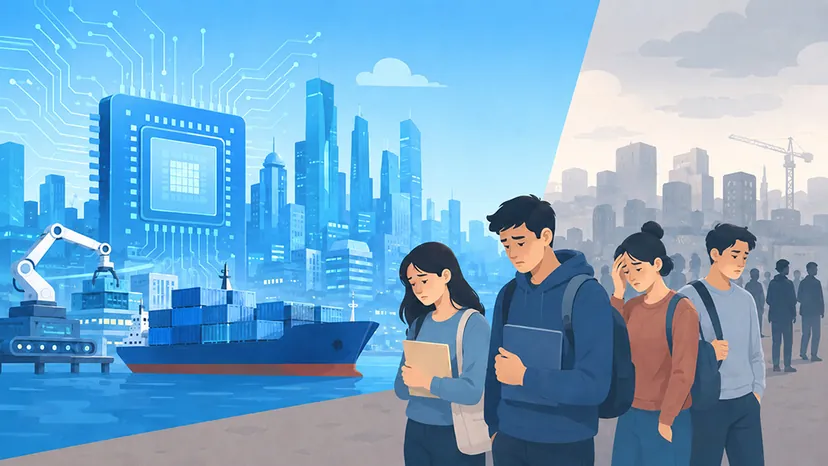
Consequently, as long as the growth rate for the second half of the year stays above an average of -0.1%, this year's growth rate will exceed 3%. While the economy is soaring thanks to semiconductors despite headwinds like the war in the Middle East, an ironic situation is unfolding where economic growth is failing to contribute significantly to employment. Given the low job-creation potential of the semiconductor industry, it is highly likely that the employment elasticity of growth will barely exceed zero. Experts point out that the unemployment problem among the youth, who are the biggest victims of jobless growth, could become even more severe, making the development of countermeasures urgent.
President Lee Jae-myung has repeatedly emphasized the creation of youth jobs. In a meeting with senior secretaries presided over at the Blue House on July 2, he stated, "The three major mega-projects are not charity for the provinces, but the only path for the Republic of Korea to become the final winner of the Fourth Industrial Revolution and a historic decision for future generations." He added, "I ask for the united strength of the people, businesses, the government, and the political sphere on this path, which will take responsibility for the next 30 years of the Republic of Korea and open a door of greater opportunity for all youth across the nation."
Furthermore, at a cabinet meeting held at the Blue House on the 21st, he noted, "While the AI revolution is injecting new vitality into our economy, it is also rapidly expanding the shadows of K-shaped polarization." He continued, "Structural mitigation of polarization is inseparable from sustainable growth," and added, "For this, a government-wide effort is needed for youth jobs, as well as youth asset accumulation and housing stability."
Despite President Lee's requests, the trend of jobless growth in our society is intensifying. The employment elasticity—a measure of how much employment increases with economic growth—is expected to plummet this year to its lowest level in eight years. If the government’s projections hold, the employment elasticity, calculated by dividing the growth rate of employed persons by the economic growth rate, will fall to 0.17 this year. In the "Second Half 2026 Economic Growth Strategy" announced on the 13th, the government raised its annual growth forecast from 2.0% to 3.0%. Looking at the GDP trend maintaining its growth momentum, there is an atmosphere that 3% growth has already become a fait accompli.
The problem is that the government has lowered its forecast for the increase in the number of employed persons from 160,000 to 150,000. This level of growth represents a mere 0.5% increase compared to last year's total number of employed persons (28.769 million). Calculating the employment elasticity based on the government's forecast yields only 0.17, barely above zero. This means that for every 1.0% growth in our economy, jobs increase by only 0.17%. If this employment elasticity becomes reality, it would be the lowest level in eight years since 2018 (0.13).
Employment elasticity hit 0.13 in 2018 as the introduction of the 52-hour workweek and a sharp rise in the minimum wage dealt a blow to the job market, after which it fluctuated. It reached 0.48 in 2019 and climbed to 1.14 in 2020, but dropped to 0.30 in 2021 as the impact of COVID-19 took hold. Subsequently, the employment elasticity rose to 1.03 in 2022, then followed a downward trend to 0.80 in 2023 and 0.27 in 2024, before rebounding to 0.64 in 2025. However, in just one year, it is now facing a situation where employment elasticity is plummeting back into jobless growth.
In reality, as the job market cools down, the youth (ages 15–29) are bearing the brunt of the impact. The youth employment rate in June of this year was 43.9%, down 1.7 percentage points from a year ago, and the rate has recorded negative growth year-on-year every month from January to June this year. In particular, the youth employment rate has been stuck in the 43% range for all six months of this year.