

[비즈한국] Many exoplanets have been discovered to date. Some are rocky like Earth, while others are shrouded in thick atmospheres like Jupiter. Some are even suspected to harbor liquid oceans on their surfaces. Each of these serves as a critical stage for potential life. Earth, for instance, owes its existence as a final biosphere to the interplay of three elements: rock, atmosphere, and ocean.
Surprisingly, we have yet to find a place where all three of these conditions are present together. If we found a rocky planet of appropriate size, it was difficult to trace an atmosphere; conversely, planets with intriguing atmospheres containing water vapor or oxygen were typically large, Jupiter-like gas giants. Recently, however, an interesting candidate that is both a rocky planet and equipped with an atmosphere has been discovered.

The planet LHS 1140b, which orbits the star LHS 1140, was first discovered in 2017. It has 5.6 times the mass of Earth and 1.7 times its diameter. It can be categorized as a "Super-Earth," being slightly larger and heavier than our home planet. Its host star is a red dwarf, which is significantly dimmer than the Sun. The planet orbits its star at a close range with a period of only 25 days. Consequently, it receives about 42% of the sunlight that Earth does. The temperature conditions are not too bad; it resides within the habitable zone.
It is a highly enticing planet. It is not merely a rocky planet with a solid metal core; it is estimated that 10–20% of its total mass consists of water or ice. It potentially possesses both rock and an ocean. If it also holds an atmosphere, it could be a "triple crown" planet featuring all three essential components.
To confirm that final element—the existence of an atmosphere—the James Webb Space Telescope (JWST) was pointed toward this planet. In September 2024, the planet transited in front of its host star, and observations were carried out for 6.5 hours. Surprisingly, the results revealed the presence of helium. However, the helium detected in the spectrum was shifted slightly to a different wavelength, suggesting that the helium is not static but in motion. It is presumed that helium gas is currently escaping from the planet's atmosphere.
Yet, in subsequent observations conducted in 2025, the helium signal did not appear. It is believed that the signal weakened temporarily because violent stellar activity in the interim blew away a significant portion of the helium in the upper atmosphere. Helium is the second lightest gas in the universe. If a planet's atmosphere contains helium, it would rise to the upper layers, and it is prone to leaking out into space, escaping the planet's gravity.
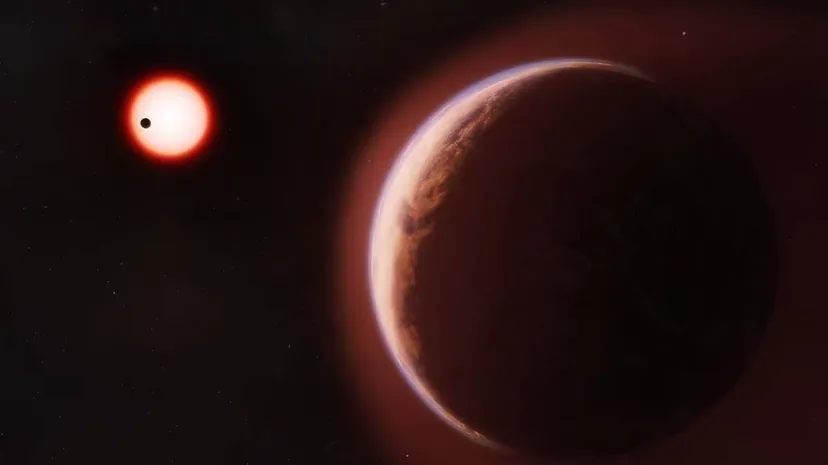
There is a reason why this discovery is particularly significant. LHS 1140b orbits a red dwarf. Most of the potentially habitable planets discovered so far also orbit red dwarfs.
However, planets around red dwarfs face a major problem. To maintain a temperature similar to Earth's near a dim red dwarf, the planet must orbit very closely. This makes it inherently vulnerable to violent stellar flares and stellar winds emitted from the star's surface. Without a magnetic field to act as a shield against these stellar winds, the planet's atmosphere would be completely stripped away into space. Because of this, many astronomers have low expectations of finding traces of life on most habitable planets orbiting red dwarfs discovered to date.
Even the TRAPPIST-1 planets, which gained massive attention when seven planets were discovered around a single star—with at least three of them in the habitable zone—have been extensively observed by the JWST without any clear signs of an atmosphere found so far. Similarly, because their host star is a red dwarf and the planets are so close to it, any atmosphere they once had might have long since blown away.
However, LHS 1140b, where helium atmospheric components have been confirmed, suggests that planets around red dwarfs may have the potential to maintain their atmospheres quite stubbornly. This gives us renewed hope for the countless other exoplanets orbiting red dwarfs.
Of course, the calm nature of the star LHS 1140 itself played a role. It is a relatively quiet star. It rotates very slowly—about once every 130 days—and it is estimated that its magnetic field is quite weak. This makes it highly unlikely that powerful flares will erupt. For life to survive on a planet, the host star needs to be calm.
In this observation, the smaller planet LHS 1140c, which orbits even closer to the same star, was also examined. However, no traces of helium were found on this planet. It is likely that because it is smaller and has weaker gravity, and is closer to the host star, it lost most of its atmosphere early on. In contrast, LHS 1140b, which is slightly further from the star and has stronger gravity, may still be holding onto its atmosphere.
Notably, the fact that this star is 3 billion years old is also important. The Sun is a little under 5 billion years old, so 3 billion years is by no means a short amount of time. The fact that a planetary atmosphere can survive without disappearing completely while stuck next to a red dwarf for such a long period gives us hope that planetary atmospheres can unexpectedly persist for a long time. I hope that, like our Earth, there are many planets hidden in the universe that are holding on to make the most of the small window of fortune they have been given, despite the harsh space environment. Among those planets, there might even be some that harbor their own unique ecosystems.
Reference
https://www.science.org/doi/10.1126/science.aea9708
https://ui.adsabs.harvard.edu/abs/arXiv:2608.19120
Who is the author Ji Woong-bae? He loves cats and the universe. After watching 'Galaxy Express 999' as a child, he dreamed of sharing the beauty of the universe with others. He currently serves as an assistant professor in the School of Interdisciplinary Studies at Sejong University, engaging in various science communication activities, including lectures and writing. He has authored books such as "On the Uselessness of Astronomers," "We Are All Born as Astronomers," and "Strange Questions That Come to Mind When Looking at the Universe," and translated books including "How I Killed Pluto," "Quantum Life," and "UFO."