

[비즈한국] Earth, in fact, doesn't just have one moon. Beyond the moon we all know, there is another moon hiding. And finally, its true form has been captured. What is the reality of this unknown moon—this other moon—that has been lurking around Earth?
This legend began in 1961 when Polish astronomer Kazimierz Kordylewski photographed faint patches of light at specific points between the Earth and the Moon. His camera was aimed at the L4 and L5 Lagrange points, created by the gravitational interaction between Earth and the Moon.
In a system where two celestial bodies orbit each other, five Lagrange points are created where gravity and orbital motion reach an exquisite balance. L1, L2, and L3 are unstable equilibrium points where objects easily drift away due to minor disturbances. On the other hand, L4 and L5—which form the third vertices of equilateral triangles with the Earth and Moon as the other two vertices—are relatively stable equilibrium points where objects can remain for a comparatively long time. In the case of the Earth-Moon system, L4 is located 60 degrees ahead of the Moon's path, while L5 is 60 degrees behind.
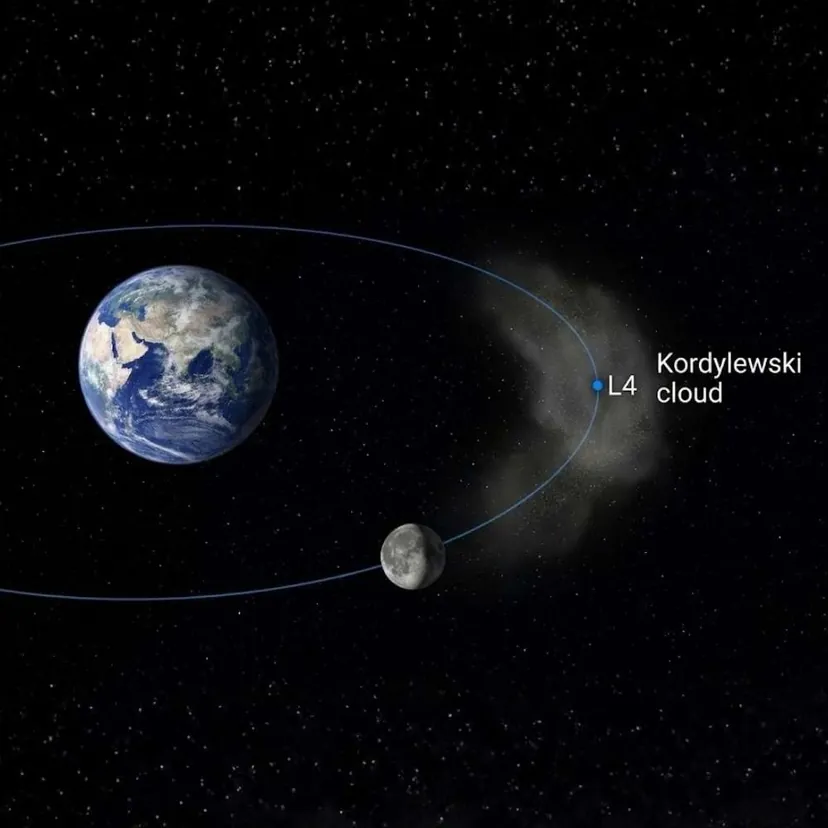
Of course, they are not perfectly stable. The Sun's gravity, solar wind, radiation pressure from sunlight, and gravitational perturbations from neighboring planets are constantly at work. Therefore, dust that flows into these Lagrange points does not stay there forever. The process of being captured, dispersed, and replenished repeats continuously. Kordylewski argued that clouds of cosmic dust exist, gathered near L4 and L5, balanced by the gravity of Earth and the Moon. Rather than a solid satellite, they are more like massive clumps of cosmic dust that stay near Earth while constantly changing shape. This is why these dust clouds are sometimes called "ghost satellites."
The problem is that verifying their existence through observation is tricky. They are too faint. The Kordylewski clouds are clouds where countless tiny dust particles are sparsely scattered across a vast space. While their total size is larger than Earth, their density is extremely low. Thus, it is difficult to distinguish them from the background light of space or light scattered in the sky using standard telescope photographs alone. For a long time, the Kordylewski clouds were considered mythical celestial bodies whose existence remained unconfirmed. Opinions on whether they even existed remained divided until recently.
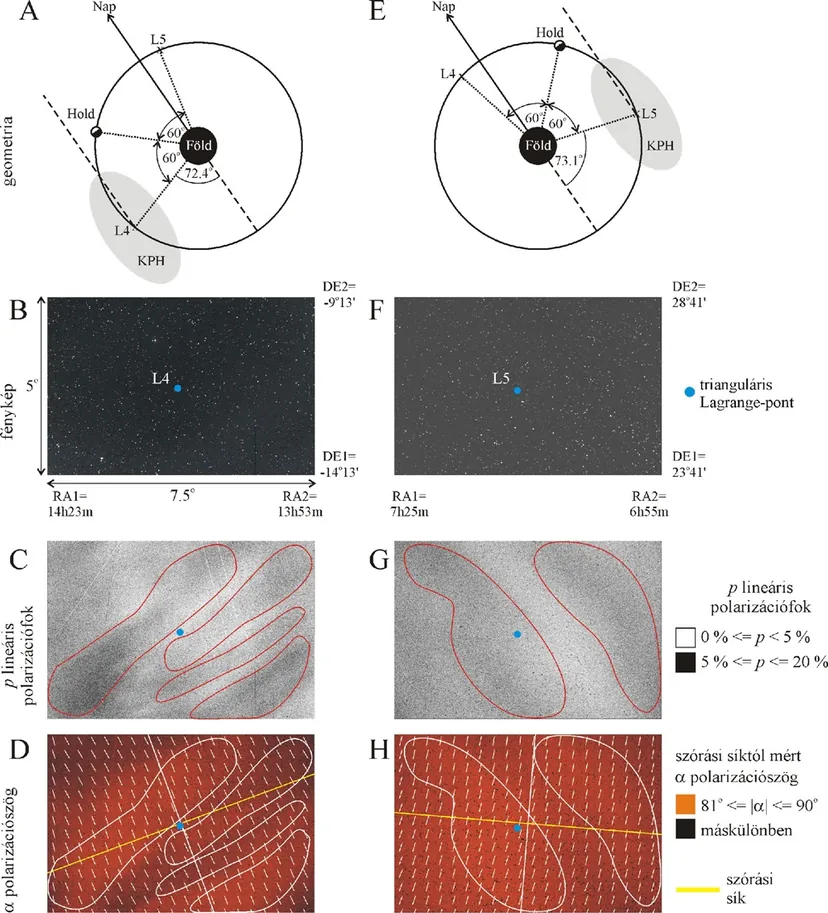
In 1966, NASA's airborne observations and the solar telescope OSO-6 captured traces that appeared to be clouds near the L4 and L5 positions. However, radar observations failed to produce clear signals. Japan's Hiten probe, launched in 1991, also searched for the presence of these dust clouds while passing near L4 and L5 but found no evidence. Then, in 2018, Hungarian astronomers found a new clue. Instead of simply photographing the dust clouds themselves, they analyzed the vibration patterns of light scattered as sunlight hit the dust particles—specifically, polarimetric observations. Through this, they identified traces of polarized, scattered light near L5. There, a dust cloud definitely existed, scattering sunlight.
In reality, Kordylewski clouds do not maintain a constant size or brightness. The quantity and distribution of particles are constantly changing. Depending on the positions of the Sun and the Moon at the time of observation, and the influx of dust, they may or may not be visible. This is why various observations over the years have yielded confusing, conflicting results. Interestingly, reports released so far suggest that the L5 cloud is captured more frequently than the L4 cloud. In a total of 21 observations up to 2022, the L5 cloud was observed 16 times, while L4 was observed only 5 times.
However, there is another type of celestial body that looks more like a "real" moon. These are quasi-satellites. At first glance, a quasi-satellite might sound like another small moon captured by Earth's gravity. But in reality, it is not held by Earth's gravity at all. It is actually an asteroid orbiting the Sun on its own. It just happens to have an orbital period almost identical to Earth's, resulting in a 1-to-1 orbital resonance. Relative to the Sun, it orbits alongside Earth, but from Earth's perspective, it appears to move in a large loop around our planet.
As you move further away from Earth, you become more influenced by the Sun's gravity than Earth's. The boundary where the Sun's influence becomes stronger than Earth's is called the "Hill sphere." Generally, quasi-satellites are located further out than Earth's Hill sphere and are bound to the Sun's gravity, not Earth's. They are also distinctly different from "mini-moons" that are accidentally captured by Earth's gravity for a few days to a few months before drifting away.
Such quasi-satellites are actually not a phenomenon unique to Earth. To date, many have been found around every planet in the solar system except Mercury. Even Venus, which has no real moons at all, has a quasi-satellite called Zoozve. Interestingly, this name was given due to a mistake. Originally, the official name of this asteroid was 2002 VE 68, but a British radio host reporting the news misunderstood "2002" as an English word rather than a number and read it as "Zoozve." The name Zoozve became popular due to this accidental mistake, and the International Astronomical Union officially adopted it. It is as if a radio host's error was permanently etched into the cosmos.
To date, seven quasi-satellites have been discovered around Earth. Among them is 2016 HO3, discovered in 2016 by the PANSTARRS telescope in Hawaii. This object was named Kamoʻoalewa, which in Hawaiian means a "fragment that oscillates." And recently, China's Tianwen-2 probe succeeded in capturing a real photograph of this quasi-satellite! We have finally confirmed with our own eyes the true, raw face of a quasi-satellite hovering near Earth, rather than our familiar Moon.
Kamoʻoalewa's semi-major axis is 1.001 AU, similar to Earth's. It wanders at an average distance of tens of millions of kilometers from Earth. According to orbital calculations, Kamoʻoalewa has been in a quasi-satellite state for about 100 years. It appears likely to maintain this state for another 300 years or so. It is relatively stable among the known quasi-satellites, making it the most favorable for a probe to approach.
However, it is not certain where exactly this object came from. A 2021 observation suggested that the surface of Kamoʻoalewa appeared similar to lunar silicate materials that have undergone long-term space weathering, leading to the theory that it might be a fragment that broke off from the Moon. Later, additional research suggested the Giordano Bruno crater—a relatively young crater on the far side of the Moon—as a likely birthplace. The theory is that fragments from a massive collision on the far side of the Moon reached escape velocity, were ejected into space, and entered into a 1-to-1 resonance with Earth.
However, recent results have contradicted this. According to new spectroscopic observations in 2026, there is a possibility that Kamoʻoalewa is a fragment of an asteroid, not the Moon. It is estimated to have originated from the asteroid belt between Mars and Jupiter, specifically the Flora asteroid family. Whether this quasi-satellite is a piece of the Moon or an asteroid that accidentally drifted near Earth remains unknown. Without flying there to bring back a sample, it is difficult to find a definitive answer.
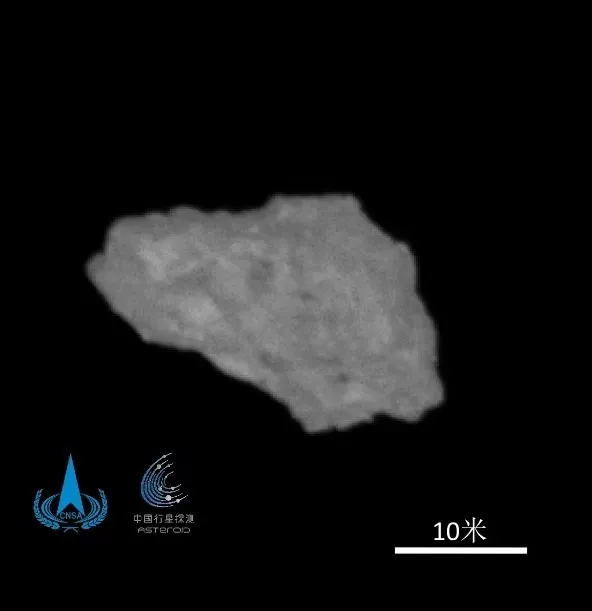
Tianwen-2 was sent out to put an end to that debate. Tianwen-2 departed Earth in May 2025 and traveled a total of 1 billion km over 400 days. It reached Kamoʻoalewa in June 2026. After slowly approaching, it finally reached a distance of about 20 km on July 2nd and was finally able to photograph the real form of Kamoʻoalewa. The reality revealed in the photos is surprising. It is not a smooth, ball-like shape at all. It looks like a gray, bumpy, and elongated rock. This is the first time humanity has photographed an Earth quasi-satellite from such a close range.
Tianwen-2’s goal is even bolder. It is not just about taking a few close-up photos. The goal is to collect samples and return them to Earth. However, there is a problem: this quasi-satellite rotates extremely quickly. Kamoʻoalewa rotates once every 27 to 30 minutes. For a small celestial body several tens of meters in size rotating this quickly, landing stably on its surface and collecting samples is inevitably very difficult.
Therefore, the probe plans to attempt collection in various ways. The first is a "hovering" method where it does not touch the surface of the asteroid but lowers a robotic arm to scoop up dust while staying above it. It matches the asteroid's rapid rotation and speed while hovering 30 meters above the surface, then approaches within 1 meter to insert the robotic arm into the surface. There is also a "touch" method. As a disc-shaped device briefly contacts the surface, a rotating brush—much like a robotic vacuum cleaner—scrapes up dust. Simultaneously, it sprays high-pressure gas to push the kicked-up samples into a storage capsule.
Finally, the third method involves actually attaching to the asteroid's surface. If the surface is sufficiently hard, a tripod-like device is placed onto the celestial body. The probe then presses itself against the surface, using a sharp device at the tip of the robotic arm to anchor the probe firmly to the asteroid. In a sense, it "hangs" on the surface of a small, fast-rotating body with almost no gravity. Methods for collecting samples in this state and storing them in a capsule are also prepared. Of course, it is hard to know which method will succeed until it is actually attempted.
The probe will also measure the impact of Kamoʻoalewa's surface temperature on its orbit, known as the Yarkovsky effect. For small celestial bodies that are only a few tens of meters in size, even the subtle thermal radiation emitted from one side of the surface can change the orbit if that influence accumulates over time. This is the Yarkovsky effect. It is the most troublesome issue when calculating asteroid orbits. To accurately predict the paths of celestial bodies that pass near Earth and pose a threat, we need to precisely understand the Yarkovsky effect. If this mission allows us to better understand the Yarkovsky effect, we will gain the know-how to forecast the orbits of potentially hazardous objects with greater precision and accuracy.
Tianwen-2’s journey will continue even after that. After the return capsule sends samples to Earth, the main body of the probe will use Earth's gravity again for a swing-by. It will then fly for another 7 years or so, aiming for another asteroid, 311P/PANSTARRS, around 2035.
This object is also strange, as it sits at the tenuous boundary between a comet and an asteroid. Its orbit is clearly in the asteroid belt, yet the Hubble Space Telescope captured as many as six long dust tails on this asteroid, just like a comet. It is estimated that these are not caused by ice sublimation like a typical comet, but are rather dust streams created as the asteroid itself rotates too quickly, causing surface material to be flung off. It is a truly bizarre celestial body that makes even the distinction between asteroids and comets ambiguous.
This is the next destination for Tianwen-2. In a single mission, this probe will explore two completely different celestial bodies. It will collect a sample from a quasi-satellite orbiting Earth, then fly on to a strange asteroid that acts like a comet by shedding its own material.
Of course, there is only one real moon captured by Earth's gravity. But the space around Earth is full of even stranger existences hiding in plain sight. In this theater created by Earth and the Moon together, much more complex events are occurring simultaneously than we ever imagined.
References
https://www.nature.com/articles/s41467-026-73284-w
Who is the author, Ji Woong-bae? He loves cats and the universe. After watching 'Galaxy Express 999' as a child, he dreamed of sharing the beauty of the universe. He currently serves as an assistant professor in the Faculty of Liberal Arts at Sejong University, engaging in various science communication activities including lectures and writing. He has authored books such as 'On the Uselessness of Astronomers,' 'We Are All Born Astronomers,' and 'Strange Questions That Come to Mind When Looking at the Universe,' and translated works like 'How I Killed Pluto,' 'Quantum Life,' and 'UFO.'