

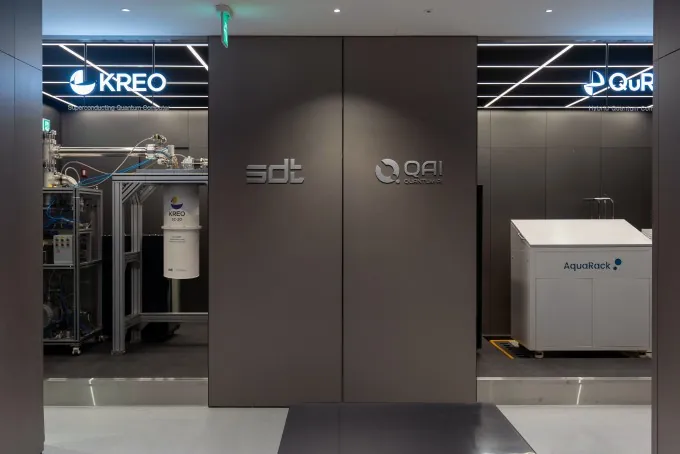
[비즈한국] Amid the ongoing race to develop quantum computers, domestic companies are expanding their business areas beyond core chip development to include control and measurement equipment as well as system integration. Domestic quantum firm SDT is partnering with global quantum computing company IonQ to secure manufacturing and integration capabilities for complete systems and push into the market. Their strategy is to participate in the global supply chain by supplying control and measurement equipment and system software, rather than directly competing with industry leaders by developing original chip technology from scratch.
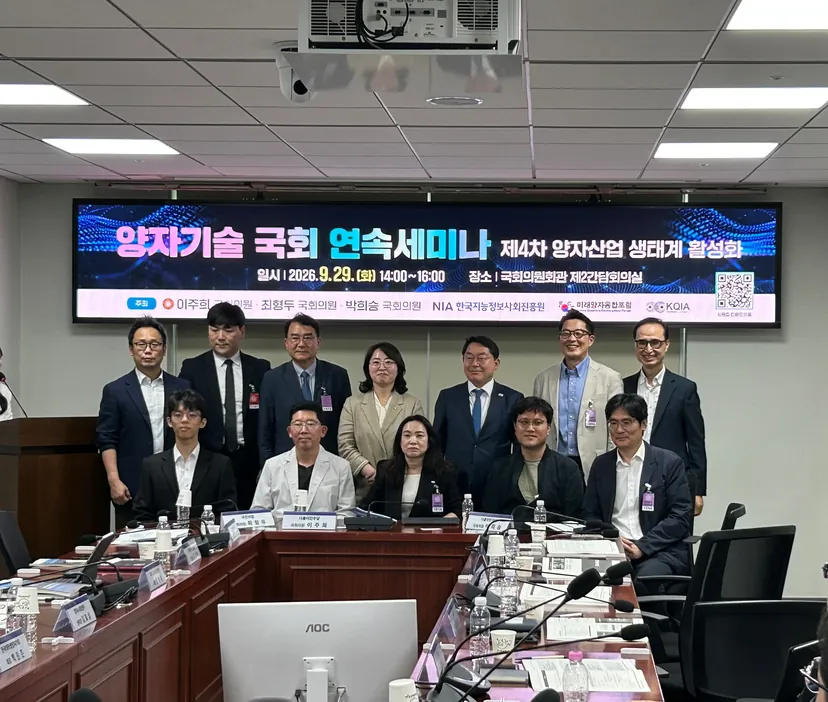
Speaking at a quantum technology seminar held at the National Assembly on the 29th, SDT CEO Yoon Ji-won said, "We are focusing on dealing with control/measurement and system software areas while collaborating with overseas companies," adding, "While independent research is something research institutes and universities must do, directly competing with companies like IBM or IonQ (industrially) is extremely difficult in terms of capital and technology."
The explanation is that aside from independent quantum technology research, for a company to sustain its business, participating in the supply chain rather than directly competing with global leaders is the more realistic path.
Betting on the System, Not Just the Chip
Quantum technology is a field that utilizes the characteristics of quantum mechanics to process, measure, or transmit information. Quantum computers are devices that calculate in ways different from traditional computers, and they are garnering interest from the industry due to their potential applications in artificial intelligence, new drug development, and materials research.
Quantum computers do not operate on a Quantum Processing Unit (QPU) alone. They require equipment to control the chips and measure calculation results, as well as software to integrate these components. SDT has based its business on control/measurement and system software. Using the GPU as an example, CEO Yoon explained, "It's not just about having a GPU chip; you also need HBM, DRAM, a motherboard, and cooling technology. Similarly, when building a quantum computer, various peripheral technologies must be combined."
SDT's business is divided into the sale of standard equipment, customized development and contract manufacturing for clients, and the supply of complete systems. While individual equipment sales target research institutions and companies, complete systems represent a business model that can secure larger revenues from a single contract. Individual equipment prices range from under 100 million KRW to 200–300 million KRW. A complete quantum computer costs 10–20 billion KRW, and IonQ's flagship model approaches 50 billion KRW.
SDT has secured approximately 80 billion KRW in investment to date. They have also secured approximately 12.2 billion KRW in subsidies by carrying out 17 national projects. Currently, they are in the final stages of securing an additional investment of approximately 42 billion KRW led by an overseas quantum computing firm. Their goal is to list on the KOSDAQ in the first half of next year.
Building a Quantum "System Foundry" in Gumi
SDT's business expansion plan was solidified with the partnership with IonQ announced on the 22nd. SDT has secured the status of IonQ's priority manufacturing partner for the Asia-Pacific and Japan region. Their plan is to establish a manufacturing hub for quantum computer-related parts and equipment in Gumi, North Gyeongsang Province—which currently does not exist in Korea—and proactively build a supply chain covering back-end processing, packaging, assembly, and system development/operation. These plans are expected to be finalized by the end of this year, with full-scale construction starting next year. The total investment is 75 billion KRW.
The first product to be supplied will be IonQ's 256-qubit system, which is slated to be introduced as research infrastructure for a hybrid quantum-classical data center at a domestic cancer center currently under development.
Regarding the view that SDT might end up as a mere subcontractor for IonQ, CEO Yoon stated, "There is nothing negative about that," emphasizing the approach of participating in the global corporate supply chain to commercialize system integration and manufacturing capabilities. He added, "Many of Korea's major companies supply parts and services needed for AI data centers rather than final products," and explained, "Securing these capabilities in advance is the role of our company."
Despite Revenue Growth, Industrial Demand Remains in Early Stages
Although the domestic quantum industry has begun to generate revenue, few companies have reached a stage of full-scale growth. According to a survey of 64 organizations by the National Information Society Agency (NIA), quantum-related revenue increased from approximately 70 billion KRW in 2024 to approximately 100 billion KRW in 2025, and is expected to reach approximately 163.9 billion KRW this year. However, it was found that there are only 29 pure-play domestic quantum firms, and there are currently no "scale-up" companies with stable revenue and customer bases.
At this point, demand is also centered on research institutions. Through the national quantum parts/materials/equipment supply program, domestic equipment has been introduced to about 10 organizations, including the Korea Institute of Science and Technology (KIST). The challenge lies in connecting research and development results to actual industrial demand and driving repeat purchases. While revenue in the quantum industry is increasing, the consensus is that the market is still in its early stages for private demand alone to drive corporate growth.
Han Sang-wook, head of KIST's Quantum Technology Application Research Center, pointed out regarding talent cultivation in the quantum field, "While PhD-level personnel will start graduating from quantum graduate schools next year, there are limits to how much the domestic industry can absorb them." His point is that there is a need for infrastructure that connects not only research training but also corporate hiring demand and practical field experience.
A lack of measurement and testing infrastructure was also cited as a constraint on commercialization. Yoo Dae-hyuk, a researcher at the Korea Research Institute of Standards and Science (KRISS), identified the lack of measurement and testing infrastructure in quantum computing and sensing as a bottleneck for industrialization. He explained that expanding the foundation is necessary to transition from research and development to productization and demonstration stages.
While expectations for the commercialization of quantum computers are high, it is still uncertain whether actual demand will follow. Leading overseas companies are investing in anticipation of market growth in the next two to three years, and for domestic companies to participate in this flow, they must secure manufacturing capabilities and clients beyond just R&D. Whether SDT's collaboration with IonQ can lead to a successful business model for the domestic quantum industry will be gauged during this process.
Kim Young-hee, a center head at NIA, said, "The quantum market is one where the risks are too high for the private sector to invest on its own," adding, "Government investment and demand creation are necessary."