

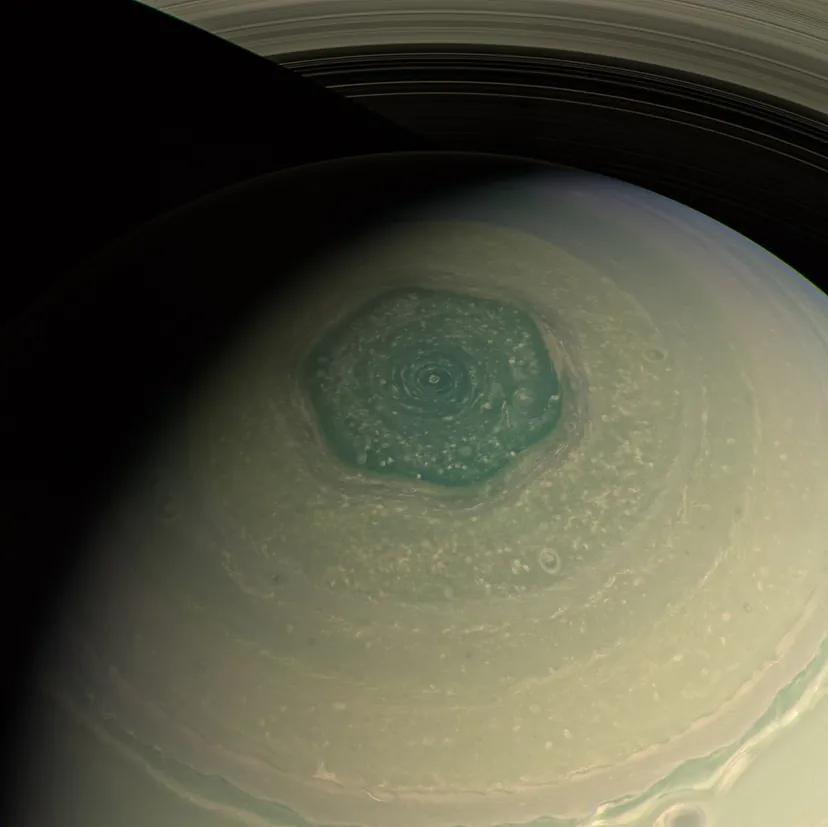
[BizHanKook] Saturn's north pole is home to a mysterious hexagonal storm. This incredible vortex was captured by the Cassini spacecraft during its time stationed near the planet. Cassini left Earth in 1997, orbited Saturn starting in July 2004, and concluded its mission in 2017 with a final plunge into the planet's clouds. During the 13 years Cassini remained at Saturn, such geometric storms were only ever discovered at the north pole; nothing unusual was observed at the south pole. However, in the last few years, strange activity has appeared at Saturn's south pole. It’s not even a hexagon—it’s a 10-sided storm!
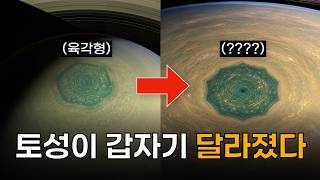
The hexagonal storm at Saturn's north pole has been known since the Voyager probes passed by the planet in the 1980s. It is an astonishing structure that has persisted at the north pole for at least 40 years. In reality, this structure is less of a simple storm and more the result of a powerful jet stream flowing around the North Pole.
At the center of Saturn's north pole is a massive vortex rotating counter-clockwise. Outside of this, a fast jet stream flows eastward along approximately 78 degrees north latitude. The speed difference between the inner polar vortex and the outer fast jet stream causes the atmospheric flow to tangle. This creates what is known as a Rossby wave, where the atmosphere undulates along that boundary. Interestingly, the north pole maintains a stable structure when there are exactly six of these waves. This is why it has maintained a symmetrical, honeycomb-like hexagonal structure for so long.
However, such a structure had not been observed at Saturn's south pole. Even Cassini, which spent a long time hovering right beside Saturn, did not see any distinct structure at the south pole. After the "Grand Finale" in 2017, Cassini ended its mission. For the nine years since then, Saturn has been left without a dedicated observer. Yet, during this time while no one was watching, something strange was happening on the planet.
In 2024, amateur astronomers discovered something strange in the photos they took of Saturn. They noticed faint, dark, undulating lines near the south pole that had never been seen before. Subsequent observations by various ground-based telescopes pointed toward Saturn, and a geometric pattern began to emerge. It wasn't a temporary appearance; something entirely different and stable that didn't exist in the past was forming on Saturn.
Coincidentally, 2024 was a time when Saturn's south pole, with the planet's slightly tilted rotational axis, was increasingly facing Earth. Like Earth, Saturn has an axial tilt of about 26.7 degrees. Its orbital period is approximately 29.5 Earth years. As a result, Saturn's north and south poles tilt toward the Sun alternately every 15 years. As Saturn orbits and spring and summer arrive in the southern hemisphere, the timing became perfect for viewing Saturn's south pole from Earth.
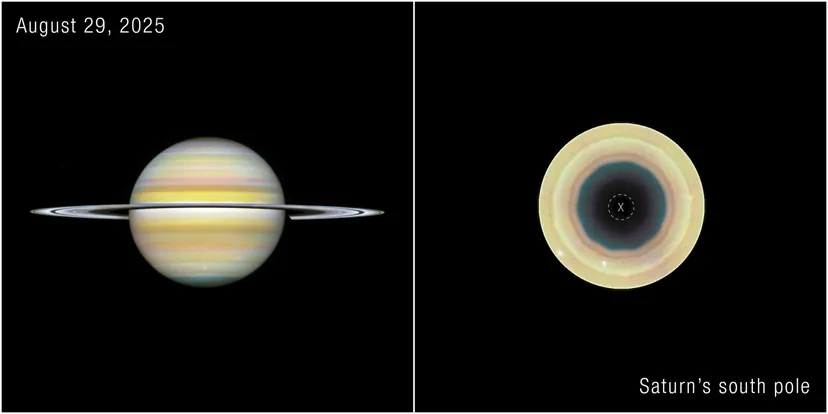
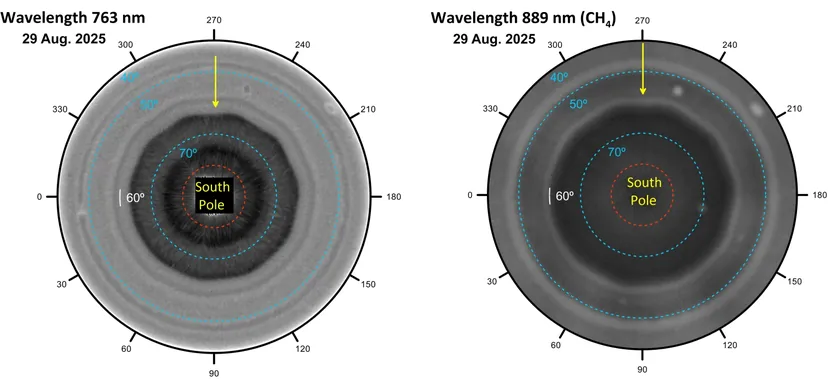
Surprisingly, a 10-sided pattern that didn't exist until a few years ago has appeared at the south pole. It is a massive structure spanning 13,000 km in width. Much like the hexagon at the north pole, this 10-sided structure is surrounded by a jet stream on its perimeter reaching speeds of over 400 km/h.
When did this structure first appear? Astronomers traced back past data from the Hubble Space Telescope and confirmed that traces of a 10-sided structure began to appear faintly in 2023. So why did this structure suddenly appear in 2023? And why is it a 10-sided shape rather than a hexagon like the one at the north pole?
Astronomers speculate that as sunlight slowly reaches Saturn's south pole, the resulting changes in temperature and wind speed around the southern jet stream are the cause. In this process, new, massive atmospheric waves likely began to fluctuate at the south pole. The southern jet stream formed at a lower latitude than the northern one, at about 60 degrees south latitude. Because the jet stream flows over a wider area than at the north pole, it formed ten sides instead of six. Additionally, a massive high-pressure vortex thousands of kilometers wide sits near the 10-sided structure. It is believed that this vortex shakes the jet stream strongly from the outside, causing the stream to fluctuate more frequently and draw more sides.
Saturn is currently moving past spring and toward summer. In six years, the southern hemisphere of Saturn will experience its peak midsummer (by Saturn's standards). If this 10-sided structure is due to seasonal changes in Saturn's southern hemisphere, it is highly likely to become even more distinct over the next six years. And perhaps, during this time, the hexagonal structure that was the trademark of Saturn's north pole may fade. While hiding the north pole on the side invisible to Earth, the hexagonal vortex might be fading without us knowing.
It is unfortunate that at this exact moment, as Saturn's southern and northern hemispheres are transitioning most intensely into the next season, there isn't a single spacecraft at Saturn. These strange events on Saturn occurred between 2017 and 2023, a period that was a blind spot for Saturn exploration. If Cassini hadn't ended its mission and had remained at Saturn, we would have been able to witness the entire process of the new 10-sided pattern emerging at the south pole from the closest possible distance. Through this, we might have even gained hints regarding an older mystery: how the hexagonal pattern at the north pole was created in the first place.
As this case shows, we must not leave planets empty. Every planet needs a probe stationed there every day. Only then can we watch every move of these planets as they change without us knowing, day by day.
These seasonal changes in the southern and northern hemispheres turn Saturn upside down. 2023 observations by the James Webb Space Telescope showed that Saturn has begun to change completely from the days when it was with Cassini. In the past, when Saturn's northern hemisphere was in winter, air currents rose in the southern hemisphere, flowed across the equator, and descended in the northern hemisphere. However, recent observations by James Webb show the exact opposite. Now, a reverse flow is observed where air currents rise in the northern hemisphere and move to the southern hemisphere. As this airflow has completely reversed, the hydrocarbon content in the northern hemisphere has decreased significantly, as the mixing of components inside and outside the atmospheric surface has changed due to the reversed circulation.
In February 2011, there was a surprising event when a super-giant "Great White Spot" suddenly appeared over Saturn's northern hemisphere. The head of this long, ribbon-like storm was several times the diameter of Earth. By the end of February 2011, the tail of the storm reached about 300,000 km, essentially wrapping entirely around the circumference of Saturn. It was one of the largest hurricanes in the history of the solar system, large enough for over 10 Earths to line up inside it.
Inside these massive white clouds, ammonia ice particles that had risen via updrafts were identified. Moreover, exceptionally hot temperatures were detected along this storm. Usually, Saturn's atmospheric temperature is very cold, ranging from -140 to -180 degrees, but in the case of this storm, a sudden temperature increase of up to 80 degrees compared to its surroundings was detected. This is believed to be because a powerful updraft occurring beneath the atmosphere caused the upper atmosphere to suddenly compress adiabatically, heating it up.
Fortunately, at that time, Cassini was stationed at Saturn. Cassini confirmed that lightning struck 10 times more frequently in these clouds compared to other storms on Saturn. The long, intense storm, which raged for nearly 200 days, eventually produced an interesting scene where the head of the storm collided with its tail. Much like a "Snake" game where the snake's head eventually touches its tail and disappears, this long storm slowly lost energy and vanished.
As such, Saturn's clouds are changing every moment. As Saturn slowly tilts its axis in various directions, it only shows us parts of itself. The side turned away from Earth cannot be seen even with the Hubble Space Telescope. There is absolutely no way to know right now what else might be happening on the hidden side. When Saturn orbits and finally shows us its north pole again, the once-vivid hexagonal pattern might have suddenly disappeared. If that happens, we will be reacting too late again, without ever knowing when or why the hexagonal pattern vanished. To catch every moment of Saturn's changing appearance, we cannot take our eyes off it for even a second. That is why a new orbiter to watch over Saturn is desperately needed.
Unfortunately, in the last few years, astronomers' interests have shifted significantly. The focus has moved more toward the icy moons orbiting Saturn rather than the planet itself. This is because they hold as much water as Earth and potentially harbor extraterrestrial life. Therefore, NASA is currently preparing very active exploration plans within the next 5 to 10 years to visit Saturn's moons, Titan and Enceladus.
However, there are no actual plans to explore Saturn itself. Only very minor discussions have taken place regarding a "Saturn atmospheric entry probe" concept—an idea to dive into Saturn's atmosphere to analyze it, much like the Galileo probe that once dove into Jupiter's clouds. This is just one of many ideas, and it is uncertain whether it will ever be realized.
While we have briefly looked away from Saturn, it has transformed into a surprising new state. It is deeply regrettable that we were unable to watch over Saturn for the past few years. The universe does not leave us alone for even a moment.
Reference
https://www.science.org/doi/10.1126/sciadv.adg9419
https://authors.library.caltech.edu/records/4qy18-2cs03
Who is the author Ji Woong-bae? He loves cats and space. After watching 'Galaxy Express 999' as a child, he dreamed of sharing the beauty of the universe. He is currently an assistant professor in the Faculty of Liberal Arts at Sejong University, participating in various science communication activities such as lectures and writing. He has authored books such as 'On the Uselessness of Astronomers,' 'We Are All Born Astronomers,' and 'Strange Questions That Come to Mind When Looking at Space,' and translated works including 'How I Killed Pluto,' 'Quantum Life,' and 'UFO.'