

[비즈한국] There is no doubt that the most important product in South Korea’s recent exports is High Bandwidth Memory (HBM), used in computers and servers. Although these components occupy only a tiny fraction of the space in a computer or server, they are the decisive factor in core performance, such as the speed of AI inference and learning.
In the main battle tank—the key weapon of modern warfare—there is something similar to HBM: it is not visible from the outside, but it determines the weapon’s core performance. That is its armor. The armor of a modern Main Battle Tank (MBT) can be described as an artistic symphony of material engineering and physics. Physics explores how to maximize armor thickness while minimizing exposure, while material engineering works on the materials and composition of composite armor, incorporating various substances to achieve higher defensive capabilities than steel of the same weight. And all these combinations are verified for quality and performance through live-fire testing.
Composite armor shares common ground with HBM in that it is not readily visible on the surface of the product, but it also shares the characteristic that its manufacturing processes and materials are strictly classified as confidential. For 40 years since the development of composite armor in the 1970s, it has been treated as one of the highest military secrets, which is also why it is the subject of the most errors and false rumors in public documentation.
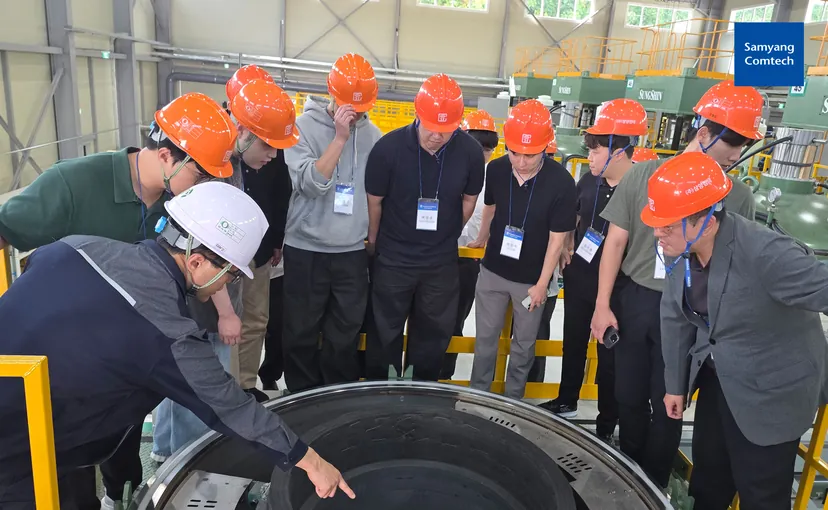
I recently had the opportunity to visit Samyang Comtech (484590), the only composite armor manufacturer in Korea, to learn about the processes and technology behind silicon carbide (SiC) ceramic-based composite armor, which is a core component of tank armor. I would like to share some of the information that is available for public disclosure.
Samyang Comtech is a company equipped with the world’s largest production facilities for ballistic ceramics. After being designated as a defense contractor in 1973, the company succeeded in localizing the composite armor for the K1A1 tank, and subsequently succeeded in creating ceramic composite armor for the K2 tank with world-class performance. In this process, they exported both technology and finished composite armor to Turkey for its main battle tank, the Altay. Currently, the ceramic armor for the K2PL, an upgraded version for Poland, offers significantly improved performance over existing armor.
Samyang Comtech does not only make tank armor. Their ceramic-based composite armor is applied to almost every armored vehicle and tank used by the South Korean Army, ranging from infantry body armor to the K21, K808, Light Tactical Vehicle (KLTV), Chunmoo multiple rocket launcher, amphibious assault vehicles, and the Tigon wheeled armored vehicle. Additionally, they supply crew ballistic protection equipment for Surion utility helicopters and light armed helicopters, and in the past, they even supplied ballistic materials for high-speed naval vessels. In essence, Samyang Comtech’s ceramics are used in almost all armor across land, sea, and air. Recently, the K9MH wheeled self-propelled howitzer, a weapon system that successfully exported to the U.S. for the first time in Korea, was also equipped with Samyang Comtech’s add-on armor, boasting superior defense compared to its competitors.
So, why is ceramic gaining attention as an armor material? SiC ceramic is a Group 4 compound consisting of silicon and carbon. It is the second hardest material after diamond and boron carbide, with a Mohs hardness of 9.5, and it has much higher defensive strength than steel or aluminum of the same weight. Furthermore, it possesses high thermal conductivity and a low coefficient of thermal expansion, giving it excellent resistance to high temperatures. This allows it to effectively block not only armor-piercing rounds fired from tanks but also High-Explosive Anti-Tank (HEAT) warheads from anti-tank missiles fired by helicopters or trucks.
However, the disadvantage of this SiC ceramic is that it is brittle, like porcelain, and prone to fracturing (brittle fracture). For this reason, the defensive strength of the armor is determined by how thick the ceramic blocks can be made at once. A thick ceramic block provides superior protection against attacks compared to layering multiple thin plates. In this sense, Samyang Comtech possesses the world’s top-tier ability to manufacture "ceramic blocks" in the SiC ceramic process. It is similar to how increasing the number of layers in HBM memory improves data transmission speeds.
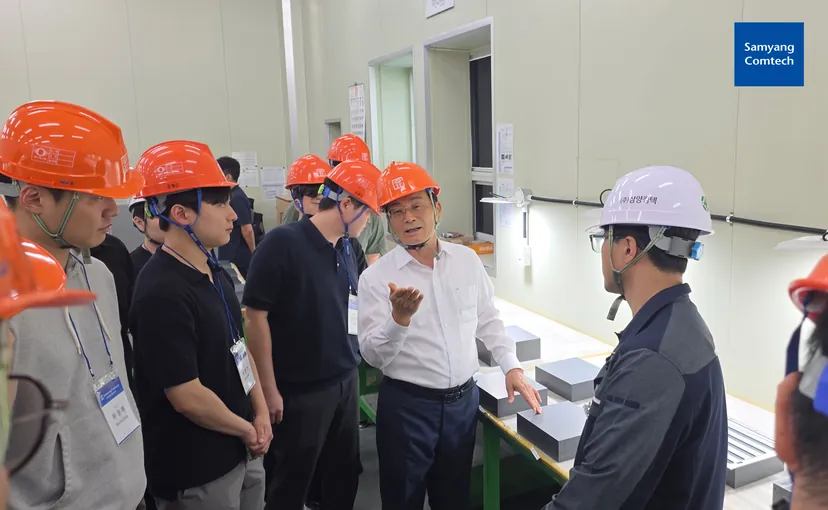
By directly inspecting Samyang Comtech’s processes and facilities, I confirmed that they possess the technology and mass-production capabilities to create the world’s thickest SiC armor modules. The K2 tank’s SiC module I saw in person was near the world’s highest level, and I confirmed that for the Polish export-model K2PL, which recently completed development, they manufactured SiC modules significantly thicker than those on the K2. While the exact defensive capabilities of the K2 tank remain classified, it is expected to block at least all existing types of armor-piercing rounds and anti-tank missiles.
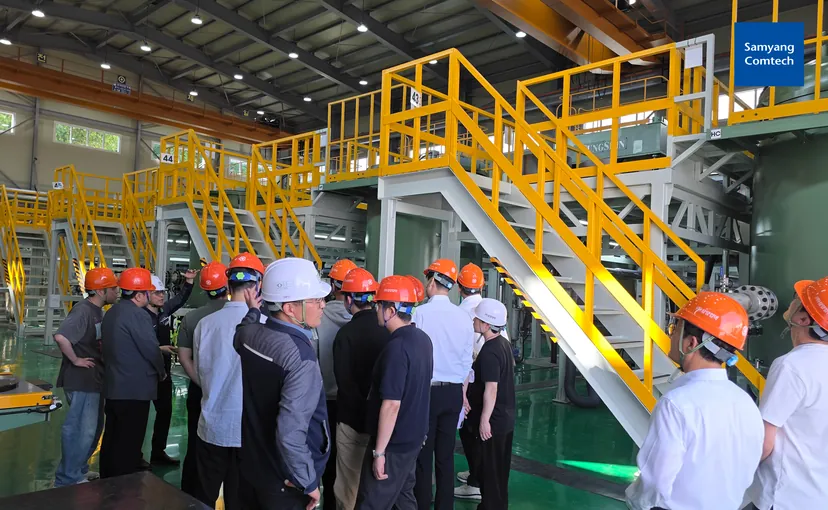
It is not just the product performance; the production capacity is also world-class. While disclosing the exact process is restricted, even just by looking at the production facilities on-site, it was clear that the size and number of the equipment are at the highest level in the world. Since tanks cannot be produced without armor, one of the secrets behind the K2 tank’s annual production volume, which is more than three times that of competing equipment, is Samyang Comtech’s world-class composite armor production capacity.
In addition, they have established a one-stop system that handles everything from material design to production and test evaluation, conducting joint research and testing organically with the Agency for Defense Development (ADD) and system integrators from the development stage. They also operate a ballistic-specialized testing laboratory that was the first in Korea to be recognized by the Korea Laboratory Accreditation Scheme (KOLAS). Because of this, they can quickly reflect customer requirements and thoroughly verify those requirements. I heard an anecdote that when the ballistic-type Light Tactical Vehicle (KLTV) was recently exported to Poland, it was delivered with Samyang Comtech’s armor installed, and the Polish military was satisfied after confirming its performance by firing intensively at the vehicle with an autocannon.
However, it remains to be seen whether Samyang Comtech’s technology will maintain the world’s best defensive power in the future. This is because the development of composite armor for next-generation tanks, currently being researched with the ADD, must be successful. In particular, attention should be paid to future research achievements regarding how to apply processes utilizing nanotechnology—a key improvement plan for the latest composite armor—and how to successfully combine new materials like carbon composites with SiC ceramics.
Furthermore, the increasing threat to tanks is another area that Samyang Comtech and the ADD are contemplating. In the case of drones targeting tanks, they concentrate on thinner parts like the top or sides, and with tactics like deploying dozens of suicide drones against a single tank, there are inherent difficulties in responding solely with armor materials.
Samyang Comtech is not the only company in the world with ceramic composite armor technology. They have even previously exported technology to countries like Turkey. However, it is said that countries that received the composite armor technology transfer from us struggle to achieve the same level of technology, yield, and quality as Samyang Comtech when they attempt to produce it themselves, leading them to return to importing Korean-made composite armor materials. This invisible gap in technical prowess is ultimately what creates the competitive edge for our "K-Defense" in the fierce global defense market.