

[BizHanKook] After a year marked by performance-based bonus conflicts amid the semiconductor boom, Samsung Electronics labor unions are gearing up for the 2027 wage and collective agreement negotiations. While the largest union, the Samsung Group Trans-Enterprise Labor Union (Trans-Enterprise Union), has unveiled its initial demands, unions representing the finished-product divisions are calling for joint negotiations. With existing inter-union friction compounded by moves to establish new labor organizations, a war of nerves is underway even before formal negotiations have begun.
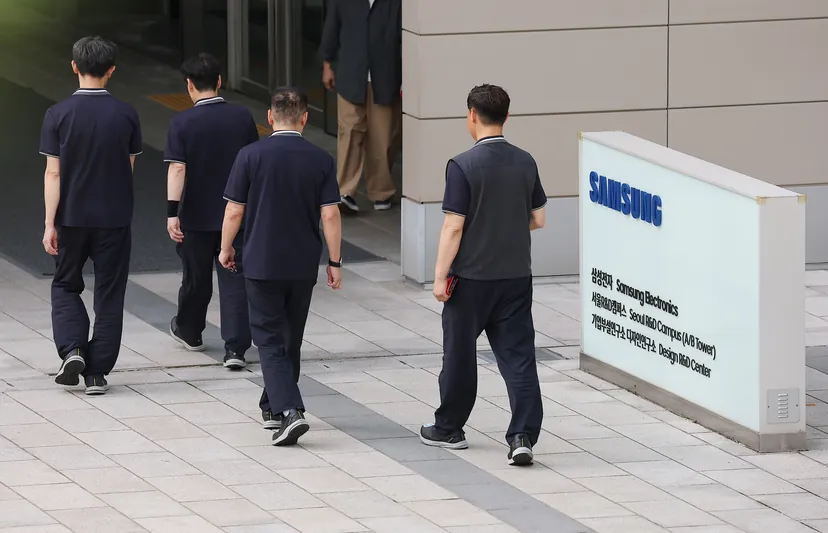
“Trans-Enterprise Union” Prepares for DS-Focused Negotiations… Focus on New Business Sites and Improved Treatment
According to industry sources on the 11th, the Trans-Enterprise Union, primarily representing the Device Solutions (DS) division in charge of semiconductors, released its "1st Draft of 2027 Wage and Collective Agreement Demands" to members on the 10th. The proposal consists of 13 wage agreement items and 11 collective agreement clauses.
The wage proposal includes a plan to reduce fixed overtime hours from the current 14 hours to 10 hours, converting the remaining 4 hours into base salary. It also includes increasing annual welfare points threefold from 1 million to 3 million and establishing a labor-management co-prosperity fund of 1 million won per member. The wage increase rate is planned to be finalized before the regular general meeting in January next year, following further review of inflation and company performance.
The collective agreement emphasizes securing employment stability following the expansion of new business sites. The Trans-Enterprise Union has requested the creation of a "Special Agreement on Employment Stability," requiring the company to provide quarterly updates on project progress if a new business site impacts the working conditions of existing members and to submit relevant documents within 7 days upon union request. It also demands that labor and management reach a prior agreement on relocation expenses, working conditions, and employment terms when employees are transferred to new sites.
Industry observers believe this clause is targeted at the semiconductor mega-project in the Honam region. In a statement last July, the Trans-Enterprise Union noted that "under the Yellow Envelope Act, business decisions that affect members' working conditions are now subject to negotiation," signaling their intent to address the mega-project in the 2027 talks.
This is seen as a move to expand the scope of negotiations by bringing issues of human resource allocation and relocation stemming from production facility expansion into the wage and collective agreement agenda, as Samsung Electronics pushes forward with its large-scale semiconductor investment plan.
Regarding the method of negotiation, the union has made its "independent path" clear. This follows a decision to shift operational focus toward the DS division after internal disagreements arose within the joint bargaining unit during this year's wage talks regarding compensation disparities between DS and Device Experience (DX).
Last month, the Trans-Enterprise Union requested that the Samsung Electronics Labor Union Donghaeng (Donghaeng Union) and the National Samsung Electronics Union (NSEU) provide their proposals in writing, stating, "As we are expected to become the representative bargaining union in the upcoming bargaining channel unification process this December, please submit your demands so we may faithfully fulfill our duty of fair representation." The NSEU rejected this, stating, "It is inappropriate to assume a specific union will be the representative bargaining union at this stage and submit 2027 negotiation demands." Earlier this month, the Trans-Enterprise Union reaffirmed its stance: "Even if a new union is formed in the DX division, we will prepare thoroughly for independent negotiations."
DX Unions Demand Joint Bargaining… Conflict Persists with Establishment of 6th Union
Currently, five unions are active at Samsung Electronics: the Trans-Enterprise Union (5th Union), the Donghaeng Union (3rd Union), the NSEU (4th Union), the Office Workers Union (1st Union), and the Gumi Network Union (2nd Union). As of November 2026, the Trans-Enterprise Union has the most members at 53,470, followed by the Donghaeng Union with 31,043, and the NSEU with 25,262.
Unions centered on the DX division, which handles finished products, are resisting the Trans-Enterprise Union's solitary bargaining policy. The Donghaeng Union maintains that the interests of DX employees were not sufficiently reflected in this year's bonus agreement and argues that a joint bargaining system involving both DS and DX must be established next year. In May, after government mediation, Samsung Electronics labor and management agreed to create a special performance bonus based on 10.5% of the DS division's business performance, while providing DX employees with company stock worth approximately 6 million won per person.
On the 5th, the Donghaeng Union held its fourth outdoor rally since July at the Suwon complex, demanding an official apology from management, separate cash-based compensation, and the establishment of a 2027 joint bargaining system. They argue that because the finished-product business, such as smartphones, absorbed cost burdens to maintain market share even while memory semiconductor prices were rising, the losses cannot be attributed solely to the employees. While the DX division recorded an operating loss of approximately 800 billion won in both the second and third quarters, the DS division posted an operating profit of 106.5 trillion won in the third quarter alone.
At the rally, the Donghaeng Union stated, "If a strategy prioritizing market share retention and sales expansion over cost management was implemented, management must explain the resulting profit-loss impacts and decision-making responsibilities. Establish compensation standards that reflect the contributions of the entire company and present concrete cash-based measures to boost morale for DX members."
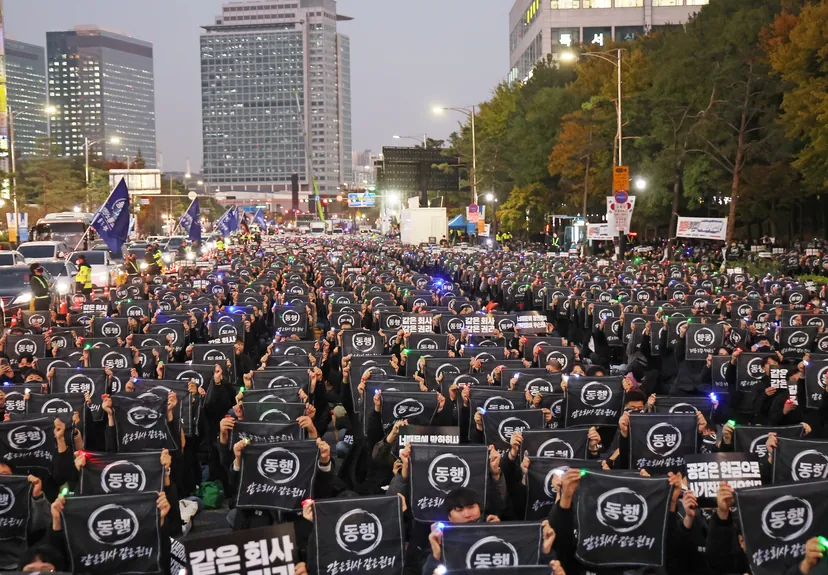
However, the Donghaeng Union's demands are also clouded by procedural controversy. On May 4th, the Donghaeng Union voluntarily withdrew from the joint bargaining unit in protest of DS-centered negotiations. It subsequently filed for an injunction against the validity of the wage agreement, claiming its members were excluded from the ratification vote, but the Suwon District Court dismissed the case in June. Since the union that left the bargaining unit this year is now demanding a joint bargaining system for next year, it is unlikely that inter-union differences will be bridged easily.
The conflict is also spiraling into criminal complaints. Last month, the NSEU announced that it would file complaints regarding the spread of false information on company message boards and online chat rooms alleging that the union leadership was acting under management's orders or receiving illicit funds. The Trans-Enterprise Union expressed regret, stating, "It is regrettable that other unions are inflaming internal conflict over issues that occurred half a year ago and filing criminal complaints against individual employees," and announced plans to provide legal support for its members, considering the possibility that they may be targets of such complaints.
Adding a new variable, an application for the establishment of the "Samsung Electronics Union Shop Labor Union" was filed with the Gumi office of the Ministry of Employment and Labor on the 4th, raising the possibility of a 6th union being launched. It is reported that individuals formerly with the Donghaeng and Trans-Enterprise unions are leading the effort, leading to speculation that it may focus its activities on the DX division.
Samsung Electronics unions are facing the bargaining channel unification process this coming December. If unions cannot autonomously select a representative, the union with the majority of members among all unions participating in the unification process becomes the representative bargaining union. If there is no majority union, follow-up procedures such as forming a joint bargaining delegation will begin. Although the Trans-Enterprise Union currently has the most members, the final outcome will be determined through formal procedures, as counts may change depending on factors like the calculation of overlapping memberships.
Even after a representative is selected, the challenge of reconciling the interests of each division remains. Because the performance gap between DS and DX has led to compensation disparities, it is difficult to reflect the requirements of each division in a single bargaining system. In particular, gathering the opinions of minority unions and coordinating compensation standards that differ by division will likely be the main issues of next year's negotiations. Amid the ongoing competition for representation among unions, Samsung Electronics is also in a position where it must devise a compromise between company-wide compensation principles and requests for treatment improvements tailored to specific divisions.
The Donghaeng Union stated, "We will demand the establishment of a practical joint bargaining system so that the situation where DX members are marginalized in next year's negotiations is not repeated." The Trans-Enterprise Union plans to refine its demands after further discussion this month and finalize the proposal at its regular general meeting in January next year.