

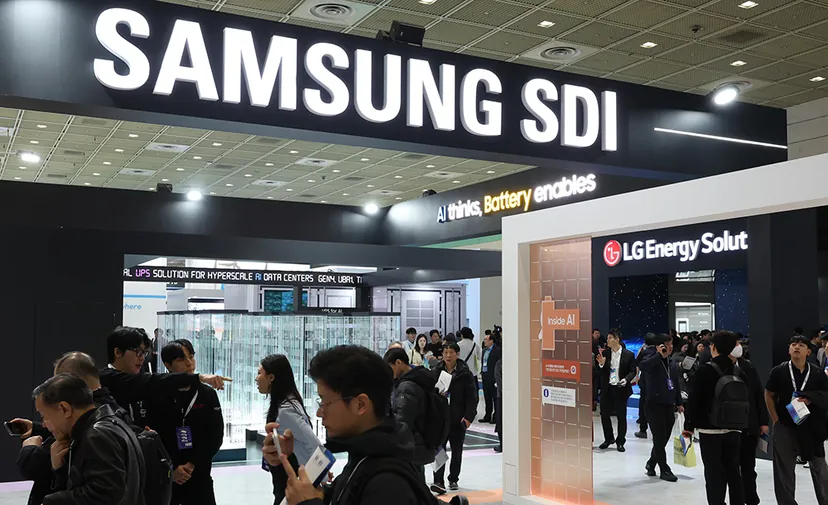
[비즈한국] Expectations for Samsung SDI’s third-quarter earnings are rising rapidly, even as the recovery in electric vehicle (EV) battery sales remains slower than anticipated. This trend is driven by an increase in energy storage system (ESS) sales and projections that the company will receive one-time compensation payments resulting from automakers failing to meet minimum purchase requirements.
According to financial information provider FnGuide on the 27th, among companies for which at least three securities firms have released earnings forecasts, Samsung SDI saw the largest increase in its third-quarter operating profit outlook. The consensus for Samsung SDI’s third-quarter operating profit has climbed more than eightfold, from 14.8 billion won three months ago to 125.1 billion won as of September 21.
However, this does not mean that Samsung SDI’s operating profit will increase eightfold compared to the previous quarter. Samsung SDI already recorded an operating profit of 203.8 billion won in the second quarter. The 125.1 billion won figure signifies that the market’s third-quarter earnings outlook, which was quite low three months ago, has been significantly revised upward.
Some individual securities firms are even projecting results that exceed the second-quarter figures. NH Investment & Securities forecast Samsung SDI’s third-quarter operating profit at 260.3 billion won, while iM Securities estimated it at 285 billion won.
An interesting point is that earnings expectations are rising while EV battery sales have yet to show a full-scale recovery. iM Securities projected that Samsung SDI’s third-quarter automotive battery revenue would decrease by approximately 3% compared to the previous quarter, noting that a decline in shipments from the U.S. StarPlus Energy (SPE) plant to Europe would have an impact.
Compensation for Unsold Batteries: The Paradox of ‘Minimum Purchase Agreements’
One of the factors cited by the securities industry for the improvement in Samsung SDI’s third-quarter performance is the compensation expected from automakers.
When battery manufacturers and automakers sign large-scale, long-term supply contracts, they often include clauses stipulating a minimum purchase volume. If actual purchases fall short of this minimum, the battery manufacturer may receive compensation based on the contract terms.
While battery sales have declined because EV demand did not grow as initially expected, the compensation resulting from the failure to meet these agreed volumes can paradoxically boost the battery maker’s short-term profits.
iM Securities expects that Samsung SDI’s third-quarter earnings will reflect these compensation payments for missing minimum purchase targets. Including this, they projected third-quarter revenue of approximately 4.1 trillion won and an operating profit of 285 billion won.
However, Samsung SDI has not disclosed which automakers it has minimum purchase agreements with, nor the actual amount of compensation involved. The compensation for missing minimum purchase volumes is currently an estimate made by securities firms.
NH Investment & Securities anticipated another one-time gain. They estimated that approximately 150 billion won in compensation would be reflected in the third quarter as Samsung SDI restructures its U.S. battery joint venture with General Motors (GM) to transition it into a wholly-owned facility.
The relationship between Samsung SDI and GM is not coming to an end. In August, Samsung SDI decided to acquire the entire 49.99% stake in Synergy Cells, the joint battery venture held by GM. The structure is not the dissolution of the joint venture, but rather its transition into a 100% subsidiary of Samsung SDI.
The two companies also signed a joint development agreement for next-generation prismatic batteries for EVs. While joint production is ending, their research and development cooperation continues.
Synergy Cells is a battery plant with an annual production capacity of 27GWh currently under construction in New Carlisle, Indiana. It was originally intended to produce batteries for GM EVs, but the business structure was changed as the growth of the EV market fell short of expectations.
After completing the stake acquisition, Samsung SDI plans to utilize this plant as its first major stand-alone battery production base in North America. Initially, it will produce batteries for ESS, and in the future, it could be used to produce prismatic batteries for EVs co-developed with GM.
From a 591.3 Billion Won Deficit in Q3 Last Year to Profit This Year
Just one year ago, Samsung SDI was hit hard by the EV "chasm" (a temporary stagnation in demand).
In the third quarter of last year, Samsung SDI recorded 3.0518 trillion won in revenue and an operating loss of 591.3 billion won. The battery division alone incurred an operating loss of 630.1 billion won. Sluggish EV battery sales were the primary cause of the poor performance.
The scale of the deficit has decreased rapidly since the beginning of this year. First-quarter revenue was 3.5764 trillion won, with an operating loss of 155.6 billion won. Sales of non-EV products, such as ESS, Uninterruptible Power Supplies (UPS), and Battery Backup Units (BBU), contributed to the performance improvement.
In the second quarter, the company recorded an operating profit of 203.8 billion won, turning a profit for the first time in seven quarters. The cumulative operating profit for the first half also turned positive at 48.2 billion won.
However, the second-quarter results included policy-related and one-time effects, such as 107.7 billion won in U.S. Advanced Manufacturing Production Credit (AMPC) and tariff refunds. Considering these factors, while Samsung SDI achieved a profit in the second quarter, it is too early to judge a complete recovery of the core business based on the figures alone.
As compensation is expected to be reflected in the third-quarter results as well, it is necessary to distinguish between actual business improvements and one-time effects.
Growth in ESS Regardless of Compensation… Third-Quarter Revenue Expected to Rise by 32%
There is also a reason why the improvement in Samsung SDI’s performance is difficult to explain solely by the "compensation effect." It is because the ESS business is genuinely growing.
iM Securities projected that Samsung SDI’s third-quarter ESS revenue will increase by approximately 32% compared to the previous quarter. This is due to the full-scale implementation of domestic central contract market projects and increasing power storage demand following the expansion of AI data centers in North America.
Cylindrical batteries used in power tools and BBUs for AI data centers are also expected to return to profitability, driven by increased sales.
Samsung SDI is also emphasizing the expansion of its ESS business. In its second-quarter earnings announcement, the company stated that it had signed long-term supply contracts with major U.S. ESS clients and achieved success in winning orders for domestic next-generation power grid ESS projects.
In particular, prismatic LFP (lithium iron phosphate) batteries are emerging as a new pillar of growth. Samsung SDI explained that the orders it has already secured for prismatic LFP batteries have filled a significant portion of its scheduled production capacity through 2029. Including projects with a high probability of being won in the second half of the year, it may exceed its production capacity starting in 2028, so the company is reviewing additional facility expansions.
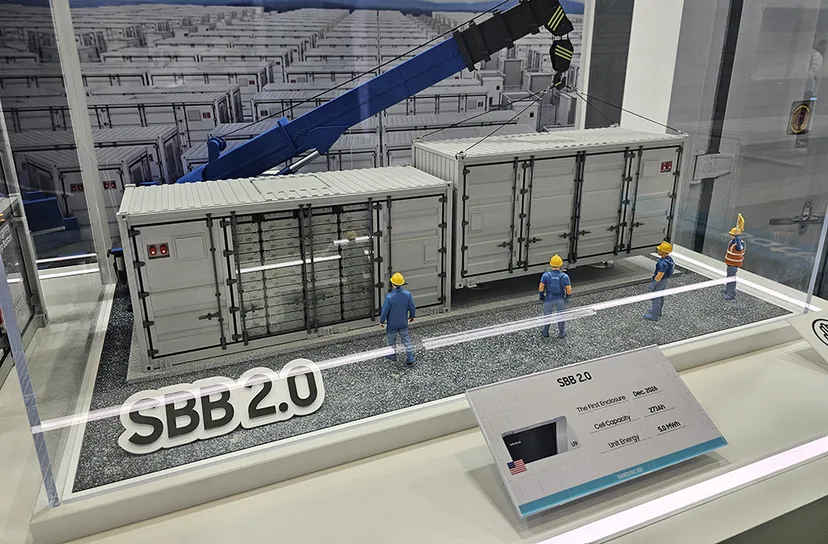
In the U.S., the company plans to mass-produce prismatic LFP cells for ESS starting in October and supply them to clients in the form of SBB 2.0 within the year. With the Synergy Cells plant also becoming a stand-alone production base for Samsung SDI, the potential for expanding North American ESS production capacity in the future is high.
NH Investment & Securities also raised its outlook for Samsung SDI’s ESS business. It estimated that if an additional 10GWh of ESS orders are secured annually, it would result in approximately 1.1 trillion won in revenue and a 540 billion won increase in operating profit.
EV Slump Persists… The Real Test Comes After the ‘Compensation Effect’ Fades
Conversely, the situation in the EV battery business is not improving as quickly as the ESS business.
NH Investment & Securities analyzed that Samsung SDI’s EV battery sales are slowing down due to inventory adjustments for older models ahead of BMW’s new car launches. While new projects such as the Hyundai Ioniq 3 and Kia EV2 will partially offset this, the firm predicted that achieving the company’s initially stated goal of 70% utilization for its European plants in the second half will not be easy.
iM Securities also expected third-quarter automotive battery revenue to decrease by about 3% compared to the previous quarter. On the other hand, it projected that ESS revenue would grow by 32%. This can be seen as an indication that the focus of Samsung SDI’s earnings improvement is shifting from EVs to ESS for the time being.
Samsung SDI’s actual business strategy reflects this shift. After deciding to convert Synergy Cells, which was intended to produce EV batteries with GM, into a wholly-owned facility, the company decided to switch its initial output to ESS batteries. This decision reflects a situation where the growth of the EV market has slowed down more than expected, while ESS demand is increasing rapidly against the backdrop of expanding AI data centers and renewable energy.