

[비즈한국] As clip-type wireless earphones that do not block the ear canal continue to grow in popularity, Samsung Electronics is officially entering the market. Their strategy is to offer more options based on the usage environment: using traditional canal-type Galaxy Buds when immersion is needed, and the clip-type 'Buds On' when the user needs to hear ambient sounds while running or on the move. However, with the number of competing products rising rapidly, whether the 299,000 won price tag is justified by its comfort and sound quality will likely determine its success in the market.
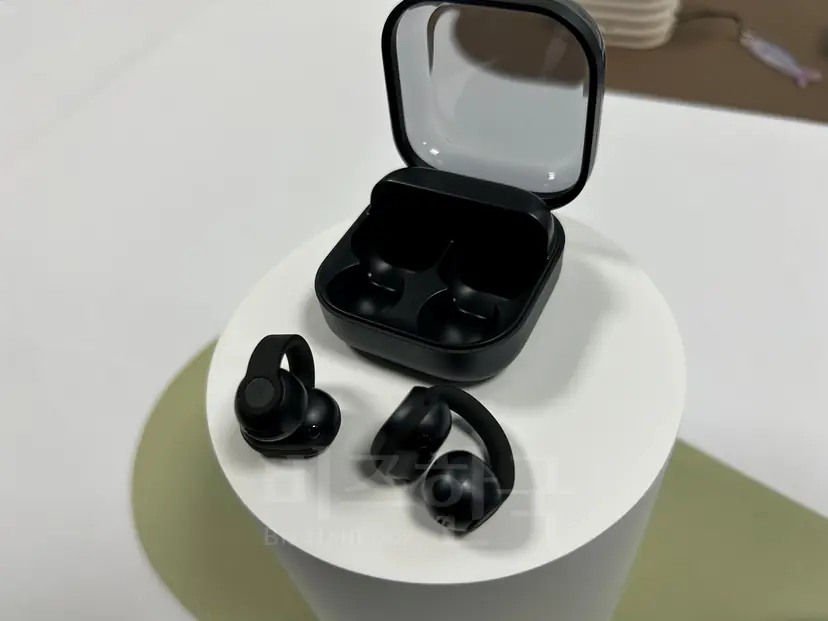
Samsung Electronics held a briefing at its press room in the Taepyeong-ro Building in Jung-gu, Seoul, on the 20th to introduce the development process and strategy behind the ‘Galaxy Buds On’, the first clip-type wireless earphone in the Galaxy Buds series.
Clip-type Earphones Grow Despite Stagnation in Wireless Earphone Market
Unlike canal-type earphones that are inserted into the ear canal, clip-type earphones hook onto the pinna like a clip to stay in place. Because they do not block the ear, they allow users to listen to music while still being aware of nearby conversations or traffic noise, making them ideal for outdoor activities. Since they are often worn for long periods without being removed, comfort is the primary factor determining a product's competitiveness.
Nam Hyun-jung, a professional at the MX Business Division, stated, "Every person's ear is as unique as a fingerprint," adding, "We secured ear data from 119 million people of various ethnicities and ages and applied it to 4D simulations." 4D simulation adds a time axis to 3D shape analysis, calculating the changes that occur between the ear and the product as the user moves.
Based on this, the placement of the speaker and battery was adjusted to ensure that the pressure on the ear is not concentrated in one spot, and a shape-memory alloy was applied to the bridge connecting the two components so that it flexes flexibly according to the ear's shape. Lee Myung-hwan, head of the Wearable Product Planning Group at the MX Business Division, emphasized, "The key was finding a balance point, as too much clamping force could compromise comfort," adding, "We are confident that our technology for comfort is the best in the world."
The company also explained that it has addressed the common weaknesses of open-ear structures, such as a lack of bass and sound leakage. It reinforced bass with a ‘Twin Boost Speaker’ consisting of two woofer speakers and applied ‘leakage reduction’ technology for the first time in the Buds series. Two grooves on the back of the product are also designed to reduce sound leakage. An ‘Auto Volume’ feature that automatically adjusts volume based on ambient noise has also been included.
The background for this new lineup launch is the recent trend where the overall wireless earphone market is stagnating, while open-type (including clip-type) models are the only segment seeing growth. According to market research firm Omdia, global shipments of wireless earphones in the second quarter of this year were 82.1 million units, down 0.7% compared to the same period last year, marking the first decline since the second quarter of 2023. During the same period, shipments of open-type models grew by 12% to 11.1 million units, with 61% of those being clip-type. Omdia predicts that annual shipments of open-type models will more than double from 43.9 million this year to 90.5 million by 2030.
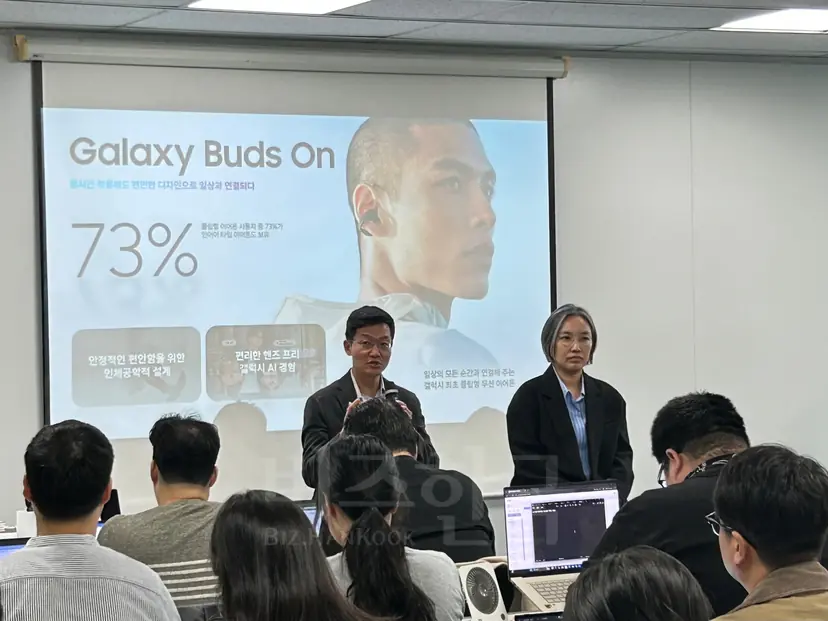
Lee stated, "Open-type earphones are one of the biggest trends recently. We have been preparing for this step by step," adding, "As customer needs become more segmented, we are releasing products suited to those situations." The idea is to secure new demand by adding products with different purposes rather than replacing existing canal-type models.
Emphasis on Galaxy Integration, But Price Competition Remains a Challenge
However, Samsung must compete with rivals who have already entered the growing market on the basis of price and feature differentiation.
The key differentiators Samsung is touting are call quality and integration with the Galaxy ecosystem. Through ‘Intelligent Clear Call’, which combines three microphones, a bone conduction-based Vibration Pickup Unit (VPU), and machine learning technology, the company explains that it separates the user's voice from background noise to support clear calls even in noisy environments.
Additionally, when connected to a device that supports Galaxy AI, users can launch Gemini Live via voice, and voice memos recorded by long-pressing the earphone can be searched via Bixby. It also supports ‘Head Gestures’, allowing users to answer calls by nodding, dismiss alarms by shaking their head, or check message notifications. Another convenience factor is the ability to adjust volume and equalizer directly from the Galaxy smartphone's settings menu without a separate app.
The Buds On will be released in Korea on the 27th in a single black color. A single charge supports up to 9.5 hours of continuous music playback.
In a market where premium and budget products compete, the question is whether Samsung can secure premium demand by leveraging ecosystem integration and feature differentiation.
Bose, another brand offering clip-type products, recently released the ‘Ultra Open Earbuds 2nd Gen’ at an official domestic retail price of 359,000 won and the ‘Sport Open Earbuds’ at 249,000 won. Sony’s ‘LinkBuds Clip’ is also priced at 299,000 won. In the low-end segment, Xiaomi has launched a clip-type earphone in the 120,000 won range, and Nothing's sub-brand, CMF, sells a $99 product in the U.S., making price-based competition fierce.
Regarding price competitiveness, Lee explained, "We set the price after considering market conditions, strategy, and product characteristics," adding, "It was determined based on the value corresponding to the benefits provided to the customer."